(via TheNewswire)
TORONTO, ON, September 1, 2026 – TheNewswire - Metalite Resources Inc. ( CSE: METL ) ( OTC: JNCCF ) ( FSE: D680 ) (" Metalite " or the " Company ") is pleased to announce that it has submitted an application for a new exploration licence adjoining its existing Arthurs Seat Project in New South Wales, Australia (the " Arthurs Seat Extension "). The application in respect of the Arthurs Seat Extension (the " Application ") has been accepted as complete under the number ELA 7109 and is progressing through the applicable regulatory process administered by the New South Wales Government.
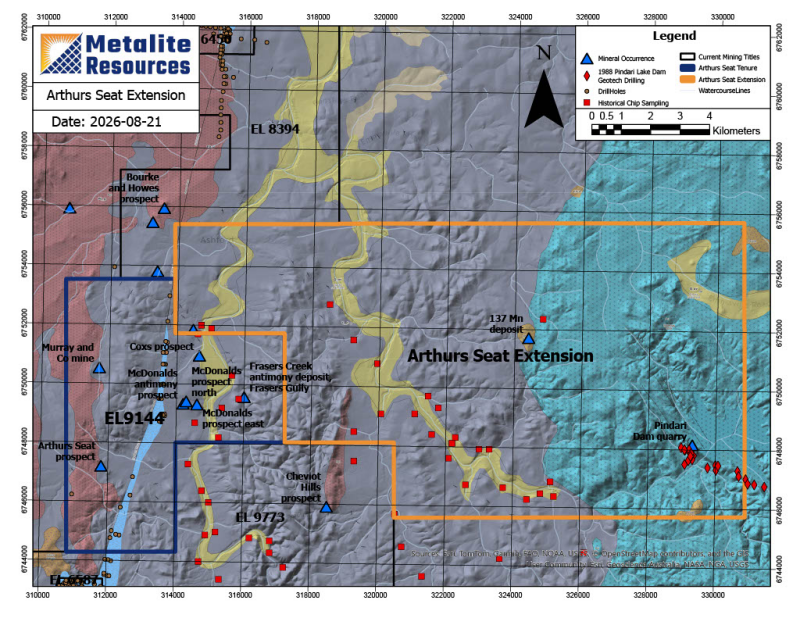
The Arthurs Seat Extension is located immediately east of the Company’s existing Arthurs Seat Silver-Antimony exploration license EL9144 and was identified through Metalite’s ongoing review and compilation of historical geological, geophysical and exploration information. If granted, the Application would materially broaden Metalite’s exposure to the geological and structural setting that hosts its existing Arthurs Seat silver-antimony prospects and extend the Company’s exploration position toward a historically identified high-priority polymetallic target corridor.
Of particular significance, five silver-antimony prospects within the existing Arthurs Seat Project occur in close proximity to an approximately 181-hectare north-south-trending metasedimentary package. The Arthurs Seat Extension would add more than 1,000 hectares of interpreted continuation of the same metasedimentary rock package, increasing Metalite’s mapped coverage of this prospective unit from approximately 181 hectares to more than 1,180 hectares. The proposed extension also encompasses the historical 137 manganese occurrence (the “ 137 Mn Occurrence ”) and extends the Company’s position toward the historical B1 structural target corridor immediately to the east.
Alex Storcheus, Executive Chairman of Metalite, commented: "We view this as a strategic expansion of Arthurs Seat rather than simply an addition of acreage. If granted, the extension would allow us to follow the same geological package associated with our existing silver-antimony prospects across a substantially larger area, while also bringing a historical manganese occurrence into our exploration model and extending our position toward a series of high-priority structural targets identified by previous explorers. The historical work describes many of the geological ingredients we are looking for at Arthurs Seat: deep-seated structures, later cross-cutting faults, intrusive activity and areas interpreted as possible alteration. Our objective is to bring these datasets together with modern geophysical processing, field mapping and geochemistry to determine whether the broader Arthurs Seat system contains additional silver, antimony, gold and polymetallic targets."
Geological Rationale for the Arthurs Seat Extension
The Arthurs Seat Extension is located within the New England Orogen and forms part of a broader district characterized by intrusive activity, multiple generations of regional structures and diverse polymetallic mineralization. Metalite’s current exploration model considers the relationship between the Mole Granite, the Bundarra Plutonic Suite, prospective metasedimentary rocks, interpreted intrusive centres and structurally focused hydrothermal activity to be important to target generation across the district.
Historical work on the former EL6825 “Severn River” licence, which covered a substantial portion of the surrounding district, was specifically undertaken to explore for high-grade silver-rich polymetallic deposits based on the area’s proximity to the Mole Granite mineralizing system. Historical mapping also described an apparent district-scale metal zonation, with tin-tungsten-rich mineralization more proximal to the Mole Granite and silver-copper-lead-zinc-rich mineralization occurring more distally.
Importantly for Metalite’s exploration model, the historical structural interpretation identified early north-south-trending structures interpreted as deep-seated thrust faults that were subsequently intersected by later east-northeast- and west-northwest-trending structures. The historical interpretation noted that known mineral occurrences in the district were, in a number of cases, spatially associated with these structural intersections or with significant later cross-cutting structures.
Expansion of the Prospective Metasedimentary Package
Metalite’s existing Arthurs Seat Project contains five distinct silver-antimony prospects located in close proximity to an approximately 181-hectare north-south-trending metasedimentary package. The Arthurs Seat Extension would add more than 1,000 hectares of interpreted continuation of this rock package in the Severn River area.
The Company considers this significant because it provides the potential to test the geological and structural framework associated with the existing Arthurs Seat prospects over a considerably larger contiguous area. Rather than treating the proposed extension as a standalone exploration area, Metalite intends to evaluate it as part of a broader district-scale geological system extending eastward from its existing tenure.
Historical geological and structural work elsewhere in the district indicates that mineralization can be strongly structurally controlled, particularly around intersections between early north-south structures and later cross-cutting structures. Metalite intends to integrate this historical framework with available stream-sediment information, modern geological interpretation and new surface exploration to identify areas where favourable lithology, structure, geochemistry and geophysical signatures coincide.
Click Image To View Full Size
Figure 1: Existing Arthurs Seat tenure and the proposed Arthurs Seat Extension showing regional geology, historical mineral occurrences, drilling and selected prospects.
Historical 137 Manganese Occurrence
The proposed Arthurs Seat Extension also encompasses the historical 137 Mn Occurrence. A 1963 Geological Survey of New South Wales report by D.W. Wynn, entitled Manganese Deposit near Ashford, described manganese oxide mineralization associated with and adjacent to a north-south-trending jasper and quartz body intruding Carboniferous mudstones 1 .
The historical work consisted principally of two shallow open cuts, reaching a maximum reported depth of approximately 10 feet (3 metres). Mineralization was historically described principally as psilomelane, with some pyrolusite, occurring along walls, joints and fractures associated with the jasper-quartz body. Approximately eight tons of material described in the historical report as high-grade manganese ore were reportedly extracted from the larger southern working.
The 1963 report ultimately concluded that the limited exposures known at the time did not justify additional publicly funded prospecting. That conclusion was based on the shallow work then available, the limited surface expression of the mineralization and market conditions and product specifications prevailing more than six decades ago. Metalite views the occurrence as an historical exploration indication rather than a defined deposit or mineral resource and intends, subject to grant of the Application, to evaluate it using modern geological, geochemical and geophysical methods.
Manganese Uses and Strategic Importance
Manganese has substantial strategic importance in modern industrial and energy supply chains. It is essential to iron and steelmaking because of its sulfur-fixing, deoxidizing and alloying properties; the U.S. Geological Survey estimates that steelmaking accounts for approximately 85% to 90% of U.S. manganese demand. Manganese is also used in rechargeable battery technologies, including nickel-manganese-cobalt (" NMC ") lithium-ion cathodes. The IEA notes that NMC remains the most widely used battery chemistry in the United States and Europe. Manganese is also currently included on the Australian Government’s Critical Minerals List, which identifies minerals important to modern technologies, economies and national security and vulnerable to supply-chain disruption.
Historical Pindari Dam B1 Structural Target Corridor
A February 2011 final report by Silver Mines Limited for former exploration licence EL6825 “Severn River,” incorporating geological and structural interpretation undertaken by Encom Technology, identified 16 targets for follow-up from the integration of regional magnetic, radiometric, geological and ASTER satellite data.
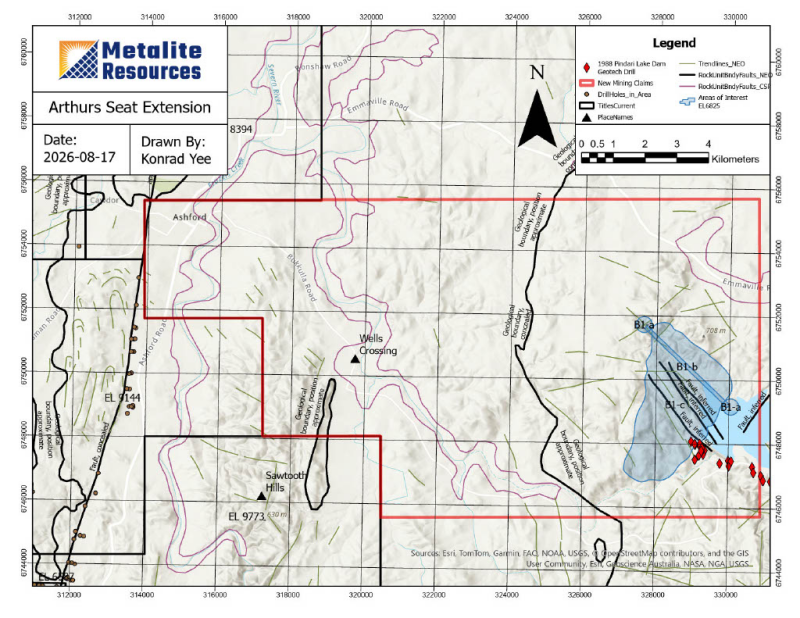
Of particular relevance to the Arthurs Seat Extension is the group of targets designated B1-a through B1-f (collectively, the “ B1 Targets ”), situated immediately east of the proposed extension. These targets were assigned the highest priority within the western portion of the historical EL6825 target area 2 .
The historical interpretation identified a series of complementary targets across the B1 corridor associated with intersections between deep-seated north-south structures and later cross-cutting faults, interpreted intrusive bodies, and zones of subdued magnetic response considered potentially indicative of alteration. The historical report interpreted these structural settings as potential pathways and focal points for ascending mineralized fluids.
The broader historical interpretation concluded that many mines and underground workings in the district displayed strong structural control and that numerous known mineral occurrences appeared to be associated with intersections between early north-south structures and later ENE- and WNW-trending faults. The report recommended field reconnaissance, rock-chip and soil sampling, integration of regional geochemistry and further refinement of the structural interpretation as the appropriate next steps for evaluating these targets.
Click Image To View Full Size
Notably, Silver Mines reported that no field work was undertaken during that reporting period and stated that it relinquished EL6825 following the Global Financial Crisis and associated downturn in mineral exploration investment, choosing instead to concentrate its resources on more mature projects. Accordingly, the historical structural targets identified through the Encom interpretation were not systematically field-tested during that program.
Expanding Metalite’s District-Scale Exploration Strategy
The Arthurs Seat Extension is consistent with Metalite’s broader strategy of building meaningful land positions across prospective mineralized systems and using historical exploration, geology and geophysics to identify high-priority targets. As Metalite continues to advance its flagship Launay Gold Property in Québec, Metalite has similarly assembled a district-scale position across a major structural corridor and is systematically integrating extensive historical datasets to guide modern exploration.
At Arthurs Seat, the proposed extension would apply the same exploration philosophy to a different mineral system: expanding Metalite’s coverage of the prospective metasedimentary package associated with its existing Silver-Antimony prospects, incorporating the historical 137 Mn Occurrence, and extending the Company’s position toward a historically identified high-priority structural corridor. Together, these features provide Metalite with a substantially larger geological framework within which to evaluate the potential scale and continuity of the Arthurs Seat mineral system.
Proposed Exploration Program
In connection with the Application, the Company has prepared a staged exploration work program for the Arthurs Seat Extension (the " Work Program " ). The Work Program is intended to progressively refine the Company’s geological model and rank prospective areas through the integration of historical information with newly acquired field data.
Initial work is expected to include compilation and reinterpretation of existing geological information, reprocessing of regional aeromagnetic data, geological and structural mapping, and targeted rock-chip and soil geochemical sampling. and field verification of historical occurrences and priority structural targets. The Company also intends to evaluate the geological setting and mineralogy of the 137 Mn Occurrence as part of this work.
The objective of the Work Program is to prioritize approximately two to four targets for potential advancement toward drill-ready status. Where results warrant, the highest-priority targets may be advanced to prospect-scale testing, including targeted ground geophysics and initial reverse-circulation or diamond drilling, subject to receipt of all required activity approvals and landholder access. The nature, timing and scope of future exploration activities will be determined by exploration results, regulatory requirements and the grant of the Application.
About Metalite Resources Inc.
Metalite Resources Inc. is a Canadian mineral exploration company focused on the acquisition, exploration and advancement of precious metals projects. The Company owns a 100% interest in the Arthurs Seat Silver-Antimony Project in New South Wales, Australia and a 100% interest in the Launay Gold Property, a district-scale gold project located in Québec's Abitibi Greenstone Belt. The Company's strategy is to create long-term shareholder value through the systematic exploration and advancement of high-potential mineral properties.
Qualified Person
The scientific and technical information contained in this news release has been reviewed and approved by Carey Galeschuk, P.Geo., a "qualified person" as defined in NI 43-101. Mr. Galeschuk is an officer of Metalite and is not independent of the Company.
Contact Information
Metalite Resources Inc.
Chris Hazelton, CEO
(647) 660-8718
info@metaliteresources.com
Forward-Looking Information
This news release contains "forward-looking information" within the meaning of applicable Canadian securities laws. Forward-looking information relates to future events or the anticipated performance of the Company and is based on current expectations, estimates and assumptions. Forward-looking information is often identified by words such as "anticipate", "believe", "expect", "intend", "plan", "may", "will", "could", "should", and similar expressions.
Forward-looking information in this news release includes, but is not limited to, statements regarding the Application, including its potential grant and timing; the Company’s interpretation of the geological, structural and mineralization potential of the Arthurs Seat Extension; the interpreted continuity and prospectivity of the metasedimentary package between the Company’s existing Arthurs Seat tenure and the Arthurs Seat Extension; the exploration significance and potential of the historical 137 Mn Occurrence and the historical B1 structural target corridor; the Company’s ability to identify, refine and prioritize silver, antimony, gold, manganese and other polymetallic exploration targets; the proposed Work Program and the timing, scope and nature of future exploration activities; the compilation, reprocessing and interpretation of historical geological, geochemical and geophysical information; geological and structural mapping, geochemical sampling and geophysical surveys; the potential advancement of selected targets toward drill-ready status; the potential for future reverse-circulation or diamond drilling; and the Company’s broader strategy of advancing its mineral properties through systematic, data-driven exploration.
Forward-looking information is subject to known and unknown risks, uncertainties and other factors that may cause actual results to differ materially from those expressed or implied by such forward-looking information. These risks and uncertainties include, without limitation, the risk that the Application may be delayed, modified or not granted; the uncertainty inherent in historical exploration information and the Company’s interpretation thereof; the possibility that historical occurrences, anomalies or exploration targets may not be confirmed by future exploration; the uncertainty of geological, structural and mineralization interpretations; the absence of defined mineral resources on the Arthurs Seat Extension; risks associated with mineral exploration, including the possibility that exploration programs may not result in the discovery of economically recoverable mineralization; commodity price fluctuations; the availability of financing; regulatory approvals and permitting; environmental risks; land access and title matters; operating risks; market conditions; and other risks generally associated with mineral exploration companies. Additional risk factors are disclosed in the Company’s public filings available under the Company’s profile on SEDAR+.
Although the Company believes that the expectations reflected in the forward-looking information are reasonable, there can be no assurance that such expectations will prove to be correct. Readers are cautioned not to place undue reliance on forward-looking information, as actual results may differ materially from those expressed or implied. The Company undertakes no obligation to update or revise any forward-looking information except as required by applicable securities laws.
Neither the Canadian Securities Exchange nor its Regulation Services Provider accepts responsibility for the adequacy or accuracy of this release. No stock exchange, securities commission or other regulatory authority has approved or disapproved the information contained herein.
NOT FOR DISTRIBUTION TO UNITED STATES WIRE SERVICES OR DISSEMINATION IN THE UNITED STATES.
1 D.W. Wynn (1963), Manganese Deposit near Ashford, Geological Survey of New South Wales Report No. 32, pp. 10-11, and D. Menzies (2011)
2 Final Report EL6825 “Severn River,” Severn River Project – Inverell, NSW, Silver Mines Limited, February 2011

Copyright (c) 2026 TheNewswire - All rights reserved.
© 2026 Canjex Publishing Ltd. All rights reserved.