- SGS test work achieved overall gold recoveries ranging from approximately 94% to 99%, averaging approximately 97%
- Results confirm Kossou mineralisation responds well to a conventional processing route utilized by several operating gold mines in Côte d'Ivoire
- Two drill rigs continue to advance resource definition and exploration drilling at Kossou ahead of an inaugural Mineral Resource Estimate expected in H2 2026
QUEBEC CITY, June 24, 2026 (GLOBE NEWSWIRE) -- Kobo Resources Inc. (“Kobo” or the “Company”) (TSX.V: KRI) (FWB: Q1Z) is pleased to report positive metallurgical test results from its 100%-owned Kossou Gold Project ("Kossou") in Côte d'Ivoire. The metallurgical program, completed by SGS Canada Inc. ("SGS"), at its Lakefield Facility in Lakefield, Ontario, Canada demonstrated strong gold recoveries across samples collected from the Jagger and Road Cut Zones using a conventional gravity and cyanidation flowsheet, with overall gold recoveries ranging from approximately 94% to 99% and averaging approximately 97%.
Edward Gosselin, CEO and Director of Kobo, commented: “Metallurgy is one of the most important technical components of any mining project because it helps determine how effectively the contained metal can be recovered and can have a significant influence on future project economics. While drilling defines the size and grade of a deposit, metallurgical performance is critical to understanding how that mineralisation may ultimately be processed and recovered.”
He continued: “These results are highly encouraging because they demonstrate that gold mineralisation from both the Jagger and Road Cut Zones responds exceptionally well to a conventional gravity and cyanidation flowsheet, a processing route widely utilized by operating gold mines in Côte d'Ivoire. Achieving average overall gold recoveries of approximately 97%, together with rapid leach kinetics, low reagent consumption and very low residue grades, provides further confidence in the recoverability and processing characteristics of the Kossou mineralisation.”
He concluded: “These results also continue to validate our understanding of the mineralisation at Kossou and emphasizes the importance of our current drilling campaign underway as we continue advancing the project toward an inaugural Mineral Resource Estimate expected later this year.”
SGS Metallurgical Program Delivers Strong Gold Recoveries
SGS completed metallurgical test work on representative samples from the Jagger and Road Cut Zones to evaluate their response to a conventional gravity and cyanidation gold recovery flowsheet.
SGS received from Kobo ~123 kilograms (“kg”) of material from 16 drill holes at the Jagger Zone and ~123 kg of material from 10 holes at the Road Cut Zone as representative samples of mineralisation. The materials were crushed to -10 mesh and used to create six variability composites and a Master Composite. The six variability composites, representing oxidised, partially oxidised and fresh mineralisation from each zone were submitted for head analysis and metallurgical test work, which was comprised of gravity separation and cyanidation tests. The head assay results indicated that the gold grades for the six variability samples ranged from 0.82 g/t Au to 1.50 g/t Au and averaged 1.23 g/t Au. The samples were ground to a typical grind size P80 target of ~75 µm and used for gravity separation and cyanidation tests. The gravity concentrates were submitted for gold assay (fire assayed to extinction).
The gravity recoverable gold for the six variability samples ranged from ~46% to ~76% and averaged ~57%. The average percent mass pull to the gravity concentrates was 0.07%, which aligns with a typical value used in operations. The calculated gold head grades averaged 1.34 g/t, which was slightly higher than the average direct head assays (1.23 g/t).
The gravity tailings were submitted for standard cyanidation bottle roll tests, which evaluated the response of the pulp to standard leach conditions. The program clearly demonstrated strong and consistent metallurgical performance across oxidized, partially oxidized and fresh mineralisation. The samples responded very well to the conditions and cyanidation extractions ranged from ~88% to ~95% (~92% on average), while overall (gravity + cyanidation) gold recoveries ranged from ~94% to ~99% (~97% on average).The final gold residue grades were very low, averaging 0.04 g/t Au.
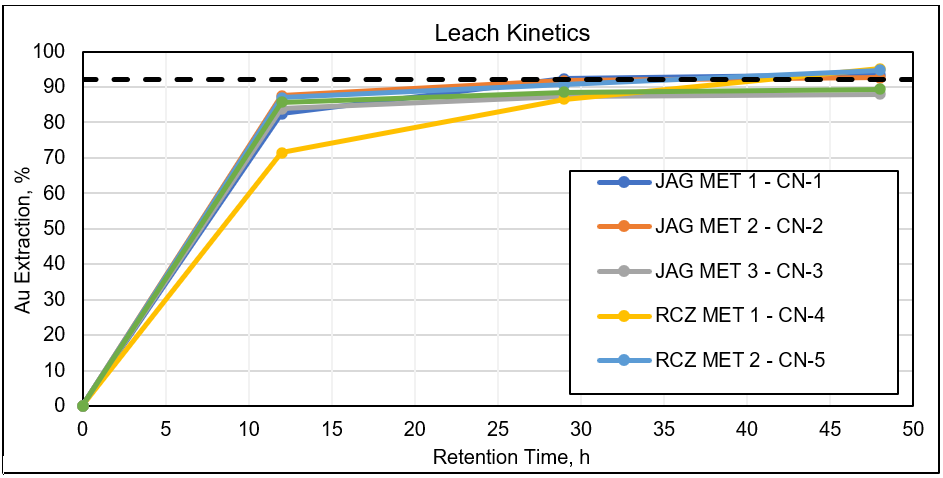
All samples exhibited rapid gold leaching kinetics, achieving 71–87% gold recovery within the first ~10 hours of leaching. Gold extraction continued to increase gradually until ~30 hours, after which the extractions started to plateau. Only minor recovery gains were observed thereafter, with maximum gold extraction achieved before completion of the 48-hour leach period. Cyanide consumptions were low, 0.39 kg/t NaCN on average and lower cyanide additions are possible, based on the final (48-hour) free cyanide concentrations. Lime consumptions averaged ~2 kg/t CaO.
The Master Composite was submitted for head assay and a complete mineralogical examination, which included XRD and TIMA analysis, along with a comprehensive microscopic gold deportment study. The mineralogy results are pending and will be issued in the coming weeks.
Table 1: Kossou Cyanidation Test Results
| | | | | | | | | | | | | | |
| Sample Details | CN | Au Extraction, % | Au Recovery, % | Au Residue, g/t | Au Head, g/t | |
| Test | Cyanidation | Gravity | Overall | |
| No. | 12 h | 29 h | 48 h | | | A | B | Avg. | CN | Gravity + CN | Direct | |
| G-1 Gravity Tail | 1 | 82.4 | 92.4 | 93.5 | 54.7 | 97.1 | <0.02 | <0.02 | <0.02 | 0.31 | 0.68 | 0.82 | |
| JAG MET 1 | | | | | | | | | | | | | |
| G-2 Gravity Tail | 2 | 87.5 | 91.8 | 92.6 | 45.5 | 96.0 | 0.03 | 0.03 | 0.03 | 0.40 | 0.73 | 1.28 | |
| JAG MET 2 | | | | | | | | | | | | | |
| G-3 Gravity Tail | 3 | 83.9 | 87.2 | 87.9 | 50.1 | 94.0 | 0.07 | 0.06 | 0.07 | 0.54 | 1.08 | 1.01 | |
| JAG MET 3 | | | | | | | | | | | | | |
| G-4 Gravity Tail | 4 | 71.5 | 86.6 | 95.1 | 59.3 | 98.0 | 0.04 | 0.04 | 0.04 | 0.81 | 1.99 | 1.36 | |
| RCZ MET 1 | | | | | | | | | | | | | |
| G-5 Gravity Tail | 5 | 87.0 | 90.7 | 94.7 | 76.4 | 98.7 | 0.03 | 0.02 | 0.03 | 0.47 | 1.99 | 1.50 | |
| RCZ MET 2 | | | | | | | | | | | | | |
| G-6 Gravity Tail | 6 | 85.7 | 88.5 | 89.4 | 54.1 | 95.1 | 0.07 | 0.08 | 0.08 | 0.71 | 1.55 | 1.38 | |
| RCZ MET 3 | | | | | | | | | | | | | |
| Minimum | -- | -- | 87.9 | 45.5 | 94.0 | -- | -- | <0.02 | 0.31 | 0.68 | 0.82 | |
| Maximum | -- | -- | 95.1 | 76.4 | 98.7 | -- | -- | 0.08 | 0.81 | 1.99 | 1.50 | |
| Average | -- | -- | 92.2 | 56.7 | 96.5 | -- | -- | 0.04 | 0.54 | 1.34 | 1.23 | |
| | | | | | | | | | | | | | |
Figure 1: Kossou Leach Kinetics – Results
Kossou Exploration Program Advances Multiple Workstreams Ahead of Inaugural MRE
The Company continues to advance multiple technical and exploration workstreams at Kossou, where more than 42,000 m of drilling has now been completed across 222 drill holes. Two drill rigs continue to operate at Kossou as the Company expands and defines gold mineralisation across the Jagger, Road Cut, Contact Zone and Kadie target areas in support of an inaugural Mineral Resource Estimate expected in the second half of 2026.
The Company is also advancing preparations for its inaugural drill program at the Kotobi Permit, expected to commence in Q3 2026, where previous work identified multiple large gold-in-soil anomalies across a prospective structural corridor. Kotobi represents a complementary exploration growth opportunity alongside the continued advancement of the Kossou Gold Project.
About SGS Canada Inc.
Metallurgical test work was completed by SGS Canada Inc. at its Lakefield, Ontario facility. Composite samples were prepared from representative drill core intervals selected by Company personnel. SGS is accredited under ISO/IEC 17025 standards.
SGS is widely recognized as one of the world's leading independent testing and metallurgical laboratories serving the global mining industry. SGS operates a network of over 2,500 laboratories and business facilities across 115 countries, supported by a team of over 100,000 dedicated professionals. SGS maintains a strong presence as a top-quality service provider at all major ports and trading hubs across Canada and is known across the world for excellence in exploration and mining. With more than 145 years of service excellence, SGS combines the precision and accuracy that define Swiss companies to help organizations achieve the highest standards of quality, compliance and sustainability. SGS is publicly traded on the six Swiss Exchange under the ticker symbol SGSN (ISIN CH1256740924, Reuters SGSN.S, Bloomberg SGSN SW). For more information, please visit www.sgs.com.
Review of Technical Information
The scientific and technical information in this press release has been reviewed and approved by Paul Sarjeant, P.Geo., who is a Qualified Persons as defined in National Instrument 43-101. Mr. Sarjeant is the President and Chief Operating Officer and Director of Kobo.
About Kobo Resources Inc.
Kobo Resources is a growth-focused gold exploration company with a compelling gold discovery in Côte d'Ivoire, one of West Africa’s most prolific gold districts, hosting several multi-million-ounce gold mines. The Company’s 100%-owned Kossou Gold Project is located approximately 20 km northwest of the capital city of Yamoussoukro and is directly adjacent to one of the region’s largest gold mines with established processing facilities.
With over 36,000 metres of diamond drilling, nearly 5,887 metres of reverse circulation (RC) drilling, and 7,200+ metres of trenching completed since 2023, Kobo has made significant progress in defining the scale and prospectivity of its Kossou’s Gold Project. Exploration has focused on multiple high-priority targets within a 9+ km strike length of highly prospective gold-in-soil geochemical anomalies, with drilling confirming extensive mineralisation at the Jagger, Road Cut, and Kadie Zones. The latest phase of drilling has further refined structural controls on gold mineralisation, setting the stage for the next phase of systematic exploration and resource development.
Beyond Kossou, the Company is advancing exploration at its Kotobi Permit and is actively expanding its land position in Côte d'Ivoire with prospective ground, aligning with its strategic vision for long-term growth in-country. Kobo remains committed to identifying and developing new opportunities to enhance its exploration portfolio within highly prospective gold regions of West Africa. Kobo offers investors the exciting combination of high-quality gold prospects led by an experienced leadership team with in-country experience.
Kobo’s common shares trade on the TSX Venture Exchange under the symbol "KRI” and on the Frankfurt Stock Exchange under the symbol “Q1Z”. For more information, please visit www.koboresources.com.
For further information, please contact:
Edward Gosselin
Chief Executive Officer and Director
1-418-609-3587
ir@kobores.com
X: @KoboResources | LinkedIn: Kobo Resources Inc.
NEITHER THE TSXV NOR ITS REGULATION SERVICES PROVIDER (AS THAT TERM IS DEFINED IN THE POLICIES OF THE TSXV) ACCEPTS RESPONSIBILITY FOR THE ADEQUACY OR ACCURACY OF THIS RELEASE.
Cautionary Statement on Forward-looking Information:
This press release may contain “forward-looking information” and “forward-looking statements” (collectively, “forward-looking statements”) within the meaning of the applicable Canadian securities legislation. All statements, other than statements of historical fact, are forward-looking statements. Any statement that involves discussions with respect to predictions, expectations, beliefs, plans, projections, objectives, assumptions, future events or performance (often but not always using phrases such as “expects”, or “does not expect”, “is expected”, “anticipates” or “does not anticipate”, “plans”, “budget”, “scheduled”, “forecasts”, “estimates”, “believes” or “intends” or variations of such words and phrases or stating that certain actions, events or results “may”, “could”, “would”, “might” or “will” be taken, occur or be achieved) are not statements of historical fact and may be forward-looking statements, including statements related to the Offering or to the exploration program of the Company. Forward-looking statements are necessarily based upon a number of estimates and assumptions that, while considered reasonable as at the date of this press release, are subject to known and unknown risks, uncertainties and other factors which may cause the actual results and future events to differ materially from those expressed or implied by such forward-looking statements. Such factors include, but are not limited to: general business, economic, competitive, political and social uncertainties; the inherent risks involved in the exploration and development of mineral properties; unanticipated costs and expenses; the delay or failure to receive board, shareholder or regulatory approvals; and other risk factors listed from time to time in documents filed by the Company with Canadian securities regulators on SEDAR+ at www.sedarplus.ca. There can be no assurance that such statements will prove to be accurate, as actual results and future events could differ materially from those anticipated in such statements. Accordingly, readers should not place undue reliance on the forward-looking statements and information contained in this press release. Except as required by law, Kobo assumes no obligation or liability to update the forward-looking statements of beliefs, opinions, projections, or other factors, should they change, except as required by law.
An infographic accompanying this announcement is available at https://www.globenewswire.com/NewsRoom/AttachmentNg/7f9b16bb-1ef8-4240-9f47-7d1a3776efc6



Figure 1
Kossou Leach Kinetics – Results
© 2026 Canjex Publishing Ltd. All rights reserved.