Edmonton, Alberta--(Newsfile Corp. - September 23, 2026) - Torr Metals Inc. (TSXV: TMET) ("Torr" or the "Company") is pleased to provide an interpretation and targeting update from its fully funded Phase II drill program at the Bertha North target, part of the 332 km² Kolos Copper-Gold Project in southern British Columbia.
Phase II drilling is progressively defining Bertha North as a large copper (Cu) - gold (Au) porphyry-style hydrothermal system, with drilling confirming copper-bearing breccias, mineralized structures and, importantly, a pyrite-chalcopyrite-bearing intrusive phase in Hole 26-KO-04 (Figure 1, Figure 2). Integration with geophysics and surface geochemistry has provided increasingly focused vectors toward a priority target immediately south of current drilling (Figure 3, Figure 4).
Here, strong copper-in-soil anomalism and mineralized structural corridors converge with overlapping magnetic, resistive and chargeable signatures above a deep resistivity feature extending beyond 1,000 m vertical depth (Figure 2), interpreted as a potential causative intrusive source. Follow-up drilling will directly test this convergence and the upper margin of the interpreted intrusion as part of Torr's fully-funded drill program of up to 6,000 metres (m).
Highlights
- Phase II Drilling is Defining a Brand New Large-Scale Porphyry-Hydrothermal System: Holes 26-KO-01 through 26-KO-04 have confirmed copper-bearing hydrothermal breccias and mineralized structural corridors along north-south and northeast-southwest trends. These trends converge within the untested southern magnetic-resistive domain, coincident with strong copper-in-soil anomalism (Figure 3, Figure 4).
- Intrusive Phases Provide Increasingly Proximal Vectors: Copper-mineralized biotite-phase and potassium-feldspar-altered intrusive dykes have been encountered within prospective portions of the hydrothermal breccia corridor. Hole 26-KO-04 provides an important vector, having advanced closest to the interpreted intrusive source and intersected a discrete magnetite-bearing intrusive dyke with disseminated pyrite-chalcopyrite mineralization within a broader 40.6 m interval of brecciated, hematized and mineralized host volcanics (Figure 2).
- Deep Resistivity Defines Potential Intrusive Source: A large resistivity feature extends beyond 1,000 m vertical depth beneath the southern target (Figure 2). Its upper margin converges with mineralized structures and overlapping magnetic, chargeable and resistive signatures, providing a priority target toward the interpreted intrusive source.
- Near-Term Assays and Follow-Up Drilling: Laboratory assays from Phase II drilling are pending and expected in the near term for 26-KO-01 and 26-KO-02. Torr is also in the process of re-establishing historical exploration roads to access planned holes KP_7 and KP_8, designed to directly test the southern structural convergence and upper margin of the interpreted deep intrusive source (Figure 4).
"Phase II drilling is demonstrating the scale of the mineralized hydrothermal system at Bertha North and, importantly, giving us a clearer path toward its interpreted centre," stated Malcolm Dorsey, President and CEO. "We began by identifying copper-bearing hydrothermal breccias and structural conduits that carried mineralizing fluids through the system, and we are now following those conduits inward through increasingly proximal intrusive phases and alteration. Hole 26-KO-04 represents an important step in that progression, intersecting a sulphide-bearing, magnetite-rich intrusive dyke within a broad brecciated, hematized and mineralized interval. The scale and intensity of alteration and pyritic hydrothermal activity encountered across our drilling are encouraging for the style of porphyry system we are exploring for, with the nearby New Afton-style providing an important regional analogue. Our next holes will follow this progression south, where copper geochemistry, mineralized structures and multiple geophysical signatures converge above the interpreted deep intrusive source."
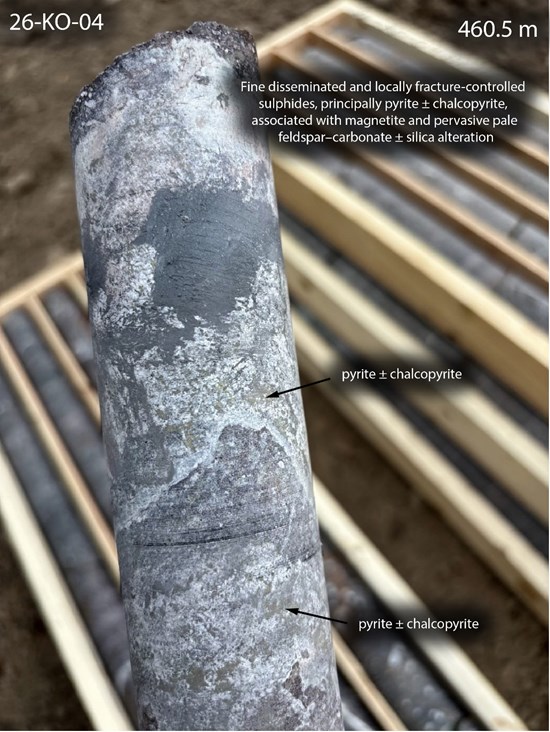
Figure 1. Hole 26-KO-04 at approximately 460.5 m showing a select magnetite-bearing intrusive dyke with disseminated pyrite-chalcopyrite mineralization within a broader brecciated volcanic and mineralized interval from approximately 429.2 to 469.8 m. Mineral and alteration identifications remain subject to petrographic, geochemical and laboratory confirmation.
To view an enhanced version of this graphic, please visit:
https://images.newsfilecorp.com/files/6794/315619_f8ded7ef94e44abf_001full.jpg
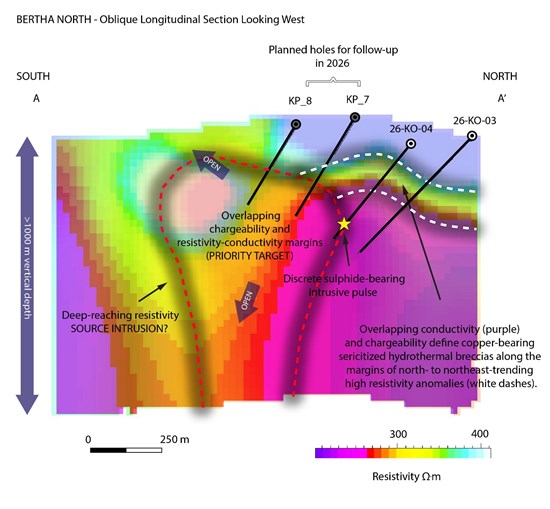
Figure 2. Oblique longitudinal section looking west through Bertha North showing completed Phase II drilling, the deep-reaching resistivity anomaly and planned follow-up holes KP_7 and KP_8. Hole 26-KO-04 intersected a discrete sulphide-bearing intrusive pulse immediately north of the priority target. Planned drilling will test overlapping chargeability and resistivity-conductivity margins above and along the interpreted deep intrusive body, which remains open at depth.
To view an enhanced version of this graphic, please visit:
https://images.newsfilecorp.com/files/6794/315619_f8ded7ef94e44abf_002full.jpg
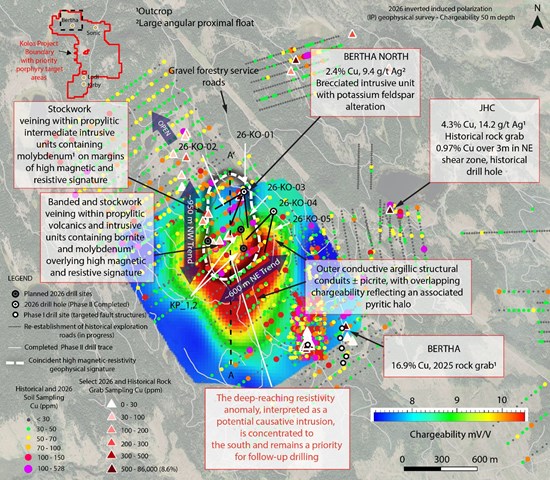
Figure 3. Plan view of the Bertha North target showing Phase II drill holes relative to 2026 IP chargeability at approximately 50 m depth, surface copper geochemistry and interpreted northwest- and northeast-trending structural corridors. Holes 26-KO-03 and 26-KO-04 tested the interpreted northeast-trending interface toward the deeper chargeability anomaly.
To view an enhanced version of this graphic, please visit:
https://images.newsfilecorp.com/files/6794/315619_f8ded7ef94e44abf_003full.jpg
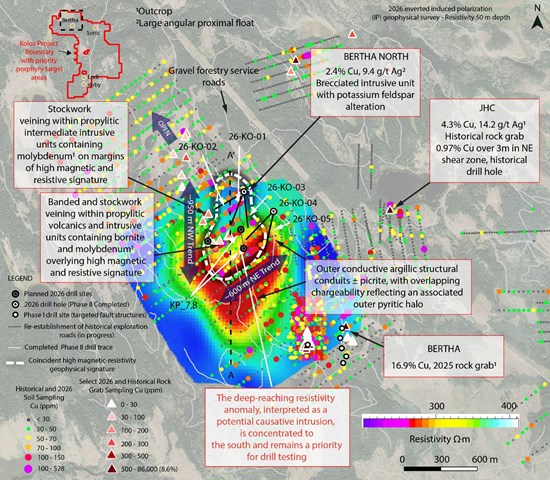
Figure 4. Plan view of the Bertha North target showing Phase II drill holes relative to 2026 IP resistivity at approximately 50 m depth, surface copper geochemistry, and interpreted northwest- and northeast-trending structural corridors. The outer pyritic chargeability halo (Figure 3) borders the southern end of the target and wraps around the margins of the resistivity anomaly, a spatial relationship interpreted to reflect sulphide-bearing hydrothermal alteration peripheral to the more resistive core of the system.
To view an enhanced version of this graphic, please visit:
https://images.newsfilecorp.com/files/6794/315619_f8ded7ef94e44abf_004full.jpg
Bertha North: Geological Takeaways
Phase II drilling is progressively defining the architecture of a large mineralized hydrothermal porphyry system at Bertha North. Initial drilling identified broad pyritic and copper-bearing hydrothermal corridors, while subsequent holes have provided vectors toward the southern part of the target where structural, geological and geophysical features increasingly converge.
Key observations guiding ongoing drilling include:
- Copper-bearing hydrothermal conduits identified: Drilling has intersected broad zones of strong to intense hydrothermal alteration, brecciation, hematization and veining containing pyrite and magnetite, with local chalcopyrite and chalcocite where mineralization is apparent. The intensity of alteration and associated fracturing has resulted in difficult ground conditions and contributed to slower-than-anticipated drilling progress. However, the scale and intensity of alteration indicate substantial hydrothermal fluid flow through the system, with these altered zones defining north- and northeast-trending structural corridors interpreted as important pathways for copper-bearing fluids.
- Hole 26-KO-04 provides an important intrusive vector: Within a broader 40.6 m brecciated and mineralized interval from 429.2 to 469.8 m, the hole intersected a discrete magnetite-bearing intrusive dyke with disseminated pyrite-chalcopyrite mineralization at approximately 460.5 m. The occurrence of sulphide-bearing intrusive material within the mineralized hydrothermal corridor provides an important vector for follow-up drilling.
- Multiple vectors converge to the south: The interpreted intersection of major northeast- and north-trending structures occurs within the southern magnetic-resistive domain and coincides with strong surface copper geochemistry. Hole 26-KO-04 is the closest drilling to date to the interpreted upper margin of the deeper southern resistivity anomaly.
- Follow-up drilling is moving toward the interpreted centre: Planned holes KP_7 and KP_8 will test farther south across the deep-reaching resistivity anomaly and the convergence of major structural and geophysical features. This structural intersection is interpreted as a favourable zone for enhanced dilation and intrusive emplacement, where intersecting structures may have provided pathways for larger intrusive phases and focused mineralizing fluids. Drilling will test this convergence and the interpreted upper margin of a potentially larger intrusive body that may represent the causative source of the broader hydrothermal system.
Approximately 3,500 m of the fully funded drill program of up to 6,000 m has been completed.
Laboratory assays remain pending due to extended turnaround times, with initial results anticipated in the near term. Results will be integrated with geological logging, geochemistry and the 2026 geophysical inversion to guide ongoing drilling.
Torr Announces Adoption of Semi-Annual Reporting
The Company announces adoption of semi-annual financial reporting ("SAR"). This news release is being filed pursuant to Coordinated Blanket Order 51 - 933 Exemptions to Permit Semi-Annual Reporting for Certain Venture Issuers ("CBO 51-933").
Coordinated Blanket Order 51-933 allows eligible venture issuers to voluntarily move from a quarterly to a semi-annual financial reporting framework. The Company's fiscal year ends on April 30. Under the provisions of CBO 51-933, the Company will be exempt from the requirements to file Q1 and Q3 financial statements and associated management's discussion and analysis ("MD&A") for so long as it continues to meet eligibility criteria under CBO 51-933. Accordingly, the Company will not be filing its interim financial statements for the three months ended July 31, 2026 and associated MD&A. The Company will also not be required to file any interim financial statements and associated MD&A for any subsequent quarters ended January 31 and July 31 in each financial year.
Quality Assurance and Control
The analytical work reported on herein was performed by ALS Global ("ALS"), Kamloops, Canada. ALS is an ISO-IEC 17025:2017 and ISO 9001:2015 accredited geoanalytical laboratory and is independent of Torr Metals Inc. and the QP. Drill core samples were subject to crushing at a minimum of 70% passing 2 mm, followed by pulverizing of a 250-gram split to 85% passing 75 microns. Base and precious metals were determined via four-acid digestion 48 element ICP-MS geochemistry and 30-gram gold fire assay.
Torr Metals Inc. follows industry standard procedures for the work carried out on the Kolos Project, with a quality assurance/quality control (QA/QC) program. Blank, duplicate, and standard samples were inserted into the sample sequence sent to the laboratory for analysis. Torr Metals Inc. detected no significant QA/QC issues during review of the data. Torr Metals Inc. is not aware of any drilling, sampling, recovery, or other factors that could materially affect the accuracy or reliability of the data referred to herein.
Qualified Person
The technical content of this news release has been reviewed and approved by Michael Dufresne, M.Sc., P.Geol., P.Geo., a consultant to the Company who is a non independent qualified person defined under National Instrument 43-101.
About Torr Metals
Torr Metals, headquartered in Edmonton, AB, is focused on unlocking new copper and gold discovery potential within proven, highly accessible mining districts across Canada, areas with both established infrastructure and a growing need for near-term feed. Torr's 100%-owned, district-scale assets are strategically located for cost-effective, year-round exploration and development. The 275 km² Kolos Copper-Gold Project and strategically option 57 km2 Bertha Property, situated in southern British Columbia's prolific Quesnel Terrane, lies just 30 km southeast of the Highland Valley Copper Mine, Canada's largest open-pit copper operation, and 40 km south of the city of Kamloops directly along Highway 5. In northern Ontario, the 261 km² Filion Gold Project covers a virtually unexplored greenstone belt with high-grade orogenic gold potential. It sits just off the Trans-Canada Highway 11, approximately 42 km from Kapuskasing and 202 km by road from the Timmins mining camp, home to world-class operations like Hollinger, McIntyre, and Dome. To learn more, visit Torr Metals online or view company documents via SEDAR+ at www.sedarplus.ca.
On behalf of the Board of Directors
Torr Metals Inc.
"Malcolm Dorsey"
Malcolm Dorsey
President, CEO and Director
Neither the TSX Venture Exchange nor its Regulation Services Provider (as that term is defined in the policies of the TSX Venture Exchange) accepts responsibility for the adequacy or accuracy of this press release.
Cautionary Statement Regarding Forward-Looking Information
This press release contains "forward-looking information" within the meaning of applicable Canadian securities legislation. Forward-looking information includes, without limitation, statements regarding the use of proceeds from the Company's recently completed financings, and the future plans or prospects of the Company. Generally, forward-looking information can be identified by the use of forward-looking terminology such as "plans", "expects" or "does not expect", "is expected", "budget", "scheduled", "estimates", "forecasts", "intends", "anticipates" or "does not anticipate", or "believes", or variations of such words and phrases or state that certain actions, events or results "may", "could", "would", "might" or "will be taken", "occur" or "be achieved". Forward-looking statements are necessarily based upon a number of assumptions that, while considered reasonable by management, are inherently subject to business, market and economic risks, uncertainties and contingencies that may cause actual results, performance or achievements to be materially different from those expressed or implied by forward-looking statements. Although the Company has attempted to identify important factors that could cause actual results to differ materially from those contained in forward-looking information, there may be other factors that cause results not to be as anticipated, estimated or intended. There can be no assurance that such information will prove to be accurate, as actual results and future events could differ materially from those anticipated in such statements. Accordingly, readers should not place undue reliance on forward-looking information. Other factors which could materially affect such forward-looking information are described in the risk factors in the Company's most recent annual management's discussion and analysis which is available on the Company's profile on SEDAR+ at www.sedarplus.ca. The Company does not undertake to update any forward-looking information, except in accordance with applicable securities laws.
To view the source version of this press release, please visit https://www.newsfilecorp.com/release/315619

© 2026 Canjex Publishing Ltd. All rights reserved.