Edmonton, Alberta--(Newsfile Corp. - January 21, 2026) - Torr Metals Inc. (TSXV: TMET) ("Torr" or the "Company") is pleased to report results from its Phase I 2,733 metre (m) drill program at the Bertha Target within the Company's 332 km² Kolos Copper-Gold Project in south-central British Columbia. The program successfully confirmed the presence of a large, structurally-controlled hydrothermal copper-gold-silver system and, importantly, defined coherent geological and geophysical vectors toward a high-priority, untested copper-gold target to the northeast (Figure 1, Figure 2).
Drilling delineated broad zones of anomalous copper mineralization spatially associated with hydrothermal magnetite, brecciation, and strong northwest-striking and north-south trending structural controls (Figure 1, Figure 2). These zones are flanked by 68 discrete native copper occurrences that locally define higher-grade intervals (Table 2) and are closely associated with hydrothermal magnetite-epidote veining, collectively defining a laterally extensive hydrothermal-copper system spanning greater than 350 m in strike and 580 m vertical depth (Figure 2).
Notably, the deepest hole drilled toward the northeast (25-KO-07) intersected the first structurally controlled gold mineralization reported from the Bertha area, returning 0.24 g/t Au over 3 metres (337-340 m). The appearance of gold at depth, together with increasing pyrite content and supergene overprinting of phyllic alteration toward the northeast, is interpreted to define a coherent geochemical and mineralogical vector toward a more proximal, gold-bearing magmatic-hydrothermal porphyry source in that direction, where it remains open and is coincident with a broad, northeast-trending, untested induced polarization (IP) chargeability anomaly identified at approximately 250 metres depth (Figure 1, Figure 2).
"The 2025 drill program did exactly what it was designed to do as the inaugural test of a previously untested, large-scale porphyry system," said Malcolm Dorsey, President and CEO of Torr Metals. "In systems of this type, it is uncommon for initial drilling to directly intersect the sulphide-bearing core, and our results are consistent with expectations for early-stage porphyry exploration on a brand new target. The structural controls, system geometry, and style of supergene alteration and copper mineralization encountered to date continue to support an alkalic porphyry model analogous to an early-stage New Afton-style system prior to discovery of its core. While drilling has not yet intersected the source intrusion, the program has confirmed significant scale to the peripheral hydrothermal copper system and established coherent vectors that all strengthen toward the northeast; including increasing alteration intensity and gold content, brecciation and veining, improved structural architecture, and a buried chargeability anomaly. Taken together, these factors are interpreted to indicate increasing proximity to a more proximal and potentially sulphide-rich portion of the porphyry system relative to the areas drilled to date. These results materially reduce geological uncertainty and define a new, untested northeast-trending chargeability target, which will be further refined through planned IP expansion in spring 2026 prior to fully funded Phase II drill targeting."
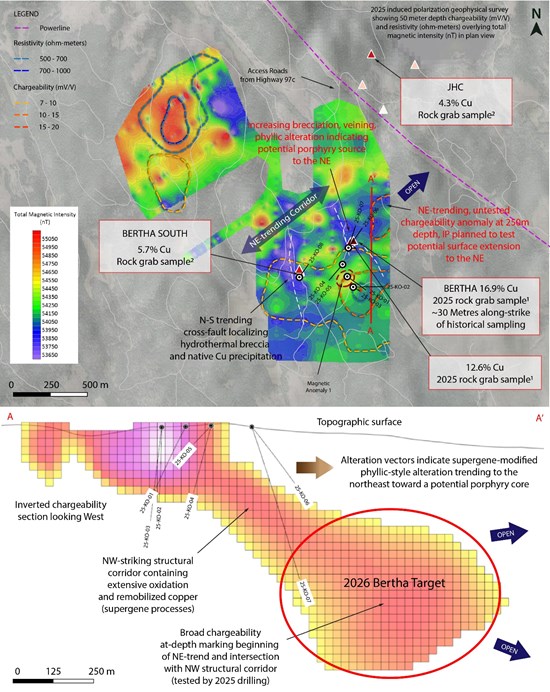
Figure 1. Plan view of the 2025 total magnetic intensity ground magnetic survey with selected rock grab samples and coincident chargeability and resistivity anomalies outlining 2025 drilling and priority northeast (NE) target for 2026 at Bertha; chargeability section shown below.
To view an enhanced version of this graphic, please visit:
https://images.newsfilecorp.com/files/6794/281060_29373004a426d82c_001full.jpg
Highlights:
- Large Hydrothermal Copper System Confirmed and Open to the Northeast: 2025 drilling delineated a laterally extensive, supergene-altered hydrothermal copper system characterized by pervasive hematite alteration, hydrothermal magnetite, and broad, repeatable copper anomalism concentrated along a northwest-striking picrite boundary (Figure 2, Table 1). This anomalism, interpreted to reflect hydrothermal introduction and/or remobilization of copper, is consistently expressed across drill holes 1-7 and is further supported by the intersection of discrete native copper occurrences (Table 2) encountered in every drill hole. Importantly, the system remains open to the northeast along a structurally linked and untested trend, where a broad induced polarization (IP) chargeability anomaly has been identified at approximately 250 m depth at the limits of the 2025 IP geophysical grid (Figure 1, Figure 2).
- Structural Framework Defines Primary and Secondary Mineralizing Pathways: Drilling has demonstrated that copper mineralization and hydrothermal brecciation along the northwest-striking corridor are localized along picrite redox boundaries and are interpreted to represent a secondary or leakage pathway. Subsequent interpretation has identified a northeast-trending structure, coincident with a steepening, parallel picrite boundary, which is interpreted as a primary mineralizing corridor potentially linked to a deeper porphyry source (Figure 1, Figure 2).
- Alteration Vectoring Toward a Hotter Potential Source to the Northeast: The northeastern-most drill hole (25-KO-06) intersected extensive hydrothermal brecciation from 14.0 to 80.17 m, characterized by increasing dickite, chlorite, epidote, and carbonate alteration accompanied by native copper, chalcocite, and magnetite (Figure 2, Figure 3, Figure 4). This alteration assemblage, together with increasing pyrite content observed in Hole 25-KO-07 and 25-KO-08, is interpreted to reflect progressively hotter and more acidic hydrothermal fluids characteristic of the phyllic zone of a porphyry system, providing a strong vector toward a more proximal mineralizing source to the northeast, where a buried chargeability anomaly is interpreted to represent a potential porphyry-style core at depth.
- Fully Funded Phase II Drill Program Planned: Torr is fully financed to advance a Phase II drill program of up to 6,000 metres, which will include follow-up drilling on the newly identified northeast-trending structural and geophysical targets as well as expanded IP targeting across the broader Bertha area to further evaluate the grade and scale potential of this hydrothermal copper system.
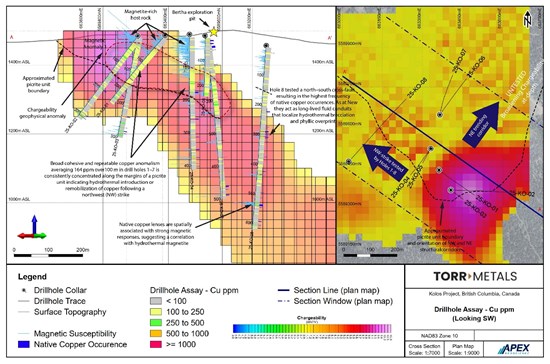
Figure 2. 2025 inverted IP chargeability geophysical survey plan and cross-sectional views with 2025 drill sites. Section looking to the southwest.
To view an enhanced version of this graphic, please visit:
https://images.newsfilecorp.com/files/6794/281060_29373004a426d82c_002full.jpg
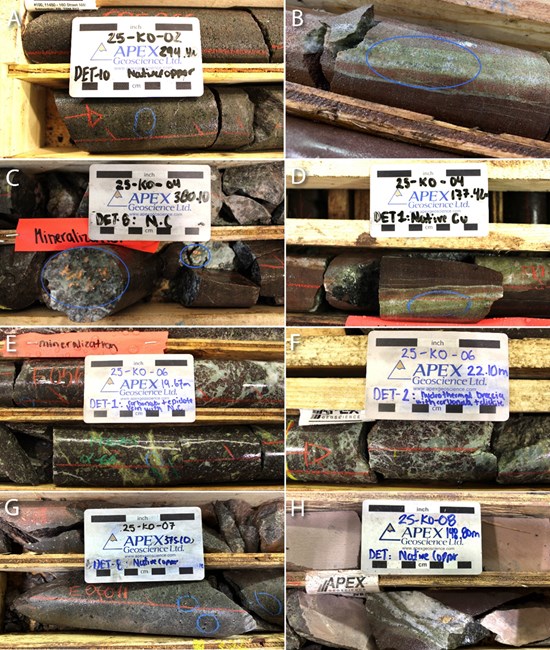
Figure 3. Select 2025 core photos. A. Native copper replacing mafic minerals in picrite. B. Native copper in epidote-carbonate veins hosted in hematized andesite. C. Native copper along chlorite filled fracture. D. Same as (B). E. Native copper in epidote-carbonate veins with hematite rims hosted in hydrothermal breccia in proximity to Bertha exploration pit. F. Hydrothermal breccia with carbonate cement ± dickite (teal clay mineral) ± epidote. G. Native copper replacing mafic minerals in picrite. H. Native copper in epidote-carbonate veins hosted in hematized andesite.
To view an enhanced version of this graphic, please visit:
https://images.newsfilecorp.com/files/6794/281060_29373004a426d82c_003full.jpg
Table 1. Composite assays of broad Cu anomalism concentrated along a northwest-striking picrite boundary.
| Drill Hole | From (m) | To (m) | Interval (m) | Cu (ppm) | Ag (g/t) |
| 25-KO-01 | 47 | 183 | 136 | 173 | 0.27 |
| 25-KO-02 | 25 | 93 | 68 | 160 | 0.31 |
| 25-KO-03 | 15 | 135 | 120 | 149 | 0.1 |
| 25-KO-04 | 105 | 175 | 70 | 162 | 0.12 |
| 25-KO-06 | 145 | 243 | 98 | 170 | 0.11 |
| 25-KO-07 | 142 | 243 | 101 | 168 | 0.13 |
Table 2. Composite assays of select inaugural Bertha drill highlights of a total 68 native copper occurrences and lenses. Of the 68 native copper occurrences intersected, 21 returned Cu values exceeding 500 ppm, including 10 samples above 1000 ppm Cu.
| Drill Hole | From (m) | To (m) | Interval (m) | Cu (%) | Ag (g/t) |
| 25-KO-02 | 304.91 | 306 | 1.09 | 0.14 | 0.2 |
| 25-KO-03 | 237 | 238.14 | 1.14 | 0.12 | 0.3 |
| 25-KO-04 | 258.92 | 261.13 | 2.21 | 0.11 | 0.23 |
| 25-KO-04 | 313.47 | 315.07 | 1.6 | 0.10 | 0.29 |
| 25-KO-04 | 379.9 | 380.35 | 0.45 | 0.17 | 0.99 |
| 25-KO-04 | 394.7 | 395 | 0.3 | 0.13 | 0.4 |
| 25-KO-07 | 323.63 | 324.12 | 0.49 | 0.14 | 0.33 |
| 25-KO-07 | 374.51 | 375.2 | 0.69 | 0.40 | 1.68 |
| 25-KO-08 | 288 | 290.1 | 2.1 | 0.24 | 0.9 |
| 25-KO-08 | 434.7 | 435.36 | 0.66 | 0.13 | 0.27 |
Geological Interpretation
Drilling to date has tested the upper to mid-levels of a large, structurally controlled hydrothermal copper system, characteristic of the outer propylitic and phyllic domains of an alkalic porphyry environment (Figure 4). This peripheral corridor is characterized by hematite alteration, hydrothermal magnetite, and supergene copper mineralization localized along structurally prepared zones and favourable lithological contacts. Accordingly, drilling is interpreted to have intersected the peripheral, redox-controlled fluid-transport domain of the system; however, systematic changes in alteration, mineralization, and geophysical responses indicate vectoring toward a potentially more proximal magmatic porphyry source to the northeast.
Copper mineralization occurs predominantly as disseminated and vein-hosted native copper and chalcocite within oxidized volcanic and intrusive host rocks, with higher-grade intervals localized within magnetite-bearing veins, hydrothermal breccias, and along picrite redox boundaries. This style of mineralization indicates long-lived and repeated copper precipitation events along structurally focused fluid pathways within the propylitic and phyllic envelopes. Outside the intercept in 25-KO-07 gold values remain weakly anomalous, which is considered significant, as gold is substantially less mobile than copper under oxidizing hydrothermal-supergene conditions. The lack of meaningful gold enrichment suggests that drilling has not yet intersected the sulphide-bearing magmatic source intrusion or the calc-potassic to potassic mineralized core, where gold would be expected to be concentrated in an alkalic porphyry system.
In the supergene zone, sericite-pyrite assemblages are unstable and are typically destroyed by oxidation, resulting in the development of iron oxides and kaolin-group clays such as kaolinite and dickite. These clays are interpreted as late weathering overprints developed within zones of intense hydrothermal brecciation, such as those observed in Hole 25-KO-06. These breccia zones are structurally focused and locally host Cu ± Ag mineralization, collectively defining permeable fluid pathways interpreted to be connected to a deeper magmatic-hydrothermal source. In alkalic porphyry systems, magnetite-rich alteration, hydrothermal breccia corridors, and late-stage Cu-Ag mineralization commonly occur above or lateral to the potassic Cu-Au core.
To further refine alteration zoning and vectoring within the system, TerraSpec shortwave infrared (SWIR) spectroscopy is being used to objectively identify alteration mineralogy and distinguish supergene from hypogene alteration phases. TerraSpec analysis is currently being conducted on Hole 25-KO-08, with additional analyses planned for Holes 25-KO-06 and 25-KO-07, to better constrain phyllic and propylitic alteration intensity and support vectoring toward higher-temperature, more proximal portions of the system.
The observed northeastward increase in chlorite-epidote intensity and kaolin clay alteration (including dickite), together with an untested northeast-trending chargeability anomaly at depth, is interpreted to provide a vector toward a hotter, more proximal magmatic-hydrothermal center (Figure 1, Figure 4). This target is considered a high-priority focus for follow-up geophysical extension and drill testing aimed at evaluating the potential for a buried alkalic porphyry Cu-Au core.
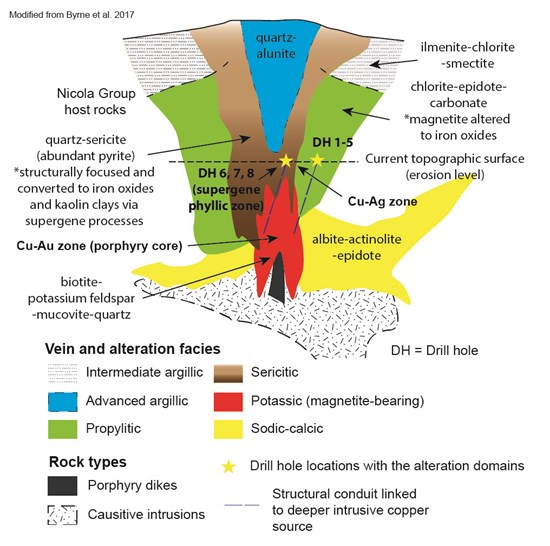
Figure 4. Schematic alteration zonation at the Bertha Zone with locations of drill holes 1-8. Modified from Byrne et al. 20171.
To view an enhanced version of this graphic, please visit:
https://images.newsfilecorp.com/files/6794/281060_29373004a426d82c_006full.jpg
Next Steps
Torr plans to extend the induced polarization (IP) survey to the northeast in 2026 to better define the geometry, depth extent, and intensity of the untested northeast-trending chargeability anomaly, with a focus on determining whether the anomaly strengthens or develops greater vertical continuity towards the surface. Follow-up drilling will target areas where increased chargeability coincides with magnetic anomalies, structural intersections, and the picrite contact, as these features are interpreted to represent key vectors toward a potential sulphide-bearing porphyry core and higher copper-gold potential. Extending the IP survey will also allow Torr to evaluate the along-strike shift in the picrite contact, which appears to mirror the northeast trend of the untested chargeability anomaly. This orientation is significant, as a northeast trend represents the predominant structural orientation of the New Afton ore body2, and its coincidence with evolving chargeability, hydrothermal magnetite, and brecciation, identified through secondary porosity resistivity signatures, will be a primary focus of follow-up drilling.
1Byrne, K., Lesage, G, Gleeson, S.A. and Lee, R.G. (2017): Large-scale sodic-calcic alteration around porphyry copper systems: examples from the Highland Valley Copper district, Guichon batholith, south-central British Columbia; in Geoscience BC Summary of Activities 2016, Geoscience BC, Report 2017-1, p. 213-222.
2Information and comparisons disclosed is not necessarily indicative of precious or base metal endowment or assays on the Kolos Project.
Quality Assurance and Control
The analytical work reported on herein was performed by ALS Global ("ALS"), Kamloops, Canada. ALS is an ISO-IEC 17025:2017 and ISO 9001:2015 accredited geoanalytical laboratory and is independent of Torr Metals Inc. and the QP. Drill core samples were subject to crushing at a minimum of 70% passing 2 mm, followed by pulverizing of a 250-gram split to 85% passing 75 microns. Base and precious metals were determined via four-acid digestion 48 element ICP-MS geochemistry and 30-gram gold fire assay.
Torr Metals Inc. follows industry standard procedures for the work carried out on the Kolos Project, with a quality assurance/quality control (QA/QC) program. Blank, duplicate, and standard samples were inserted into the sample sequence sent to the laboratory for analysis. Torr Metals Inc. detected no significant QA/QC issues during review of the data. Torr Metals Inc. is not aware of any drilling, sampling, recovery, or other factors that could materially affect the accuracy or reliability of the data referred to herein.
Qualified Person
The technical content of this news release has been reviewed and approved by Michael Dufresne, M.Sc., P.Geol., P.Geo., a consultant to the Company who is a non independent qualified person defined under National Instrument 43-101.
About Torr Metals
Torr Metals, headquartered in Edmonton, AB, is focused on unlocking new copper and gold discovery potential within proven, highly accessible mining districts across Canada, areas with both established infrastructure and a growing need for near-term feed. Torr's 100%-owned, district-scale assets are strategically located for cost-effective, year-round exploration and development. The 275 km² Kolos Copper-Gold Project and strategically option 57 km2 Bertha Property, situated in southern British Columbia's prolific Quesnel Terrane, lies just 30 km southeast of the Highland Valley Copper Mine, Canada's largest open-pit copper operation, and 40 km south of the city of Kamloops directly along Highway 5. In northern Ontario, the 261 km² Filion Gold Project covers a virtually unexplored greenstone belt with high-grade orogenic gold potential. It sits just off the Trans-Canada Highway 11, approximately 42 km from Kapuskasing and 202 km by road from the Timmins mining camp, home to world-class operations like Hollinger, McIntyre, and Dome. To learn more, visit Torr Metals online or view company documents via SEDAR+ at www.sedarplus.ca.
On behalf of the Board of Directors
Torr Metals Inc.
"Malcolm Dorsey"
Malcolm Dorsey
President, CEO and Director
Neither the TSX Venture Exchange nor its Regulation Services Provider (as that term is defined in the policies of the TSX Venture Exchange) accepts responsibility for the adequacy or accuracy of this press release.
Cautionary Statement Regarding Forward-Looking Information
This press release contains "forward-looking information" within the meaning of applicable Canadian securities legislation. Forward-looking information includes, without limitation, statements regarding the use of proceeds from the Company's recently completed financings, and the future plans or prospects of the Company. Generally, forward-looking information can be identified by the use of forward-looking terminology such as "plans", "expects" or "does not expect", "is expected", "budget", "scheduled", "estimates", "forecasts", "intends", "anticipates" or "does not anticipate", or "believes", or variations of such words and phrases or state that certain actions, events or results "may", "could", "would", "might" or "will be taken", "occur" or "be achieved". Forward-looking statements are necessarily based upon a number of assumptions that, while considered reasonable by management, are inherently subject to business, market and economic risks, uncertainties and contingencies that may cause actual results, performance or achievements to be materially different from those expressed or implied by forward-looking statements. Although the Company has attempted to identify important factors that could cause actual results to differ materially from those contained in forward-looking information, there may be other factors that cause results not to be as anticipated, estimated or intended. There can be no assurance that such information will prove to be accurate, as actual results and future events could differ materially from those anticipated in such statements. Accordingly, readers should not place undue reliance on forward-looking information. Other factors which could materially affect such forward-looking information are described in the risk factors in the Company's most recent annual management's discussion and analysis which is available on the Company's profile on SEDAR at www.sedarplus.ca. The Company does not undertake to update any forward-looking information, except in accordance with applicable securities laws.
To view the source version of this press release, please visit https://www.newsfilecorp.com/release/281060

© 2026 Canjex Publishing Ltd. All rights reserved.