(via TheNewswire)
Vancouver, BC – TheNewswire - October 6, 2026 – Stellar AfricaGold Inc. (TSXV: SPX, TGAT: 6YP, FSX: 6YP ) ("Stellar" or the "Company") is pleased to announce the completion of the Phase 1 trenching program at the new dyke target area - now officially designated by Stellar as Zone D - at its Tichka Est Gold Project, Morocco. Seven trenches were excavated, geologically mapped and channel-sampled over a two-week period, and all samples have been submitted for assay. Additionally, the Phase II diamond drill campaign is advancing towards commencement. ( See news releases dated August 11 and September 22, 2026) .
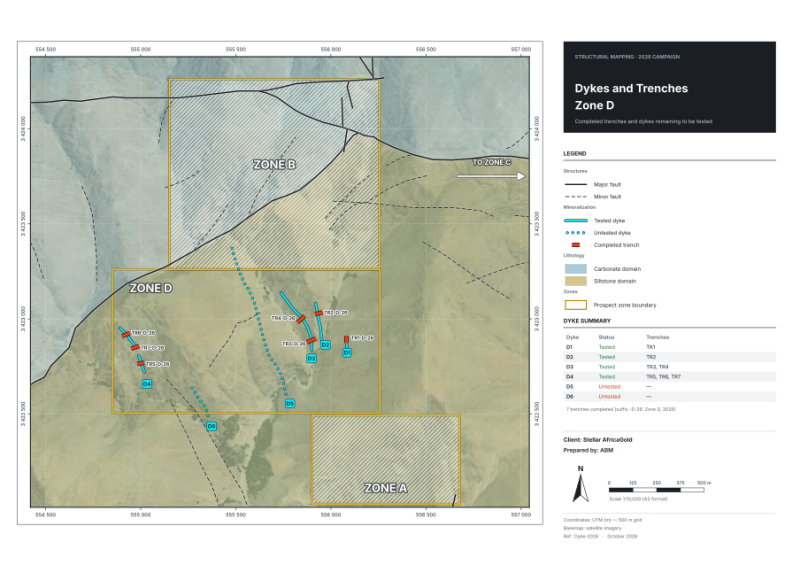
Click Image To View Full Size
Figure 1. Aerial view of the Tichka Est Gold Project showing the location of new Zone D
and the positions of tested dykes relative to Zones A and B.
Highlights
Zone D Phase 1 trenching completed. Between September 14 and September 27, 2026 seven trenches totalling 84 metres were excavated, mapped and channel-sampled. Four separate dykes were tested within the target corridor. Two further dykes were mapped within the corridor (D5 and D6, see Figure 1) and remain untested.
Sixty-four (64) channel samples, together with nine (9) quality-control samples (certified reference materials, blanks and field duplicates equalling approximately 12% of the total samples sent for assaying), have been submitted to Afrilab (Marrakech, Morocco), an ISO-certified laboratory independent of the Company. Assay results will be reported once received, validated and interpreted in accordance with NI 43-101 standards.
The trenches tested four dykes (from east to west), all hosted in foliated siltstone:
Dyke 1 - tested by one 16-metre trench; the dyke crops out over approximately 20 metres in a road cut, and its extent beneath cover remains untested.
Dyke 2 - a dioritic dyke traced over approximately 161 metres at surface; tested by one 8-metre trench.
Dyke 3 - a north–south-trending composite dioritic–doleritic intrusion traced over approximately 600 metres along strike; tested by two trenches totalling 38 metres.
Dyke 4 - a dioritic dyke traced over approximately 300 metres at surface; tested by three trenches totalling 22 metres, one of which exposed no visible veining and was not sampled.
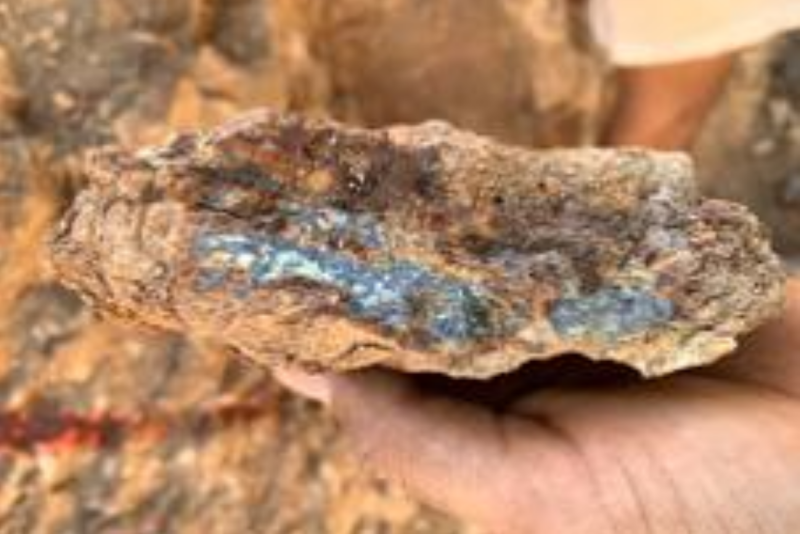
Quartz veining carrying arsenopyrite and pyrite was observed in the trenches on Dykes 1, 2 and 4 - including semi-massive arsenopyrite in trench TR1-D-26 (Figure 4) - and oxidized quartz veining was observed in both the dioritic and doleritic phases of Dyke 3. Visual observations are not a substitute for assay results, and no grade estimates can be made prior to assay.
Detailed structural mapping of the target area was completed alongside the excavation using the Company's digital field-mapping workflow and has been integrated into the project's 3D litho-structural model.
Assay results will guide the drill plan for the five holes of the 24-hole Phase II program provisionally allocated to this area; drilling of the new target may follow in Q4 2026, after the initial Zone B holes.
The Phase II drill program is advancing with Compagnie Marocaine des Forages Minier ("CMFM".) CMFM’s final rig mobilization and crew departure to site is awaiting administrative authorization in the normal course. Drilling expected to commence in later in October, 2026.
The detailed flight plan for the PROGREM high-resolution drone magnetic survey over Zones A, B and C was submitted for drone flight authorization on September 28, 2026 and approved on October 1, 2026. with mobilization scheduled for October 20, 2026.
Phase 1 Trenching Completed at the New Dyke Target
The new dyke target designated Zone D was identified by the integration of the Company's 2026 satellite remote-sensing study, dyke-population mapping and anomalous rock sampling ( see press release dated August 11, 2026 ). The Phase 1 trenching program comprised seven trenches (TR1-D-26 to TR7-D-26) totalling 84 metres, excavated broadly perpendicular to the dyke trends to test the four principal dykes of the corridor beneath surface cover. Trench excavation commenced on September 14, 2026 and was completed on September 27, 2026.
The program was refined during execution from the approximately 217 metres of trenching originally planned with excavation focused where cover was thinnest and at critical dyke-margin positions. All four dykes were thereby tested with a total of 84 metres of excavation, ahead of schedule and below budget.
Each trench was geologically mapped and systematically channel-sampled on nominal 1-metre intervals. The nine quality-control samples were inserted throughout the 64-sample stream, and all samples were delivered under chain of custody to Afrilab (Marrakech), where they will be prepared and assayed by 50 g fire assay with AAS finish.
Geological Observations
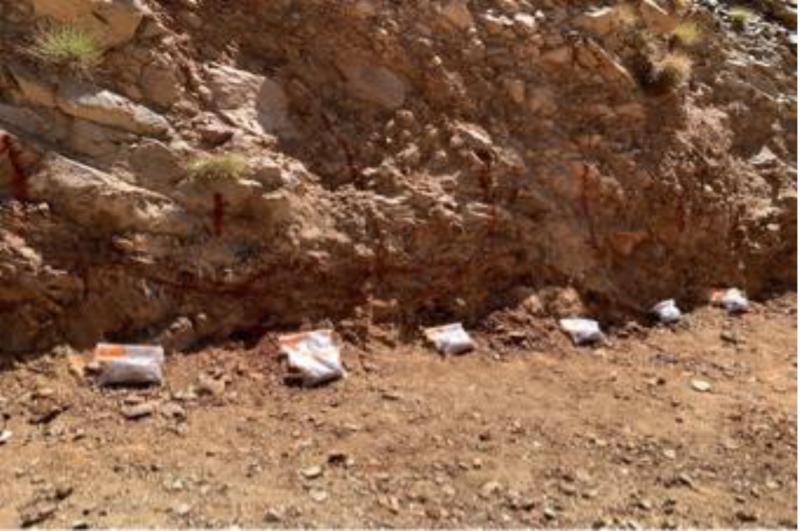
The trenches exposed dioritic and doleritic dykes intruding a foliated, greenish siltstone host, including the north-south trending composite diorite–dolerite intrusion (Dyke 3) traced over approximately 600 metres along strike. Dyke margins are locally brecciated and are cut by iron-oxide-bearing fault structures. Quartz veins and veinlets, generally moderately to steeply dipping (approximately 50° to 85°), cross-cut both dyke phases and the brecciated contact zones (Figures 2 and 3). Arsenopyrite and pyrite were observed in vein material in three of the seven trenches, locally as semi-massive arsenopyrite (Figure 4). Near-surface exposures are variably to strongly oxidized, with limonite and other iron oxides developed along veins, fractures and contacts, and the dykes remain only partly exposed beneath surface cover. The quartz-arsenopyrite vein style observed is consistent with the mineralization intersected in drilling at Zone B ( see press release dated February 3, 2026 ). Visual observations are not a substitute for assay results and no grade estimates can be made prior to assay. Assays are pending and will be reported once received, validated and interpreted.
Click Image To View Full Size
Figure 2. Trench TR1-D-26 — azimuth 170°–175°, length 14 m .
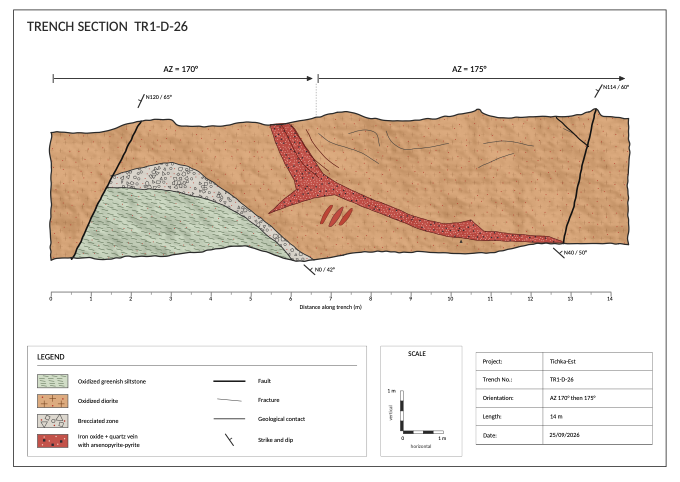
Figure 3. Geological section of trench TR1-D-26 — azimuth 170°–175°, length 14 m.
Click Image To View Full Size
Figure 4. Semi-massive arsenopyrite in quartz vein, trench TR1-D-26.
Next Steps
Assay results, together with the completed structural mapping, will assist Stellar to finalize collar positions and orientations for the five drill holes provisionally allocated to the new target area within the fully funded 24-hole, ~5,000-metre Phase II program. Subject to the assay results, and access and weather conditions, drilling of this target may commence in Q4 2026, following the initial holes at Zone B. The target area will also be covered by the planned high-resolution magnetic survey, further refining structural interpretation ahead of drilling.
Phase II Program Status
Initial preparation for final mobilization of CMFM's drilling equipment is complete, and final mobilization and transportation to site of the drill rigs and crews are pending receipt of administrative authorization. Drilling is now expected to commence later in October 2026, subject to receipt of the authorization and completion of mobilization. The Company will announce the commencement of drilling.
For the PROGREM drone magnetic survey (~144 line-kilometres over Zones A, B and C), the detailed flight program and supporting documentation were submitted for drone flight authorization on September 28, 2026 and approved on October 1, 2026. Mobilization is scheduled for October 20, 2026. Drill platforms and access are in place, and the program remains fully funded.
Management Commentary
" Completing the trenching program on a brand-new target inside two weeks, with samples already at the laboratory, exemplifies the operating tempo we intend to maintain through the fall’ said Stellar President and CEO J. François Lalonde. “With the drill rig and crew on standby waiting on final permitting, and the magnetic survey scheduled, Tichka Est is entering the most active - and most results rich - period in its history. Exploration results will be released as quickly as is practicable. "
About the Tichka Est Gold Project
The Tichka Est Gold Project comprises five research permits and one exploitation licence covering 82 km² in the High Atlas region of Morocco, approximately 90 km south of Marrakech. Under an earn-in agreement with Morocco's Office National des Hydrocarbures et des Mines (ONHYM), Stellar can earn an 85% interest in the project by incurring US$2.39 million in exploration expenditures over three years. Gold mineralization is currently recognized in three zones: Zone A, Zone B representing the most advanced area following recent drilling, and Zone C. A newly identified Zone D is pending receipt of trenching assay results to confirm the presence of gold mineralization. Much of the overall 82 km² project area remains unexplored or only superficially explored.
Mineralization at Tichka Est is at an early exploration stage. Insufficient exploration has been undertaken to define a mineral resource, and it is uncertain whether further exploration will result in the delineation of a mineral resource. Rock (grab) samples previously reported from this area are selective in nature and may not be representative of overall mineralization. Trench intervals, once reported, will be measured along the trench floor and are not true widths.
About Stellar AfricaGold Inc.
Stellar AfricaGold Inc. is a Canadian precious metals exploration company focused on North and West Africa, with active exploration programs in Morocco and Côte d'Ivoire. The Company's principal projects are the Tichka Est Gold Project in Morocco, where Stellar is advancing a gold discovery with a fully-funded 5,000 meters diamond drilling program scheduled for the fall and winter of 2026, and the Zuénoula Gold Project in Côte d'Ivoire, operated under an earn-in and joint venture agreement with MetalsGrove Mining Limited with a fully funded 10,000 meters auger drilling program is underway. Stellar trades on the TSX Venture Exchange (TSXV: SPX), the Tradegate Exchange (TGAT: 6YP) and the Frankfurt Stock Exchange (FSX: 6YP). The Company maintains its head office in Vancouver, BC, and its in-country office in Marrakech, Morocco.
Qualified Person — The technical content of this press release has been reviewed and approved by M. Yassine Belkabir, MScDIC, CEng, MIMMM, a Stellar director and a Qualified Person as defined in National Instrument 43-101.
Stellar’s President and CEO J. François Lalonde can be contacted at +1 514-9940654 or by email at lalondejf@stellarafricagold.com . Additional information is available on the Company’s website at www.stellarafricagold.com .
On Behalf of the Board
J. François Lalonde
President & CEO
Forward-Looking Statements — This news release contains “forward-looking statements” within the meaning of applicable Canadian securities laws, including statements regarding the timing and reporting of assay results, the finalization of drill plans, the timing and receipt of administrative authorizations, the timing of contractor mobilization, the commencement of drilling, and the conduct and timing of geophysical surveys. Forward-looking statements are based on current expectations and are subject to known and unknown risks and uncertainties, including laboratory turnaround, contractor scheduling, administrative processes, weather and access conditions, and results of exploration, as well as the risk factors set out in the Company's most recent Management's Discussion and Analysis available on SEDAR+ at www.sedarplus.ca.
Forward-looking statements are not guarantees of future performance and should not be unduly relied upon. Except as required by law, the Company undertakes no obligation to update or revise any forward-looking statements contained herein.
Neither the TSX Venture Exchange nor its Regulation Services Provider (as that term is defined in the policies of the TSX Venture Exchange) accepts responsibility for the adequacy or accuracy of this release.

Copyright (c) 2026 TheNewswire - All rights reserved.
© 2026 Canjex Publishing Ltd. All rights reserved.