- Snowline set to be included in S&P/TSX Composite Index and FTSE Canada All Cap Index on upcoming September rebalances
- Pre-Feasibility Study (“PFS”) on track for delivery by Q1 2027, with engineering field studies largely complete
- Project description submission to initiate mine permitting planned concurrently with PFS, based on comprehensive environmental and geoscience baseline
- Step out drilling at Valley intersects broad zones of gold mineralization hundreds of metres beyond and below current mineral resource boundaries
- Exploration drilling advancing on regional targets with assays pending.
VANCOUVER, British Columbia, Sept. 09, 2026 (GLOBE NEWSWIRE) -- SNOWLINE GOLD CORP. (TSX: SGD) (US OTCQB: SNWGF) (the “Company” or “Snowline”) announces its inclusion into the S&P/TSX Composite Index, Canada’s premier equity benchmark index which includes the largest and most actively traded companies on the Toronto Stock Exchange (visit: S&P/TSX Composite Index | S&P Dow Jones Indices) as well as the FTSE Canada All Cap Index. Both index rebalances will take effect after market close on Friday, September 18.
“Our inclusion into multiple equity indices reflects the momentum underway at Snowline and the significance of our flagship asset, Valley, positioning Snowline alongside the largest and most established companies in Canada,” said Scott Berdahl, CEO & Director of Snowline. “We expect these inclusions to enhance our visibility amongst a broader investor base, particularly amidst the backdrop of increased generalist attention on gold and the wider natural resource space.”
In addition, the Company is pleased to provide updates on its field activities from the ongoing 2026 field season, which represents Snowline’s largest field campaign to date. Comprehensive engineering, environmental baseline and exploration programs are currently underway.
“This has been an incredibly productive year for Snowline to date,” said Berdahl. “Our primary focus is on the progression of the Valley gold deposit on our Rogue Project. We have made significant progress towards a PFS, based on rigorous engineering fieldwork and lab work to inform key trade-offs in mine design. Complementing this work are extensive, multi-faceted environmental baseline studies, providing a clear picture to inform upcoming project permitting.”
“Value creation through exploration remains a core part of our strategy. The discovery of Valley serves as a strong proof-of-concept for the prospectivity of the surrounding geological district. We are intrigued by the scale of the mineralized system that continues to unfold at Valley, with gold mineralization encountered across a wide footprint well beyond the mineral resource boundaries in current drilling on the target. In addition, we eagerly await assay results for exploration drill programs underway on the Gracie and Duke targets on our Rogue Project, as well as the first ever drill program on our Cynthia Project’s newly discovered Crossroad target.”
ENGINEERING UPDATE
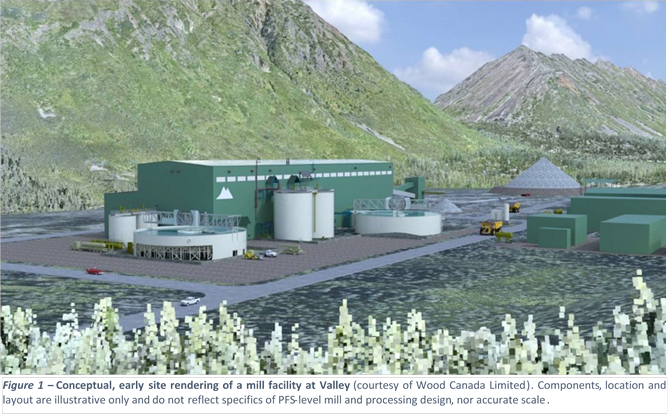
Rogue PFS: Snowline’s PFS for the Valley gold deposit on the Rogue Project remains on track for delivery by Q1 2027, supported by an extensive 2026 field investigation program that is nearing completion. The PFS will represent a key milestone for the Company, with a refined mine plan reflecting integrated trade-off considerations around various design components. The associated rigour in site investigation and cost estimation are expected to allow the Company to establish initial Proven and Probable Reserves for the Valley gold deposit, based on an updated Mineral Resource Estimate for Valley and associated mine plan.
Key trade-offs being explored for the PFS include:
- Throughput: Increasing mill capacity from the 25 ktpd rate contemplated in the Preliminary Economic Assessment (“PEA”) may have positive effects on gold output and overall project economics, considered against associated increases in pre-production capital expenditures and other factors.
- Power: Liquified natural gas is being explored as a primary fuel versus diesel generators used in the PEA, based on a detailed power and load model for the project site. With power as the largest driver of operating costs1, gains in efficiency can have meaningful impact on project economics. Studies to assess potential contributions from solar, hydro and wind energy sources have also been advanced.
- Tailings and waste rock layout: The PEA envisioned a tailings storage facility (“TSF”) served by an 18 km tailings pipeline. For the PFS, trade-offs are considered for this site against additional locations, including sites closer to the mine site with potential for co-disposal of waste rock and tailings.
- Flowsheet optimization: Multiple mill-based processing methods are considered, complemented by optimization of grind size versus gold recovery and site layout providing efficiency and optionality moving forward.
- Water management: Water management, site water balance and the discharge and treatment strategy advancing to support permitting.
The PFS will establish the design basis and project description that are expected to carry directly into a feasibility study and project permitting, allowing the two to advance in parallel.
ENVIRONMENT & PERMITTING UPDATE
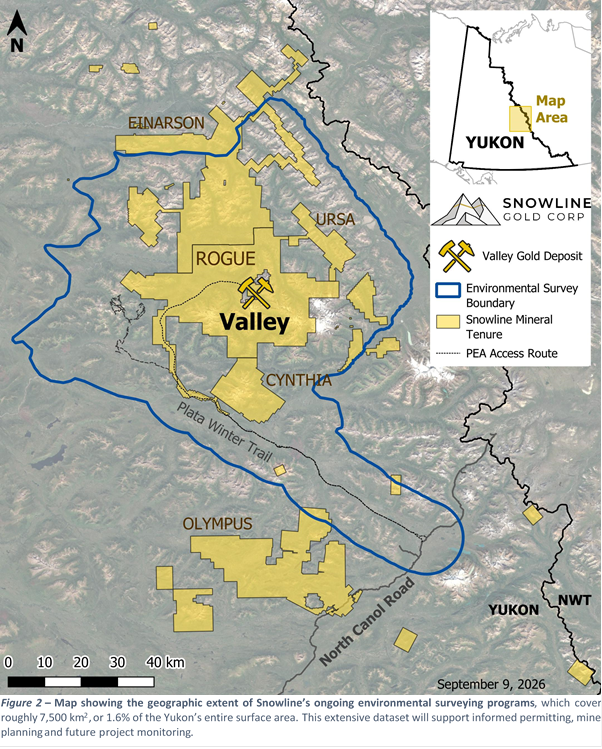
Environment: Snowline’s 2026 environmental baseline program is underway and on schedule, marking nearly one full year of significant expansion on work initiated in 2022. Field programs include hydrology, hydrogeology, water quality, meteorology, geochemistry, fish and aquatic habitat, terrestrial environment including wildlife and vegetation, heritage resources and air quality. The geographic extent of environmental surveys is shown in Figure 2.
Environmental baseline data will be integrated into PFS engineering design and trade-off studies to ensure the project design meets rigorous environmental standards and permitting requirements.
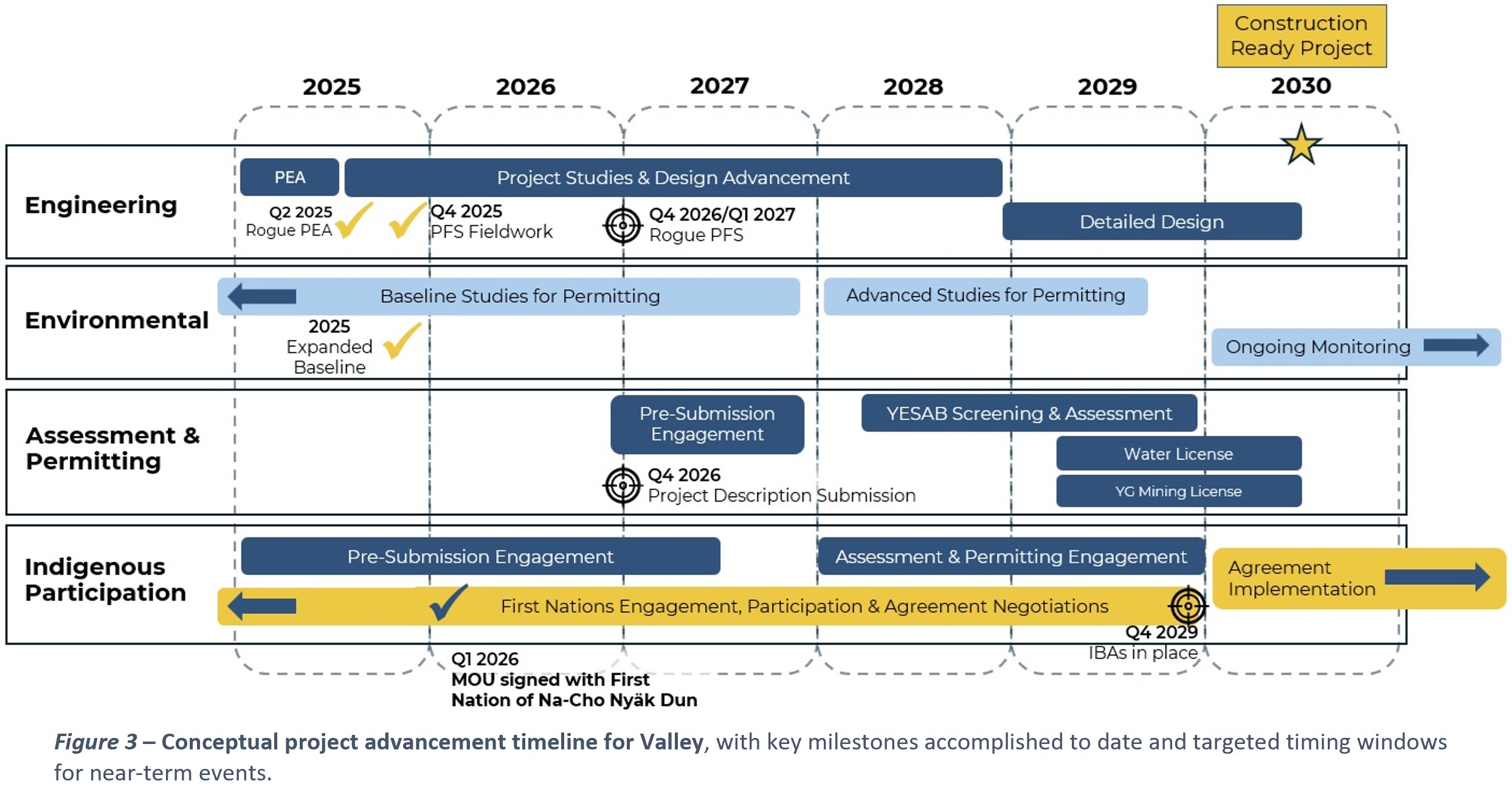
Permitting: The Company is targeting submission of a Project Description to the Yukon Environmental and Socio-economic Assessment Board (“YESAB”) in conjunction with its PFS, to initiate the Pre-Submission Engagement (“PSE”) for the Rogue Project. YESAB's PSE process is a newly introduced (2022), early, structured engagement process for major Yukon projects that aims to identify issues, clarify information requirements, and align proponents, First Nations, regulators, and communities before a formal environmental and socio-economic assessment is submitted to YESAB, improving the quality, efficiency and predictability of the subsequent YESAB review. Following PSE, Snowline intends to submit the Project Proposal to YESAB that will initiate the Screening & Assessment process in early 2028. Figure 3 illustrates the permitting process in alignment with completion of the PFS, advancement of environmental studies and ongoing engagement with First Nations.
EXPLORATION UPDATE
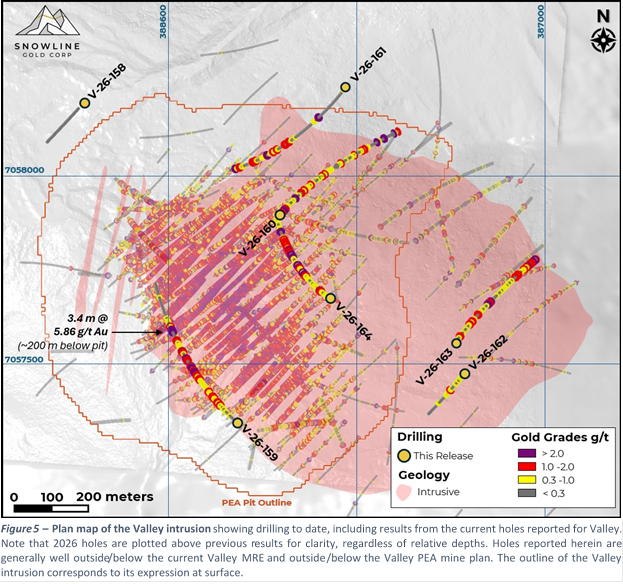
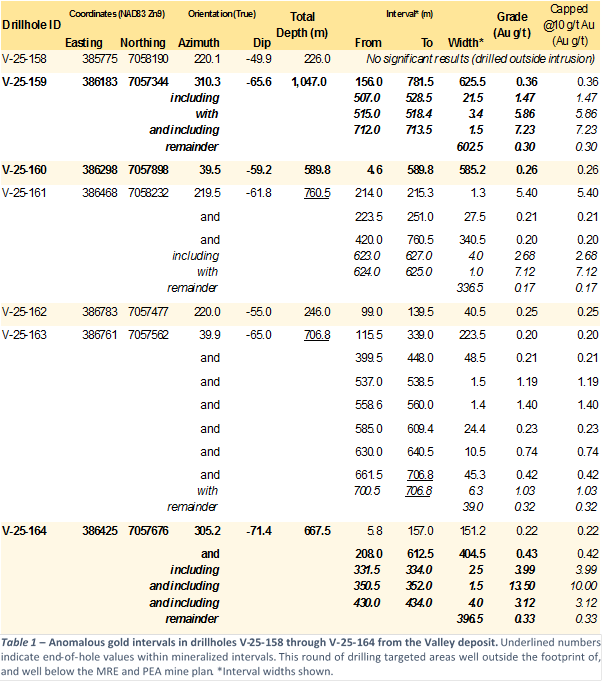
Valley: Roughly 4,200 m of exploration drilling has been completed to date on Valley in 2026, in addition to approximately 2,300 m focused on geotechnical definition, infrastructure design, condemnation, and potential borrow source delineation. Recent exploration drilling at Valley focuses on untested areas within and around the Valley intrusion, including at depth and distal to the current Mineral Resource Estimate (“MRE”). Brief notes on reported drill holes follow, with locations shown on Figure 5 and results summarized in Table 1.
V-26-158 Drilled outside of the intrusion and outside of PEA pit, as a 300 m step-out from previous drilling along a northwest trending structural corridor.
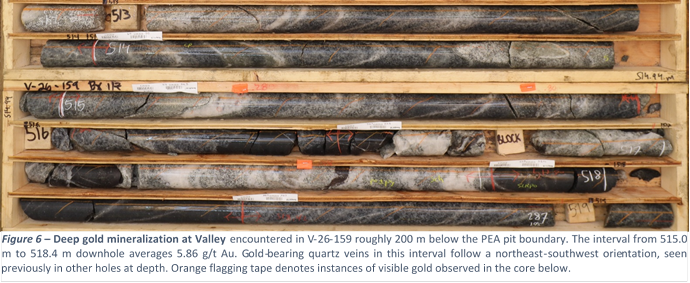
V-26-159 Deepest hole to date at Valley, ending at 1,047 m downhole (~900 m vertical depth), drilled along western margin of the intrusion, west of and below the central high-grade zone of the deposit. The hole intersected 3.4 m averaging 5.86 g/t Au from 515.0 m downhole, more than 200 m below the PEA pit shell, associated with a zone of northeast trending quartz veins. This interval sits within a 625.5 m run of core almost entirely below the PEA pit shell averaging 0.36 g/t Au, including intermittent barren zones.
V-26-160 Long intersection of low grade outside of pit, with isolated >1g/t Au occurrences at depth. Did not intersect northeastern wall of the intrusion and ended in weakly mineralized granodiorite.
V-26-161 Drilled from northeast, entirely outside of PEA pit. Intersected a broad zone of low grade at depth, with isolated occurrences of >1 g/t Au, including 2.68 g/t Au over 4.0 m from 624 m downhole, roughly 300 m below the PEA pit shell.
V-26-162 A short (246 m) hole drilled in an untested area in the southeastern part of the Valley intrusion, intersecting low grades.
V-26-163 Deepest hole to date along the northeast margin of the intrusion; extends known low grade mineralization to depth. The strongest gold mineralization was encountered at the bottom of the hole, which ended in mineralization within the intrusion (6.3 m averaging 1.03 g/t Au).
V-26-164 Long run of low to moderate grades at depth, returned 450.5 m averaging 0.4 g/t Au outside of the pit shell boundary with localized high grades (Table 1).
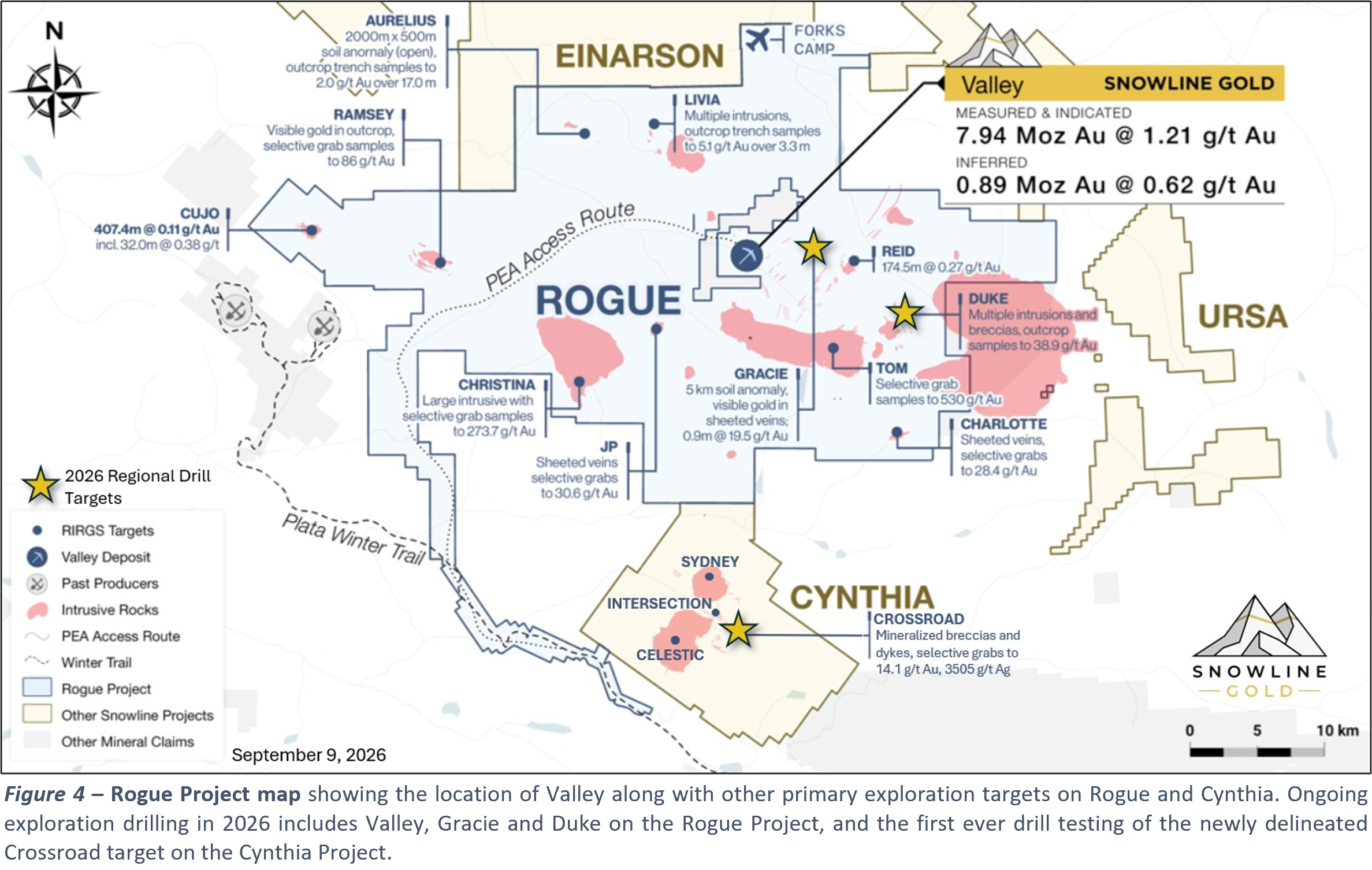
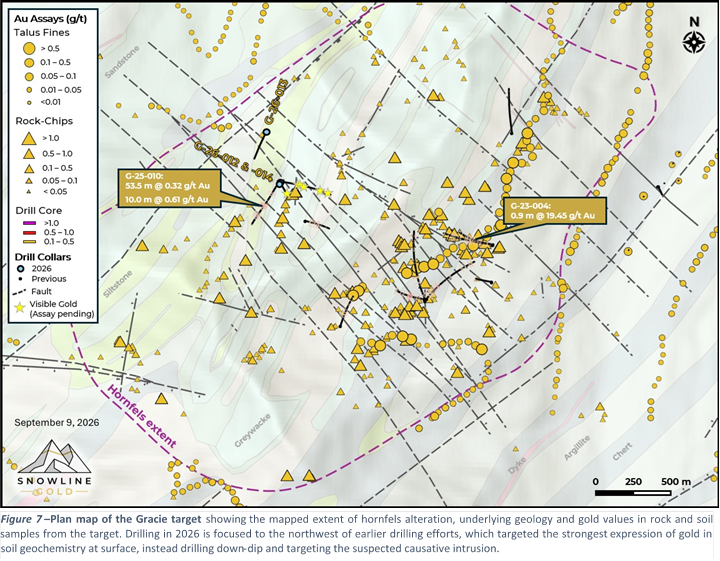
Gracie: Gracie is a reduced-intrusion related gold system (“RIRGS”) target on the Rogue Project located roughly 4 km east of Valley (Figure 4). Unlike Valley (also a RIRGS), where the mineralized intrusion is exposed at surface, the causative intrusion at Gracie does not daylight. The scale of alteration and anomalous gold geochemistry, the potential to host a completely intact RIRGS, and the proximity to Valley make Gracie an attractive exploration target.
Snowline has drilled roughly 2,300 m to date at Gracie in 2026 across three holes, with drilling ongoing. The 2026 drill program at Gracie targets a down-dip search space, northwest of the anomalous surface geochemistry targeted in earlier drilling by the Company, following up on promising results in a single 2025 drill hole in this area (Figure 7). Assays for 2026 drilling at Gracie are pending.
Duke: Duke is an RIRGS target on the Rogue Project roughly 11 km southeast of Valley (Figure 4). The system is centered on a 1.4 x 1.3 km multi-phase intrusive complex with multiple breccia centers. Preliminary drilling of a minor breccia in DUK-25-0032 returned 8.0 m averaging 1.72 g/t Au, including 4.0 m at 2.73 g/t Au2.
Snowline has drilled roughly 1,600 m at Duke in 2026 across five holes. This season’s drilling targets breccia units identified by mapping and prospecting in 2025, as well as by geophysics. Assays for 2026 drilling at Duke are pending.
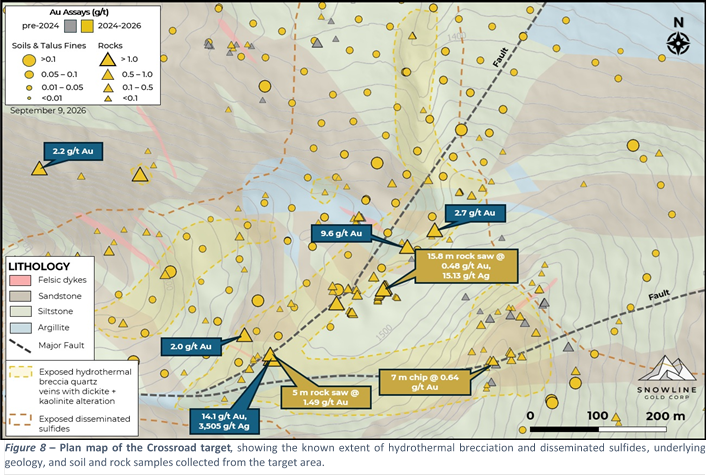
Crossroad: Late 2025 prospecting identified a new gold target, Crossroad, roughly 27 km south of Valley on the Cynthia Project, hosting mineralization in granitic dikes, hydrothermal breccias, and altered sedimentary rocks. Crossroad is situated along the same five-kilometer structural trend as the Company’s Intersection target. Selective grab samples from Crossroad returned up to 14.1 g/t Au and 3,505 g/t Ag3.
Follow-up surface sampling in 2026 has yielded encouraging results, including a continuous rock-saw channel sample yielding 1.5 g/t Au over 5.0 m. Soil and talus fine sampling shows elevated to anomalous gold values across a zone of roughly 900 x 200 m. An initial drill program at Crossroad is underway, with 435 m drilling across two holes drilled to date, and drilling ongoing. All assays for this drilling are pending.
QA/QC
On receipt from the drill site NQ2-sized (50.6 mm diameter) drill core was systematically logged for geological attributes, photographed and sampled at Snowline’s Forks camp. Sample lengths as small as 0.5 m were used to isolate features of interest, but most samples within moderate to strong mineralization were 1.0 m in length; otherwise, a default 1.5 m downhole sample length was used. Core was cut in half lengthwise along a pre-determined line, with one half (same half, consistently, dictated by orientation line where present or by dominant vein orientation where absent) collected for analysis and one half stored as a record. Field duplicates were collected at regular intervals as ¼ core samples by splitting the ½ core sent for sampling, leaving a consistent record of half core material from duplicate and non-duplicate samples alike. Standard reference materials and blanks were inserted by Snowline personnel at regular intervals into the sample stream. Bagged samples were sealed with security tags to ensure integrity during transport. They were delivered by expeditor to Bureau Veritas’ preparatory facility in Whitehorse, Yukon. Sample preparation was completed in Whitehorse, with analyses completed in Vancouver.
Bureau Veritas (“BV”) is accredited to ISO/IEC 17025 and ISO9001 for quality management and is independent of Snowline. Samples were crushed by BV to >85% passing below 2 mm and split using a riffle splitter. 250 g splits were pulverized to >85% passing below 75 microns. A four-acid digest with an inductively coupled plasma mass spectroscopy (ICP-MS) finish was used for 59-element analysis on 0.25 g sample pulps (BV code: MA250). All samples were analysed for gold content by fire assay with an atomic absorption spectroscopy (AAS) finish on 30 g samples (BV code: FA430). Any sample returning >10 g/t Au was reanalysed by fire assay with a gravimetric finish on a 30 g sample (BV code: FA530).
ABOUT SNOWLINE GOLD CORP.
Snowline Gold Corp. is a Yukon Territory gold exploration and development company focused on advancing its 100% owned Valley gold deposit on its flagship Rogue Project, while unlocking district upside on its 360,000 ha (3,600 km2) mineral tenure in the highly prospective yet underexplored Selwyn Basin.
Valley is a large, low strip, near surface, >1 g/t Au bulk tonnage gold system hosting an open MRE of 7.94 million ounces gold at 1.21 g/t Au Measured & Indicated (in 204.0 million tonnes)4 and an additional 0.89 million ounces gold Inferred at 0.62 g/t Au (in 44.5 million tonnes)5, with a cut-off grade of 0.3 g/t Au. Results of a PEA for Valley suggest the potential to support a long-life mining operation with a strong production profile and low production costs. The MRE and PEA are detailed in the recent technical report for Rogue, prepared in accordance with NI 43-101 (as defined below) standards, entitled “Independent Preliminary Economic Assessment for the Rogue Project Yukon, Canada,” dated August 27, 2025, with an effective date of March 1, 2025, and available on SEDAR+ and the Company’s website (the “Technical Report”). The PEA is preliminary in nature and includes Inferred Mineral Resources that are considered too speculative geologically to have economic considerations applied to them that would enable classification as Mineral Reserves. There is no certainty that the results of the PEA will be realized. Work is underway on a PFS to supersede the Valley PEA on completion, anticipated during or before Q1 2027.
Snowline’s project portfolio sits within the prolific Tintina Gold Province, host to multiple million-ounce-plus gold mines and deposits across the central Yukon and Alaska. The Company’s comprehensive first-mover position and extensive exploration database provide a distinct competitive advantage and a unique opportunity for investors to be part of multiple discoveries, the advancement of a significant gold deposit, and the creation of a new gold district.
QUALIFIED PERSON
Information in this release has been prepared under the supervision of and reviewed and approved by Thomas Branson, M.Sc., P. Geo., VP Exploration for Snowline, and Victor Vdovin, MBA, P.Eng., VP Engineering for Snowline, each a Qualified Person for the purposes of National Instrument 43-101– Standards of Disclosure for Mineral Projects (“NI 43-101”).
All terms not otherwise defined have the meaning given to them under the CIM Definition Standards for mineral resources and reserves.
ON BEHALF OF THE BOARD
Scott Berdahl
CEO & Director
For further information, please contact:
Snowline Gold Corp.
+1 778 650 5485
info@snowlinegold.com
CAUTIONARY NOTE REGARDING FORWARD-LOOKING STATEMENTS
This news release contains certain forward-looking statements, including statements about the Company’s expected timing and inclusion into multiple equity indices – namely the S&P/TSX Composite Index and FTSE Canada All Cap Index, the 2026 field program (drilling and exploration plans, engineering plans, environmental baseline programs, continued local and First Nation collaboration and initiation of the PSE with YESAB), upcoming milestones (including advanced permitting activities, completion of drilling programs, including at Gracie, Duke and Crossroad, and the completion and timing of the PFS), the life of mine at Valley, the establishment through exploration of multiple mineralized centres, and the creation of a new gold district. Wherever possible, words such as “may”, “will”, “should”, “could”, “expect”, “plan”, “intend”, “anticipate”, “believe”, “estimate”, “target”, “predict” or “potential” or the negative or other variations of these words, or similar words or phrases, have been used to identify these forward-looking statements. These statements reflect management’s current beliefs and are based on information currently available to management as at the date hereof.
Forward-looking statements involve significant risk, uncertainties and assumptions. Many factors could cause actual results, performance or achievements to differ materially from the results discussed or implied in the forward-looking statements. Such factors include, among other things: assumptions that inclusion in equity indices will enhance the Company’s visibility amongst a broader investor base; risks related to uncertainties inherent in drill results and the estimation of mineral resources, including assay results from the 2026 drill programs at Gracie, Duke and Crossroad; risks that the results of the PEA will not be realized; risks related to the timing and completion of comprehensive engineering, environmental baseline and exploration programs currently underway; risks related to the timing and completion of the PFS; risks relating to the timing and submission of a Project Description to the YESAB in conjunction with the PFS; risks related to the successful initiation of the PSE for the Rogue Project; and risks associated with executing the Company’s plans and intentions. These factors should be considered carefully, and readers should not place undue reliance on the forward-looking statements. Although the forward-looking statements contained in this news release are based upon what management believes to be reasonable assumptions, the Company cannot assure readers that actual results will be consistent with these forward-looking statements. These forward-looking statements are made as of the date of this news release, and the Company assumes no obligation to update or revise them to reflect new events or circumstances, except as required by law.
__________________________
1 As per the Technical Report (as defined below) available on the Company’s profile on SEDAR+ at www.sedarplus.ca and the Company’s website.
2 See news release dated November 24, 2025, available on the Company’s website www.snowlinegold.com and under the Company’s profile on SEDAR+ at www.sedarplus.ca.
3 See news release dated February 11, 2026, available on the Company’s website www.snowlinegold.com and under the Company’s profile on SEDAR+ at www.sedarplus.ca.
4 Comprising 3.15 million ounces at 1.41 g/t Au in Measured and 4.79 million ounces at 1.11 g/t Au in Indicated.
5 Mineral resources are not mineral reserves and do not have demonstrated economic viability. The estimate of mineral resources may be materially affected by metal prices, economic factors, environmental, permitting, legal, title, or other relevant issues.
Figures accompanying this announcement are available at:
https://www.globenewswire.com/NewsRoom/AttachmentNg/d536bb38-ee33-4bb6-9bc5-4ac2a7849815
https://www.globenewswire.com/NewsRoom/AttachmentNg/2addc0cc-f0f2-4edb-88b4-c4dd96864bd8
https://www.globenewswire.com/NewsRoom/AttachmentNg/f2aec5ce-8d45-4531-af6e-6c06040f60a7
https://www.globenewswire.com/NewsRoom/AttachmentNg/aebe174f-b972-4b6b-93b7-bc5623f37a13
https://www.globenewswire.com/NewsRoom/AttachmentNg/17a1b580-7956-4ecd-ae16-f44322598949
https://www.globenewswire.com/NewsRoom/AttachmentNg/67c5db1b-5c5e-4d15-9f89-e417c861eb84
https://www.globenewswire.com/NewsRoom/AttachmentNg/ca996d52-78d2-4687-98a0-1045e2c362ff
https://www.globenewswire.com/NewsRoom/AttachmentNg/deed4a4c-8d74-4bd0-a70e-408788dc6e9c
A Table accompanying this announcement is available at: https://www.globenewswire.com/NewsRoom/AttachmentNg/3b9e185d-9c92-42ff-82b3-fe28fae6652f


Figure 1
Conceptual, early site rendering of a mill facility at Valley (courtesy of Wood Canada Limited). Components, location and layout are illustrative only and do not reflect specifics of PFS-level mill and processing design, nor accurate scale.
Figure 2
Map showing the geographic extent of Snowline’s ongoing environmental surveying programs, which cover roughly 7,500 km2, or 1.6% of the Yukon’s entire surface area. This extensive dataset will support informed permitting, mine planning and future project monitoring.
Figure 3
Conceptual project advancement timeline for Valley, with key milestones accomplished to date and targeted timing windows for near-term events.
Figure 4
Rogue Project map showing the location of Valley along with other primary exploration targets on Rogue and Cynthia. Ongoing exploration drilling in 2026 includes Valley, Gracie and Duke on the Rogue Project, and the first ever drill testing of the newly delineated Crossroad target on the Cynthia Project.
Figure 5
Plan map of the Valley intrusion showing drilling to date, including results from the current holes reported for Valley. Note that 2026 holes are plotted above previous results for clarity, regardless of relative depths. Holes reported herein are generally well outside/below the current Valley MRE and outside/below the Valley PEA mine plan. The outline of the Valley intrusion corresponds to its expression at surface.
Figure 6
Deep gold mineralization at Valley encountered in V-26-159 roughly 200 m below the PEA pit boundary. The interval from 515.0 m to 518.4 m downhole averages 5.86 g/t Au. Gold-bearing quartz veins in this interval follow a northeast-southwest orientation, seen previously in other holes at depth. Orange flagging tape denotes instances of visible gold observed in the core below.
Figure 7
Plan map of the Gracie target showing the mapped extent of hornfels alteration, underlying geology and gold values in rock and soil samples from the target. Drilling in 2026 is focused to the northwest of earlier drilling efforts, which targeted the strongest expression of gold in soil geochemistry at surface, instead drilling down-dip and targeting the suspected causative intrusion.
Figure 8
Plan map of the Crossroad target, showing the known extent of hydrothermal brecciation and disseminated sulfides, underlying geology, and soil and rock samples collected from the target area.
Table 1
Anomalous gold intervals in drillholes V-25-158 through V-25-164 from the Valley deposit. Underlined numbers indicate end-of-hole values within mineralized intervals. This round of drilling targeted areas well outside the footprint of, and well below the MRE and PEA mine plan. *Interval widths shown.
© 2026 Canjex Publishing Ltd. All rights reserved.