TORONTO, ON / ACCESS Newswire / June 17, 2026 / Sterling Metals Corp. (TSXV:SAG)(OTCQB:SAGGF) ("Sterling" or the "Company") is pleased to report assay results from the first six holes of it 2026 drilling program at the Soo Copper Project ("Soo Copper" or the "Project") located near Batchewana Bay, Ontario. These results continue to demonstrate the scale and continuity of the Soo Copper system at the MEPS Discovery ("MEPS"), expanding the footprint of copper mineralization, confirming a copper bearing, multi-phase porphyry stock across a 1.4-kilometre corridor (Figure 1), and identifying a new higher grade molybdenum zone at depth.
Highlights
Broad intervals of near surface mineralization returned:
503.9m of 0.26% CuEq (0.14% Cu, 0.05 g/t Au, 0.64 g/t Ag, 177.4 ppm Mo) from 3.1m depth in SC-26-04;
289.5m of 0.26% CuEq (0.2% Cu, 0.03 g/t Au, 0.97 g/t Ag, 50.9 ppm Mo) from 3.5m depth in SC-26-05; and
214.5m of 0.29% CuEq (0.22% Cu, 0.02 g/t Au, 0.94 g/t Ag, 75.3 ppm Mo) from 3.0m depth in SC-26-06, including 10.5m of 1.01% CuEq (0.41% Cu, 0.07 g/t Au, 2.67 g/t Ag, 1003.8 ppm Mo) from 207.0m depth.
Extensive copper-molybdenum mineralization highlights the robust mineralization system associated with the underlying porphyry complex.
The presence of a multi-phase porphyry stock was intersected in two separate locations - beneath MEPS (SC-26-04 and SC-26-05) and approximately 1km east of MEPS (SC-26-01 and SC-26-02) - supporting Sterling's interpretation of a robust copper system.
The Company has drilled over 12,000m across 22 holes in 2026.
Watch Mathew Wilson, CEO walk through cross sections and an interactive 3D visualization of today's highlighted drill holes on VRIFY, while discussing the broader potential of the Soo Copper Project and Sterling Metals by clicking here.
Mat Wilson, CEO, commented, "With the launch of VRIFY, investors and stakeholders can follow along with us as we plug assay results into our model, as we look to define extensions and edges at MEPS, and new areas of mineralization. It is rare to come across such a giant copper system with so little drilling and part of the fun - once you have a discovery to grasp onto - is testing new areas while also expanding on the known. With 12km of drilling completed across 22 holes we are just getting started as we expand MEPS and find new zones to dig into across our 8km corridor of outcrop within the 30km copper system."
Jeremy Niemi, SVP Exploration, commented, "In these first six holes, we have intersected a mineralized multiphase porphyry stock below two separate and significant copper prospects, beneath MEPS and approximately one kilometre to the east. This confirms to us that the copper mineral system is very large with the potential of clustered centres of more concentrated copper mineralization at shallow depths, allowing for a rapid succession of more new copper discoveries and future copper resources. At MEPS, the broad continuous copper intervals and high-grade molybdenum-copper beneath are but two parts of what is clearly revealing itself to being a very large porphyry copper-molybdenum system. This comes to surface, is remarkably well-preserved, and will continue to rapidly grow with more exploratory drilling. Follow-up holes are already drilled and we look forward to what the future has in store."
Figure 1. Plan map of 2026 drilling and reported results on holes.
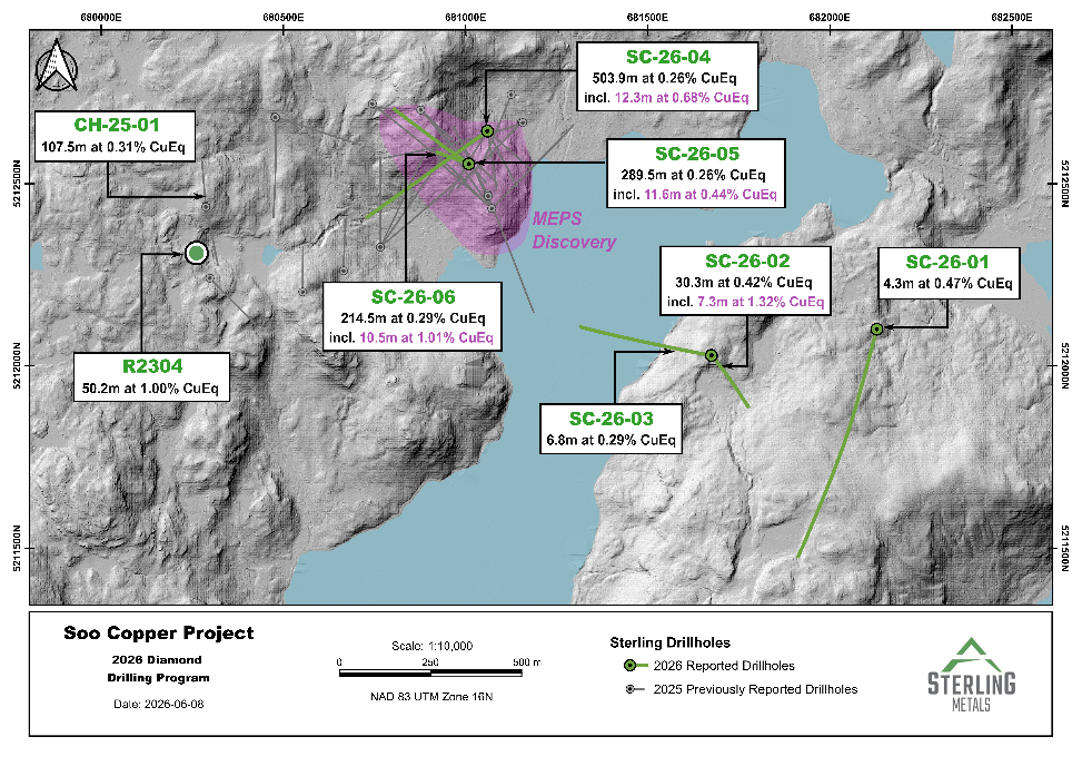
Figure 2. High-grade molybdenite core photo from hole SC-26-04 at 360.3m depth grading 1.7% Mo over 1m length
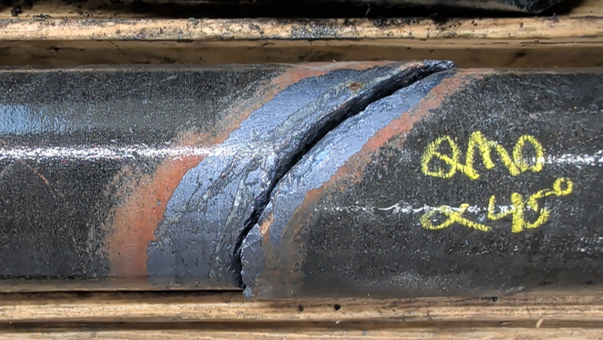
Figure 3. Copper mineralization above GFP dyke in SC-26-05 at 140.7m depth grading 1.79% CuEq
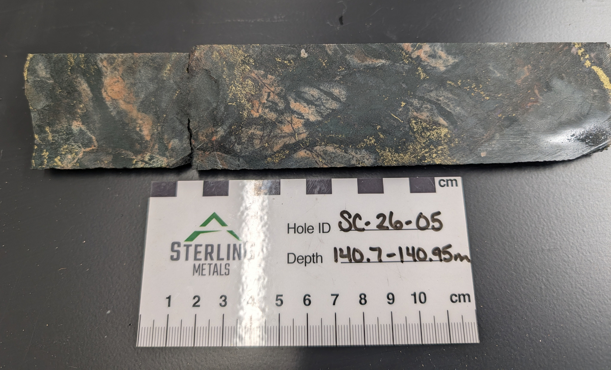
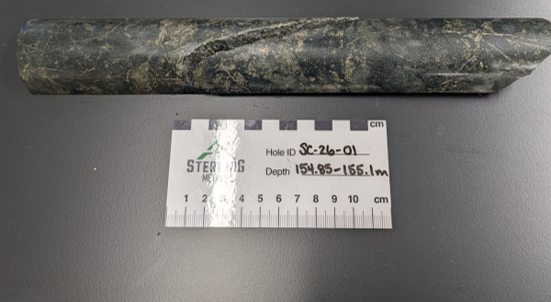
Figure 4. High-grade copper mineralization grading 2.07% CuEq in hole SC-26-01 at 154.85m depth, located approximately 1km east of the main MEPS discovery
SC-26-01 - Eastern ZTEM Target; Discovery of New Cu-Mo mineralized Porphyry Stock
SC-26-01 was designed to test the large ZTEM resistivity anomaly located approximately one kilometre east of the MEPS Discovery zone. Drilled toward the south-southwest, the hole intersected altered mafic volcanics before entering a felsic porphyry stock complex dominated by coarse-grained granite porphyry, at approximately 637m depth. The upper mafic volcanics host copper mineralization, including distinct higher-grade intervals of semi-massive chalcopyrite and pyrrhotite between approximately 154m and 207m. At depth, the granite porphyry hosts widespread copper-molybdenum mineralization as quartz-molybdenite and quartz-biotite-chalcopyrite stockwork veining associated with pervasive potassic (biotite and feldspar) alteration, with copper sulphides also occurring as pervasive finely disseminated chalcopyrite and lesser bornite within the groundmass. Assays confirm widespread copper-molybdenum mineralization throughout the intrusive section; the porphyry complex remains open at depth beyond one kilometre and along strike to north, east and south.
SC-26-02 - Western Flank Test of Eastern ZTEM Anomaly and Porphyry Stock
SC-26-02 tested the western flank of the eastern ZTEM anomaly to evaluate whether copper grades increase approaching the main intrusive contact. The hole remained within chlorite-magnetite altered mafic volcanics to approximately 634m hole depth before entering the stock, again dominated by granite porphyry. The upper volcanic package hosts pervasive copper mineralization as disseminated chalcopyrite within the groundmass, within local zones of magnetite alteration, and within quartz-sulphide veins. At the main contact with the porphyry stock, mineralization changes to stockwork veining dominated by early biotite and quartz-molybdenite veins with minor disseminated chalcopyrite and trace bornite throughout.
SC-26-03 - ZTEM Continuity / Western Linkage Test
SC-26-03 was drilled to the west to test the continuity of the eastern ZTEM anomaly and to evaluate a possible structural linkage toward the western anomaly. The hole remained entirely within largely chlorite-epidote altered mafic volcanics, intersecting only a narrow GFP-type felsic porphyry dyke between approximately 145m and 152m hole depth. Volcanic-hosted mineralization consists of minor but pervasive pyrite-chalcopyrite with trace bornite that locally intensifies along hydrothermal fracture networks. This strong, pyrite-dominated mineralization with widespread, anomalous copper-molybdenum contents is interpreted to represent a pyritic propylitic shell located outboard of inner copper zone mineralization.
SC-26-04 - MEPS West Extension and ZTEM Target
SC-26-04 tested the western ZTEM anomaly and found that its upper margin coincides with the contact zone of a multi-phase felsic porphyry stock complex. The hole intercepted a cluster of three distinct intermineral porphyry dyke phases before entering a granite porphyry stock at approximately 631m hole depth. The shallower porphyry dyke phases host veins, hydrothermal brecciation and increased presence of chalcopyrite-molybdenite, with local minor presence of bornite-covellite. At approximately 444m hole depth, the hole intercepted a 50m length of hydrothermal quartz-sulphide breccia dominated by molybdenite-chalcopyrite, helping define a high-priority, structural corridor of copper-molybdenum mineralization interpreted to link Cu-Mo mineralization intercepted in holes MJ-25-02 and MEPS-25-02 drilled in 2025. The deeper granite porphyry stock is altered and hosts extensive, minor quartz-molybdenite and quartz-biotite-chalcopyrite stockwork veining.
SC-26-05 - MEPS West Extension and ZTEM Target
SC-26-05 also tested the ZTEM anomaly west of MEPS, adjacent to SC-26-04 and intersected a broadly mineralized mafic volcanic succession hosting generally minor but widespread chalcopyrite, bornite and covellite mineralization. The hole entered the contact zone of the granite porphyry stock complex at approximately 609m hole depth, where it intersected a well-developed hydrothermal quartz-sulphide breccia, containing chalcopyrite and molybdenite, along the upper contact boundary. Below this breccia the granite porphyry hosts pervasive but minor quartz-molybdenite and quartz-biotite-chalcopyrite stockwork veining with potassic alteration.
SC-26-06 - MEPS Near-Surface Extension
SC-26-06 tested the extension of near-surface mineralization at a steeper angle to SC-26-05. The hole remained entirely within mineralized mafic volcanics, intersecting a GFP porphyry dyke between approximately 110m and 124m. Elevated copper grades are associated with increased chalcopyrite-bornite-covellite mineralization developed in the mafic volcanics immediately adjacent to this GFP dyke. Volcanic-hosted mineralization consists of chalcopyrite-molybdenite-bornite-pyrite with associated potassic alteration, that locally intensifies along hydrothermal fractures and vein networks. The hole entered a sub-vertical gabbro dyke, interpreted as a subvolcanic intrusive within the Archean mafic volcanic succession, at approximately 217m hole depth and continued drilling down this unit until the end of the hole. In general, these gabbro units host weaker copper mineralization as compared to the basalts; their more massive, less permeable nature may have hindered hydrothermal fluid flow during the subsequent porphyry copper event.
Exploration Update
Drilling continues at Soo Copper. Sterling is currently drilling the 22nd hole of its 2026 program and has completed approximately 12,000m of a minimum 20,000m campaign. Following completion of follow-up drilling in the core of the MEPS system, the rig is now testing a favourable northeast trend approximately one kilometre northeast of the MEPS Discovery and a recently identified, high-priority target along that corridor. Sterling intends to return to the MEPS area and extend drilling westward towards the zones of mineralization seen in CH-25-01 and R2304 (see Figure 1) and then towards the very large Gimlet target area where in 9 days during last year's field program, 93 copper outcrop samples were found (38 with bornite) within a 3 x 3km area approximately 2km from the MEPS Discovery.
The company has begun making access trails for field work, including detailed prospecting across other areas of Gimlet, as it plans to work its way from the MEPS Discovery zone towards the Gimlet target area. During the trail construction, approximately 1.2 kilometres west of the MEPS Discovery, the Sterling team made a new surface discovery of copper mineralization in outcrop. To date, surface copper mineralization covers an area of approximately 25 metres by 5 metres and consists of quartz-sulphide breccia hosted chalcopyrite and bornite with pyrite hosted in neighboring mafic volcanic rocks - sulphide mineralogy comparable to that observed in surface outcrop at the MEPS Discovery. The showing lies along the same northeast-southwest trending corridor that runs through the MEPS Discovery and farther to the northeast toward the area of current drilling and other regional exploration targets.
Figure 5. New Outcropping Areas of Interest seen in Parallel Structure to MEPS Discovery
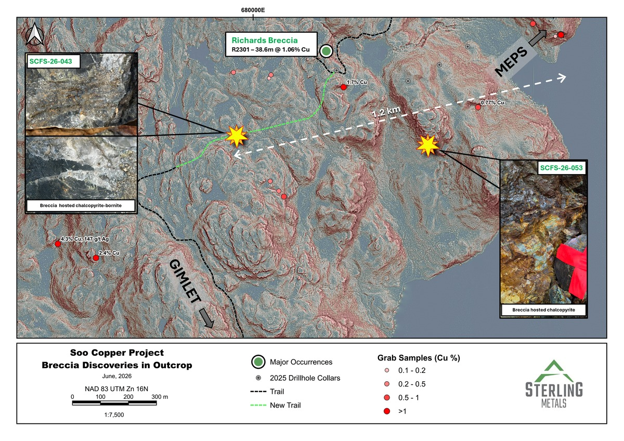
Table 1. Significant Assay Intervals
Hole ID | Min Style | From | To | Length | CuEq % | Cu % | Au g/t | Ag g/t | Mo ppm | Mo % |
SC-26-01 | Gold+Cu sulphides | 98 | 102.3 | 4.3 | 0.47 | 0.02 | 0.49 | 0.72 | 1 | |
and | Cu sulphides | 123 | 136.4 | 13.4 | 0.16 | 0.13 | 0.02 | 0.72 | 2.74 | |
and | Cu sulphides | 154.4 | 155.4 | 3.6 | 0.79 | 0.71 | 0.06 | 2.71 | 2.84 | |
and | Cu sulphides | 630 | 637.1 | 7.1 | 0.21 | 0.17 | 0.04 | 0.46 | 8.2 | |
and | Mo sulphides | 721 | 721.6 | 0.6 | 1.31 | 0.02 | 0.003 | 1.2 | 2500 | |
and | Cu+Mo sulphides | 755 | 765 | 10 | 0.1 | 0.04 | 0 | 0.25 | 116.9 | |
and | Cu+Mo sulphides | 780 | 785 | 5 | 0.15 | 0.05 | 0.25 | 0.25 | 171.48 | |
and | Cu+Mo sulphides | 811 | 814 | 3 | 0.36 | 0.23 | 0.02 | 1.8 | 178 | |
| | | | | | | | | | |
SC-26-02 | Cu sulphides | 248 | 258.8 | 10.8 | 0.13 | 0.11 | 0.01 | 0.28 | 5.66 | |
and | Cu+Mo sulphides | 633.7 | 664 | 30.3 | 0.42 | 0.02 | 0 | 0.26 | 781.3 | |
including | Cu+Mo sulphides | 633.7 | 641 | 7.3 | 1.32 | 0.03 | 0 | 0.29 | 2531.74 | 0.25 |
and | Cu+Mo sulphides | 680 | 683 | 3 | 0.26 | 0.03 | 0 | 0.25 | 434.6 | |
| | | | | | | | | | |
SC-26-03 | Cu sulphides | 121 | 129 | 8 | 0.19 | 0.18 | 0.01 | 0.54 | 0.18 | |
and | Cu sulphides | 354.7 | 361.5 | 6.8 | 0.29 | 0.27 | 0.02 | 0.67 | 7.04 | |
| | | | | | | | | | |
SC-26-04 | Cu sulphides | 3.07 | 507 | 503.93 | 0.26 | 0.14 | 0.05 | 0.64 | 177.16 | |
and | Cu sulphides | 36 | 48.3 | 12.3 | 0.68 | 0.27 | 1.31 | 1.23 | 260.98 | |
and | Cu sulphides | 82.9 | 92.2 | 9.4 | 0.48 | 0.31 | 0.81 | 0.06 | 208.98 | |
and | Cu sulphides | 217 | 229.3 | 12.3 | 0.45 | 0.26 | 0.04 | 1.5 | 254.41 | |
and | Cu sulphides | 259.5 | 263.4 | 3.9 | 0.78 | 0.11 | 7.39 | 0.59 | 17.87 | |
and | Mo Sulphides | 359.3 | 360.3 | 1 | 8.74 | 0.06 | 0 | 0.25 | 17,000.00 | 1.70 |
and | Mo Sulphides | 463.4 | 464.1 | 0.7 | 8.66 | 0.03 | 0.01 | 0.25 | 16,900.00 | 1.69 |
| | | | | | | | | | |
SC-26-05 | Cu sulphide | 3.52 | 293 | 289.48 | 0.26 | 0.2 | 0.03 | 0.97 | 50.82 | |
and | Cu+Mo sulphides | 365.4 | 377.0 | 11.6 | 0.44 | 0.15 | 0.01 | 0.38 | 539.87 | |
SC-26-06 | Cu+Mo sulphides | 3.0 | 452.3 | 449.3 | 0.21 | 0.15 | 0.02 | 0.72 | 78.30 | |
and | Cu sulphides | 3.0 | 217.5 | 214.5 | 0.29 | 0.22 | 0.02 | 0.94 | 75.33 | |
inc | Cu sulphides | 107.0 | 133.5 | 26.5 | 0.50 | 0.41 | 0.05 | 2.17 | 33.47 | |
inc | Cu sulphides | 107.0 | 110.9 | 3.9 | 1.13 | 0.92 | 0.14 | 5.80 | 35.98 | |
inc | Cu sulphides | 123.3 | 126.6 | 3.3 | 1.04 | 0.88 | 0.11 | 4.46 | 22.37 | |
and | Cu sulphides | 197.0 | 240.5 | 43.5 | 0.50 | 0.29 | 0.04 | 1.67 | 314.76 | |
inc | Cu + Mo sulphides | 207.0 | 217.5 | 10.5 | 1.01 | 0.41 | 0.07 | 2.67 | 1,003.78 | |
and | Cu+Mo sulphides | 217.5 | 452.3 | 234.8 | 0.14 | 0.08 | 0.01 | 0.52 | 81.02 | |
Intervals may not represent true widths which are not yet known and capping has not been applied to grades. Copper Equivalent (CuEq) for drill intersections is calculated based on a three-year trailing average for each commodity (2023, 2024 and 2025) which equates to US$4.18/lb Cu, US$2,600/oz Au, US$30.54/oz Ag and US$21.46/lb Mo, with 80% metallurgical recoveries assumed for all metals. The formula is: CuEq % = Cu % + (0.907 x Au g/t) + (0.0107 x Ag g/t) + (0.00051 x Mo ppm).
Table 2. Hole locations, directions and final depths.
Drillhole | Easting | Northing | Elevation | Depth | Dip | Azimuth |
SC-26-01 | 682129.00 | 5212101.00 | 429.00 | 1073.00 | -53.00 | 195.00 |
SC-26-02 | 681675.00 | 5212029.00 | 446.00 | 709.00 | -75.00 | 140.00 |
SC-26-03 | 681675.00 | 5212029.00 | 446.00 | 516.00 | -45.00 | 280.00 |
SC-26-04 | 681060.00 | 5212644.00 | 446.00 | 1167.00 | -70.00 | 233.00 |
SC-26-05 | 681009.00 | 5212554.00 | 460.00 | 654.00 | -67.00 | 303.00 |
SC-26-06 | 681009.00 | 5212554.00 | 460.00 | 452.3 | -78.00 | 290.00 |
Sampling Procedures - Quality Assurance/Quality Control
Analytical services were provided by Actlabs, which is an independent, CALA- and SCC-accredited analytical services firm registered to ISO 17025 and ISO 9001 standard. Drill core samples were logged and split in half with a diamond core saw. Half-core samples were securely stored at the core logging facility until being delivered to Actlabs Thunder Bay lab by commercial transport. Samples were crushed (< 7 kg) up to 90% passing 2mm (10 mesh), riffle split to 250 g and pulverized by mild steel to 95% passing 105μm (150 mesh). Samples splits underwent a 4-acid near total digestion followed by a multi-element analysis, including base metals, using an ICP method for 35 elements. Selected sample pulps were then analyzed for gold using a 30 g aliquot mixed with fire assay fluxes and Ag as a collector, placed in a fire clay crucible, gradually heated to 1060ºC for 60 min, and followed with an AA finish.
Laboratory QA/QC for the ICP analysis was 14% for each batch, including 5 method reagent blanks, 10 in-house controls, 10 samples duplicates, and 8 certified reference materials. An additional 13% QA/QC was performed as part of the instrumental analysis to ensure quality in the areas of instrumental drift. Laboratory quality control for the gold fire assay included two blanks per 42 samples, three sample duplicates and 2 certified reference materials, one high and one low (QC 7 out of 42 samples). In-house QA/QC included the systematic insertion of blanks, duplicates, and certified reference materials (CRM).
Qualified Person
Jeremy Niemi, P.Geo., Senior Vice President, Exploration and Evaluation for Sterling Metals has reviewed and approved the technical information presented herein.
About the Soo Copper Project
The Soo Copper Project sits just 20 minutes off the Trans-Canada Highway, one hour north of Sault Ste. Marie, and 20km from rail and deep-water access. With easily accessible, near-surface copper deposits and prospects, significant associated metals (molybdenum, silver and gold), and with the project now demonstrating the resource potential for scale, grade and contained copper, Sterling is dedicated to achieving the potential for Soo Copper to become a nationally significant mine asset as Canada accelerates its efforts to secure and develop strategic copper resources.
About Sterling Metals
Sterling Metals is a mineral exploration company focused on large scale and high-grade Canadian exploration opportunities. The Company is advancing the 25,000-hectare Soo Copper Project in Ontario which has past production, and multiple breccia and porphyry targets strategically located near robust infrastructure and the 29,000-hectare Adeline Project in Labrador which covers an entire sediment-hosted copper belt with significant silver credits. Both opportunities have demonstrated potential for important new copper discoveries, underscoring Sterling's commitment to pioneering exploration in mineral rich Canada.
Sterling Metals acknowledges that its exploration activities within the Soo Copper project are conducted on the traditional lands of the First Nations of the North Shore of Lake Superior. We recognize and respect the longstanding and diverse relationships Indigenous Peoples have with the land and are committed to engaging in a manner that is respectful, transparent, and inclusive.
For more information, please contact:
Sterling Metals Corp.
Mathew Wilson, CEO and Director
Tel: (416) 643-3887
Email: info@sterlingmetals.ca
Website: www.sterlingmetals.ca
Neither the TSX Venture Exchange nor its Regulation Services Provider (as that term is defined in the policies of the TSX Venture Exchange) accepts responsibility for the adequacy or accuracy of this release. This news release contains certain "forward-looking information" within the meaning of applicable securities laws. Forward looking information is frequently characterized by words such as "plan", "expect", "project", "intend", "believe", "anticipate", "estimate", "may", "will", "would", "potential", "proposed" and other similar words, or statements that certain events or conditions "may" or "will" occur. These statements are only predictions. Forward-looking information is based on the opinions and estimates of management at the date the information is provided and is subject to a variety of risks and uncertainties and other factors that could cause actual events or results to differ materially from those projected in the forward-looking information. For a description of the risks and uncertainties facing the Company and its business and affairs, readers should refer to the Company's Management's Discussion and Analysis. The Company undertakes no obligation to update forward-looking information if circumstances or management's estimates or opinions should change, unless required by law. The reader is cautioned not to place undue reliance on forward-looking information.
SOURCE: Sterling Metals Corp.
View the original press release on ACCESS Newswire

© 2026 Canjex Publishing Ltd. All rights reserved.