Vancouver, British Columbia--(Newsfile Corp. - August 4, 2026) - Rua Gold Inc. (TSX: RUA) (NZX: RGI) (OTCQX: NZAUF) (FSE: X9R) ("RUA GOLD" or the "Company") is pleased to announce that it has received required regulatory approval to commence exploration drilling at the Glamorgan Project, an epithermal gold project in the Hauraki Goldfield on New Zealand's North Island.
The Hauraki Goldfield is a major epithermal gold province, where more than 50 historic mines have collectively produced over 15 million ounces of gold. The Glamorgan Project is adjacent to OceanaGold's Wharekirauponga deposit, which hosts Indicated Mineral Resources of 1.5Moz at 17.3 g/t Au1. The Wharekirauponga project received final permitting approval in December 2025 following a 112-day review process and is now under construction.
Highlights:
Extensive surface exploration and data analysis completed at the Glamorgan Project over the past 2 years have identified several compelling drill targets.
The Company has received approval for nine drill pads, allowing it to test the three most compelling drill targets.
Construction of protective fencing, the exploration camps and drill pads will commence immediately following ecological checks.
A fully funded initial exploration program of approximately 9,000m has been planned across the targets with drilling expected to commence in Q4 2026.
Simon Henderson, Chief Operating Officer, has more than 30 years of experience in this region of New Zealand and played an integral role in the discovery of Wharekirauponga.
Surface exploration completed to date has identified classic features of a major epithermal gold-silver system, comparable to those observed at the Wharekirauponga project, located just 2.8 km to the south.
Significant gold-arsenic soil anomalies trend north, northeast and north-northwest strike out individually over 4 kms in length. Drill targets were selected where these surface features coincide with strong resistivity anomalies identified through CSAMT surveying, interpreted to represent major quartz systems.
Simon Henderson, Chief Operation Officer of RUA GOLD, commented: "Receiving approval to commence drilling at Glamorgan is a significant milestone for RUA GOLD. Our exploration team has systematically developed a compelling geological model and identified three priority drill targets supported by coincident geophysical, geochemical and geological indicators.
With drilling now set to test this highly prospective epithermal system for the first time, we have an exceptional opportunity to unlock a potentially significant new gold discovery in one of New Zealand's premier gold districts."
Exploration Work Completed to Date
Exploration activities completed to date include extensive geological mapping, geochemical sampling, TerraSpec clay-mineral analysis, and ultra-detailed magnetic and resistivity surveys. This work has focused on three target areas overlapping with major alteration cells. The alteration cells are directly associated with surface quartz veins, platy quartz after calcite, quartz-adularia mineralization and sinter-like textures, which are characteristic of the upper levels of an epithermal gold-silver system.
The principal components of the surface exploration program completed include:
- Geological mapping
- Vein morphologies and orientations mapped across the target areas, paralleling regional trends
- Soil and rock-chip sampling
- Soil geochemistry highlights high-grade gold and arsenic enveloping outcropping quartz veins paralleling north-northeast. Rock-chip sampling revealed anomalous Au (>40 g/t) and Ag (>200 g/t) across wide areas of the permit.
- TerraSpec spectrometry
- Si-clay mineralization identified through TerraSpec analysis confirms silica-flooding and chalcedony classic features of the upper levels of epithermal systems, overlying gold-in-soil anomalies.
- UAV magnetic surveying
- Approximately 590 line kilometres ("line-km") were flown, identifying two areas of strong alteration, expressed as demagnetization of the host rocks, that are interpreted to represent the footprint of a major epithermal system.
- Ground resistivity survey
- Two separate CSAMT campaigns totalling >11 km in length identified several deep-rooted resistive features associated with high-grade gold at surface and surrounded by strongly anomalous gold-in-soil geochemistry.
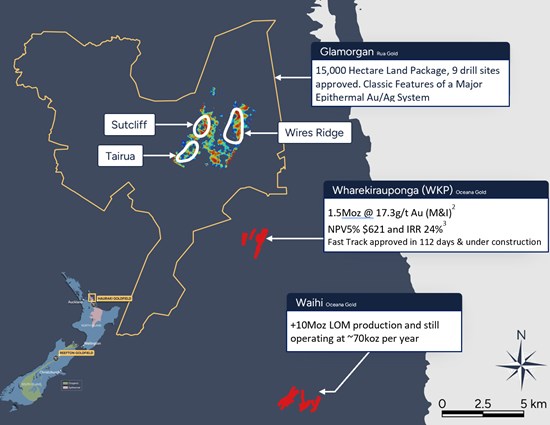
Figure 1: Location map with of Glamorgan with initial drill targets.
To view an enhanced version of this graphic, please visit:
https://images.newsfilecorp.com/files/10755/307888_79e5edc124b218a5_022full.jpg
Glamorgan Exploration Overview
Following the grant of a drone concession in May 2024 and approval for minimum-impact exploration in July 2024, RUA GOLD commenced exploration with an ultra-detailed UAV magnetic survey. The survey comprised approximately 590 line-km flown using a Geometrics MagArrow magnetometer suspended beneath a DJI M300 drone.
Interpretation of the magnetic data has helped define key lithological and alteration features within the Whitianga Group rhyolites and Coromandel Group andesites. The data also indicate major structural features aligned with regional mineralization trends.
Soil sampling commenced in July 2024 along cross-lines spaced 250 metres apart, with samples collected at 20-metre intervals. Infill sampling in target areas and further extensions of the grid have brought the total number of soil samples to 4,137 (Figure 2). All samples dried and sieved at RUA GOLD's Waihi facility, then transported to Reefton for portable X-ray fluorescence ("pXRF") analysis. Each sample was also scanned using a TerraSpec 4 Hi-Res mineral analyzer to characterize the clay-alteration system and identify the upper levels of the epithermal system. A 50-gram subsample was then sent to ALS in Brisbane for low-level gold analysis.
Collection of Controlled-Source Audio-Magnetotellurics (CSAMT) data across two campaigns in Q1 2025 and Q1 2026 covered large parts of the Glamorgan permit area not covered by previously collected Induced Polarisation (IP) data. This has led to the identification of several deep resistors across the target areas with narrow spacing between CSAMT lines enabling correlation of resistors across multiple profiles.
Combination of anomalous soil and rock chip results, geological mapping, and anomalies identified in the UAV magnetics and CSAMT results evidencing large alteration cells was used to identify three main targets for the initial drill program: Sutcliff, Wires Ridge, and Tairua (Figure 2).
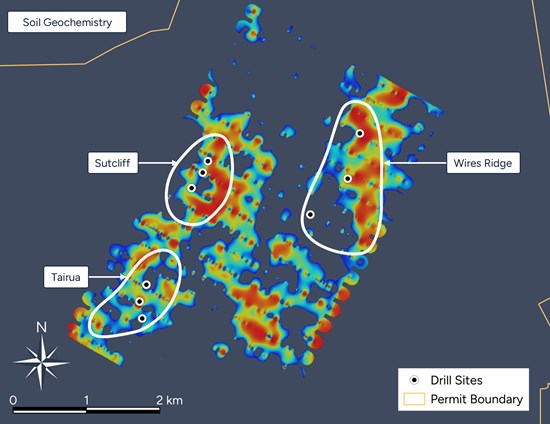
Figure 2: Gold and Arsenic anomalies and initial drill targets within the RUA GOLD Glamorgan permit.
To view an enhanced version of this graphic, please visit:
https://images.newsfilecorp.com/files/10755/307888_79e5edc124b218a5_033full.jpg
The Sutcliff anomaly trends northeast for at least 1.3 km and shows high gold, arsenic, and silver in rock chips and soils. Strong alteration is observed at the surface from geological mapping and UAV magnetics and is underlain by a strong resistor visible in CSAMT data, interpreted to represent the footprint of a major epithermal system. It remains open to the southwest. Its orientation is consistent with that of the WKP deposit, located approximately 3 km southeast of the Glamorgan permit.
The Wires Ridge anomaly trends north-northeast for at least 2.1 km, evidenced by anomalous gold and arsenic geochemistry and strong resistors at depth. This target remains open to the north and south. Its southern extent coincides with the historic Wentworth and Auckland mine workings.
The Tairua anomaly trends northeast over at least 1.6 km and is evident in numerous quartz veins with anomalous gold and silver outcropping across a width of >600m. Quartz veins commonly show extensive banding and width exceeding 50 cm. The broad alteration zone is interpreted as stockwork-like veining. The Tairua anomaly remains open to the south.
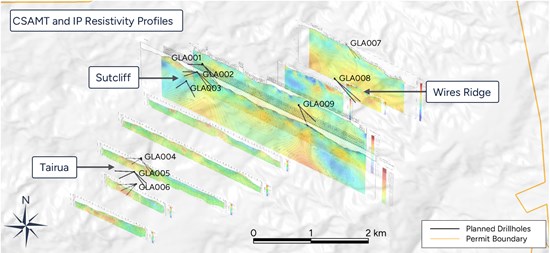
Figure 3: CSAMT and IP resistivity results as point cloud data. Red indicates areas of high resistivity.
To view an enhanced version of this graphic, please visit:
https://images.newsfilecorp.com/files/10755/307888_79e5edc124b218a5_034full.jpg
An initial drill program of approximately 9,000m has been planned across the three targets at Sutcliff, Wires Ridge, and Tairua (Figure 3) with drilling expected to commence in Q4 2026.
ABOUT RUA GOLD
RUA GOLD is an exploration company, strategically focused on New Zealand. With decades of expertise, our team has successfully taken major discoveries into producing world-class mines across multiple continents. The team is now focused on maximizing the asset potential of RUA GOLD's two highly prospective high-grade gold projects.
The Company controls the Reefton Gold District as the dominant landholder in the Reefton Goldfield on New Zealand's South Island with over 120,000 hectares of tenements, in a district that historically produced over 2Moz of gold grading between 9 and 50g/t4.
The Company's Glamorgan Project solidifies RUA GOLD's position as a leading high-grade gold explorer on New Zealand's North Island. This highly prospective project is located within the North Islands' Hauraki district, a region that has produced an impressive 15Moz of gold and 60Moz of silver5. Glamorgan is adjacent to OceanaGold Corporation's biggest gold mining project, Wharekirauponga.
For further information, please refer to the Company's disclosure record on SEDAR+ at www.sedarplus.ca.
TECHNICAL INFORMATION
Simon Henderson CP, AUSIMM, a qualified person under National Instrument 43-101 Standards of Disclosure for Mineral Projects and Chief Operating Officer and a director of RUA GOLD, has reviewed and approved the technical disclosure contained herein. Mr. Henderson has participated in the geophysical, sampling, and mapping programs to verify that they have been conducted in accordance with the standard operating procedures. Mr. Henderson has verified the data disclosed by running checks on the location, analytical, and test data underlying the information in the technical disclosure herein.
RUA GOLD Contact
This news release includes certain statements that may be deemed "forward-looking statements". All statements in this new release, other than statements of historical facts, that address events or developments that the Company expects to occur, are forward-looking statements. Forward-looking statements are statements that are not historical facts and are generally, but not always, identified by the words "expects", "plans", "anticipates", "believes", "intends", "estimates", "projects", "potential" and similar expressions, or that events or conditions "will", "would", "may", "could" or "should" occur and specifically include statements regarding, without limitation: the commencement of the Company's drilling program at the Glamorgan Project; the vegetation and invertebrate checks will clear; and the commencement of the construction of protective fencing, the exploration camps and drill pads . Although the Company believes the expectations expressed in such forward-looking statements are based on reasonable assumptions, such statements are not guarantees of future performance and actual results may differ materially from those in the forward-looking statements.
Investors are cautioned that any such forward-looking statements are not guarantees of future performance and actual results or developments may differ materially from those projected in the forward-looking statements. A variety of inherent risks, uncertainties and factors, many of which are beyond the Company's control, affect the operations, performance and results of the Company and its business, and could cause actual events or results to differ materially from estimated or anticipated events or results expressed or implied by forward looking statements. Some of these risks, uncertainties and factors include: general business, economic, competitive, political and social uncertainties; risks related to the effects of the Russia-Ukraine war and the war in the Middle East; risks related to climate change; operational risks in exploration, delays or changes in plans with respect to exploration projects or capital expenditures; the actual results of current exploration activities; conclusions of economic evaluations; changes in project parameters as plans continue to be refined; changes in labour costs and other costs and expenses or equipment or processes to operate as anticipated, accidents, labour disputes and other risks of the mining industry, including but not limited to environmental hazards, flooding or unfavorable operating conditions and losses, insurrection or war, delays in obtaining governmental approvals or financing, and commodity prices. This list is not exhaustive of the factors that may affect any of the Company's forward-looking statements and reference should also be made to the Company's short form base shelf prospectus dated July 11, 2024, and the documents incorporated by reference therein, filed under its SEDAR+ profile at www.sedarplus.ca for a description of additional risk factors.
Forward-looking statements are based on the assumptions, beliefs, estimates and opinions of the Company's management on the date the statements are made, which include but are not limited to: to the accuracy of the Company's current mineral resource estimates; that there will be no material adverse change affecting the Company or its properties; the duration and effect of global and local inflation; geo-political uncertainties on the Company's workforce, business, operations and financial condition; the expected trends in mineral prices, inflation and currency exchange rates; that all required approvals and permits will be obtained for the Company's business and operations on acceptable terms including for underground mining at Auld Creek; that there will be no significant disruptions affecting the Company's operations and such other assumptions herein. Except as required by applicable securities laws, the Company undertakes no obligation to update these forward-looking statements in the event that management's beliefs, estimates or opinions, or other factors, should change.
1 See OceanaGold's news release dated February 18, 2026.
2 See OceanaGold's news release dated February 18, 2026.
3 See OceanaGold's "NI 43-101 Technical Report Waihi Operations and Wharekirauponga Underground Pre-feasibility Study, New Zealand", dated December 11, 2024.
4 Technical Report on the Reefton Project, New Zealand, with an effective date of February 27, 2026 available under the Company's SEDAR+ profile at www.sedarplus.ca.
5 Christie, A., Simpson, M., Barker, R., and Braithwaite, R. 2019. Exploration for epithermal Au-Ag deposits in New Zealand: history and strategy. New Zealand Journal of Geology and Geophysics, 62:1, 414-441. NI 43-101 Technical Report, Waihi District Pre-feasibility Study, New Zealand. OceanaGold Corporation, Report Date: December 11, 2024.

To view the source version of this press release, please visit https://www.newsfilecorp.com/release/307888

© 2026 Canjex Publishing Ltd. All rights reserved.