Highlights
- Record 23.5% H₂ encountered within only the first 300 metres of ongoing drill hole DDH-26-05, approximately 540 metres shallower than the Company's previous record of 24.3% H₂ at 707 metres in DDH-26-04.
- Observations consistent with free gas at 164 metres, together with a ~54-metre corridor of sustained percent-level hydrogen concentrations (143-197 m), support the interpretation of a robust, structurally controlled natural hydrogen system.
- DDH-26-05 has exceeded the Company's previous Bennett Hill drill hole over the comparable upper interval in hydrogen concentrations, hydrogen frequency and geological continuity, while drilling continues beyond the first 300 metres.
Why This Hole Matters
DDH-26-05 has now exceeded the Company's previous Bennett Hill discovery over the comparable upper interval in hydrogen concentrations, hydrogen frequency, structural observations and geological continuity, while remaining open at depth. These results further strengthen the interpretation that Bennett Hill hosts a large, structurally controlled natural hydrogen system.
Montreal, Quebec--(Newsfile Corp. - August 11, 2026) - Quebec Innovative Materials Corp. (CSE: QIMC) (OTCQB: QIMCF) (FSE: 7FJ) ("QIMC" or the "Company") is pleased to announce the strongest natural hydrogen results ever reported by the Company from the first approximately 300 metres of ongoing diamond drill hole DDH-26-05 at its Bennett Hill Natural Hydrogen Project in Nova Scotia. These results represent only the initial portion of the hole. Hydrogen concentrations of up to 23.5% H₂, together with drilling observations consistent with free gas entering the borehole within a major structural zone, represent a significant new milestone for the Company's natural hydrogen exploration program. Achieving these record concentrations within only the first 300 metres of an active drill hole—compared with the Company's previous record of 24.3% H₂ at 707 metres in DDH-26-04—further validates QIMC's evolving geological model for a large-scale, structurally controlled natural hydrogen district and further refines the Company's geological interpretation of Bennett Hill, which indicates the characteristics required to move toward a pilot-scale production project as a pathway to commercial development.
The combination of record hydrogen concentrations, observations consistent with free gas entering the borehole and the continued validation of the Company's structural geological model represents an important milestone in advancing Bennett Hill from exploration toward pilot production development.
CEO Commentary
"DDH-26-05 has delivered the two things every natural hydrogen developer wants to see: concentrations and free gas — and it delivered them in the first 300 metres," said John Karagiannidis, President and Chief Executive Officer of QIMC. "Hydrogen concentrations of 23.5% within only the first 300 metres fundamentally strengthen our confidence that Bennett Hill hosts one of Canada's most significant emerging natural hydrogen systems. Our record hole DDH-26-04 needed 707 metres to reach 24.3%; DDH-26-05 has come within striking distance of that record at less than a quarter of the depth. And at 164 metres, the system did something remarkable — it came to us. Free gas flowed into the hole, our rig analyzers picked up hydrogen in the open air, and the strongest readings of the hole bracket that structure on both sides. Shallow, clean, high-concentration hydrogen is precisely what our pilot production pathway model calls for. With roughly seventy-four percent of our readings above one percent hydrogen and methane at zero across the board, Bennett Hill continues to look like exactly what we believe it is: the cornerstone of a district-scale clean hydrogen system."
Summary of Results: 0-300 Metres, DDH-26-05
IsoJar mud-gas hydrogen readings (EAGLE II analyzer) were collected at nominal 3-metre intervals from 32 m to 305 m, with multiple replicate measurements per depth (192 valid readings across 91 sampled depths). Significant results include:
| Depth (m) | Peak H₂ reading | Other readings at depth | Geological context |
| 143 | 5.6% H₂ | 4.2%, 3.0%, 2.0% | Base of graphitic fault breccia / faulted contact |
| 155 | 6.4% H₂ | 4.4%, 4.4%, 3.9% | Siltstone approaching free-gas structure |
| 158 | 20.8% H₂ | 7.5%, 4.8% | 6-7 m above free gas intersection |
| 164-167 | Free gas flow | Mud seam, lost core; void at 167 m | Free gas intersection — no water return |
| 170 | 23.5% H₂ | 16.5%, 15.5% | Directly below free gas structure — peak of hole to date |
| 176 | 17.6% H₂ | 3.4% | Granitized siltstone with syenitic dykes |
| 179 | 16.0% H₂ | 1.1% | Granitized siltstone |
| 182-194 | 5.9-8.0% H₂ | Multiple 5.9-8.0% readings | Granitized siltstone / plagioclase-rich intrusive |
| 260-263 | 13.9% H₂ | 5.3% | Green siltstone below graphitic breccias |
The overall distribution of hydrogen concentrations through the first 300 metres of DDH-26-05 is shown in Figure 1. Rather than representing a single isolated high-concentration interval, the data define an approximately 54-metre corridor (143-197 m) of sustained percent-level hydrogen concentrations culminating in a record 23.5% H₂ at 170 metres. The profile also highlights a second double-digit hydrogen interval at 260-263 metres and the interval where drilling observations were consistent with free gas entering the borehole. Collectively, these results illustrate the continuity and intensity of hydrogen concentrations through the first 300 metres of DDH-26-05 and provide further support for the Company's interpretation of a structurally controlled natural hydrogen system at Bennett Hill.
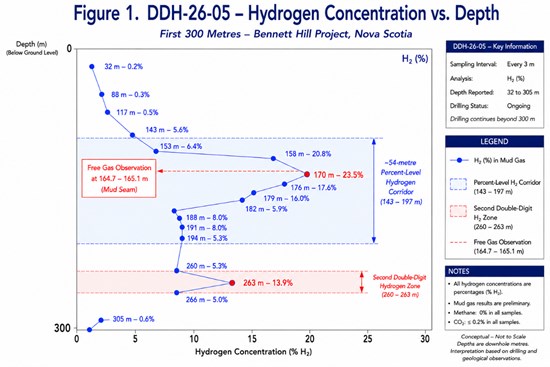
Figure 1. Distribution of hydrogen concentrations through the first 300 metres of DDH-26-05, highlighting the principal hydrogen-bearing corridor, observations consistent with free gas entering the borehole, and continued drilling beyond 300 metres. Note: conceptual image, not to scale.
To view an enhanced version of this graphic, please visit:
https://images.newsfilecorp.com/files/7968/309171_869666a76456db39_001full.jpg
Free Gas at 164 Metres
At approximately 164 metres, DDH-26-05 intersected a mud seam (164.7-165.1 m, with approximately 40 cm of lost core) within a competent siltstone package. As the drill advanced through this interval, rig-mounted gas monitoring equipment detected elevated hydrogen concentrations in the ambient air at the rig — an observation the Company interprets as a free gas flow from the formation into the borehole. Immediately beyond it, at 167 metres, the drill encountered an open void with complete loss of water return; further voids were encountered at 257 m and 296 m.
The geochemistry underlines the significance of this structure: the two strongest readings of the hole — 20.8% H₂ at 158 m and 23.5% H₂ at 170 m — sit directly above and below the free gas intersection, defining a gas-charged structural zone at the heart of a ~54-metre percent-level hydrogen corridor.
Mud-gas geochemistry demonstrates that hydrogen is present in the fractured rock. Free gas deliverability is one of the central assumptions of the pilot production pathway model the Company began evaluating in July 2026, and DDH-26-05 has now provided the first direct drilling evidence in support of that assumption — at a depth shallow enough to be reached by simple, low-cost wells.
Geology of the First 300 Metres: The Structural Plumbing Predicted by R2G2™
Logging of DDH-26-05 (collared at an azimuth of 155° and a dip of -70°, NQ core, 100% core recovery through the reported interval) confirms the architecture predicted by the Company's R2G2™ targeting framework:
- 35.0-143.5 m — Graphitic fault breccia: a more than 108-metre-thick graphitic fault zone hosting numerous discrete fault gouge intervals, interpreted as a long-lived, reactivated structural conduit — the primary hydrogen migration pathway. Hydrogen readings through this zone ran consistently at 1-4.2% H₂.
- 143.5-175.2 m — Siltstone hosting the free gas intersection: competent, thinly bedded siltstone containing the 164.7-165.1 m mud seam and the 167 m void, bracketed by the 20.8% and 23.5% H₂ peaks — a gas-charged conduit and potential trap geometry.
- 176.0-251.8 m — Granitized siltstone, syenitic intrusions and graphitic silica-granitic breccias: sustained percent-level hydrogen (peaks of 17.6%, 16.0% and 8.0% H₂) through an interval of granitization, syenite dykes and hydrothermal breccias associated with the Cobequid-Chedabucto Fault Zone.
- 251.8-300+ m — Green siltstone: a second double-digit hydrogen zone (13.9% H₂ at 263 m) with an associated void at 257 m, and readings of 2.1-3.5% H₂ continuing toward 300 m.
Building on Record Hole DDH-26-04
DDH-26-05 is the second hole at Bennett Hill, located approximately 15 kilometres from the Company's Eatonville Road drill area (DDH-26-01 to DDH-26-03). The first Bennett Hill hole, DDH-26-04, was completed to 818 metres and returned a peak mud-gas reading of 24.3% H₂ at 707 metres — the highest single hydrogen reading recorded across QIMC's 2026 Advocate Area program — with 104 of 284 IsoJar readings (approximately 37%) at or above 1% H₂. Over the upper interval comparable to today's results, DDH-26-04 peaked at 16.0% H₂ at 236 metres.
DDH-26-05 has exceeded that benchmark on every measure over the first 300 metres: substantially higher hydrogen concentrations within the upper 300 metres (23.5% vs 16.0%), a higher hit rate (approximately 74% vs 37% of readings at or above 1% H₂), a free gas intersection, and open gas-charged structure confirmed by drilling voids. In the Company's interpretation, two consecutive holes with intensifying hydrogen — 700 metres apart on the same structure — support a laterally extensive, structurally controlled and vertically persistent hydrogen system at Bennett Hill. DDH-26-05 is planned to a total depth of 900 metres to test the depth continuation of this system below the horizon that produced the 24.3% record in DDH-26-04. Collectively, the geological observations, sustained hydrogen concentrations, and observations consistent with free gas entering the borehole continue to strengthen the Company's confidence in Bennett Hill as an emerging district-scale natural hydrogen system.
Importance for the Pilot Production Pathway
On July 20, 2026, the Company announced the beginning of a technical evaluation of a pathway toward pilot-scale characterization and clean energy generation of the Advocate Area hydrogen system. The results reported today advance that pathway on four fronts: (i) the free gas intersection at 164 metres provides the first direct evidence of mobile, free-phase gas — the fundamental prerequisite for pilot testing; (ii) 23.5% H₂ at 170 metres demonstrates that high-concentration hydrogen exists at depths reachable by simple, low-cost pilot wells; (iii) a second consecutive hydrogen-bearing hole at Bennett Hill, stronger than the first over the equivalent interval, supports resource continuity; and (iv) the confirmation of the predicted fault-breccia architecture continues to validate the R2G2™ targeting framework as a repeatable exploration and development tool across the Company's 43-kilometre district-scale corridor.
About Québec Innovative Materials Corp. (QIMC)
Québec Innovative Materials Corp. is a North American exploration and development company advancing a portfolio of natural hydrogen and critical mineral projects, with properties in Québec, Ontario, Nova Scotia and Minnesota (USA). The Company applies its proprietary R2G2™ (Reactivated Rift and Graben Geostructure) exploration framework, developed in collaboration with INRS, and is focused on responsible exploration, technical innovation, and the advancement of natural hydrogen opportunities that may contribute to future clean-energy development. The Company's exploration in the Advocate Area involves no hydraulic fracturing and no reservoir stimulation.
Neither the Canadian Securities Exchange nor its Regulation Services Provider accepts responsibility for the adequacy or accuracy of this release.
Forward-Looking Statements
This news release contains "forward-looking information" within the meaning of applicable Canadian securities legislation, including statements regarding the continued drilling and anticipated results of DDH-26-05; the interpretation of free gas observations, drilling voids, mud-gas and soil-gas data; the existence, scale and continuity of a district-scale natural hydrogen system; and the potential advancement toward pilot-scale characterization, clean energy generation or any future development pathway. Forward-looking information is based on assumptions management considers reasonable, including assumptions regarding field conditions, instrument performance, the continuity of geological structures, the availability of financing, and permitting and regulatory frameworks. Actual results may differ materially. Risks include, without limitation, that preliminary field readings are not confirmed by laboratory analysis or subsequent work; that free gas observations do not reflect sustained deliverability or recoverable accumulations; that the remainder of DDH-26-05 does not deliver results consistent with readings observed to date; that no economically recoverable hydrogen accumulation exists on the Company's properties; that regulatory frameworks for natural hydrogen in Nova Scotia and elsewhere remain under development; and that additional financing may not be available on acceptable terms. No resource estimate has been prepared for the Advocate Area projects, and there is no assurance that the exploration results described herein will translate into a discovery of commercial quantities of natural hydrogen. Readers are cautioned not to place undue reliance on forward-looking information. The Company undertakes no obligation to update forward-looking information except as required by law.
Sampling, Methodology and Data Verification
Mud-gas readings reported in this release are preliminary field readings from co-collected IsoJar headspace samples taken at nominal 3-metre depth intervals during the drilling of DDH-26-05, measured with a portable EAGLE II gas analyzer, consistent with the methodology disclosed by the Company on June 18 and June 29, 2026. A total of 192 valid readings were recorded across 91 sampled depths between 32 m and 305 m; reported statistics count individual replicate measurements. Values are transcribed from original handwritten field records; individual values flagged as unclear on the field sheets have been excluded from headline statistics pending verification against the original records. Real-time readings from rig-mounted monitoring equipment measure hydrogen concentrations in ambient air at the drill rig, are continuous indicative measurements used for safety and operational correlation purposes and are not directly comparable to headspace mud-gas sample values. Preliminary field readings are subject to confirmation by laboratory analysis.

To view the source version of this press release, please visit https://www.newsfilecorp.com/release/309171

© 2026 Canjex Publishing Ltd. All rights reserved.