Vancouver, British Columbia--(Newsfile Corp. - October 5, 2026) - Onyx Gold Corp. (TSXV: ONYX) (OTCQX: ONXGF) ("Onyx" or the "Company") is pleased to report results from the Company's first systematic drill program at the Flipper Zone ("Flipper"), located approximately 3 kilometers south of the Argus Gold System ("Argus") at its 100%-owned Munro-Croesus Project ("Munro-Croesus" or the "Project"), located 75 kilometers east of Timmins, Ontario.
The six-hole (6), 2,172-meter first-pass program confirms broad and locally higher-grade gold mineralization within sedimentary rocks south of Argus, demonstrating that this extensive and historically underexplored geological package can host broad widths of gold mineralization. Drill hole MC26-277 returned 0.7 g/t Au over 46.7 m, including 4.0 g/t Au over 5.0 m, including 13.5 g/t Au over 1.0 m, with a second interval of 0.2 g/t Au over 44.0 m.
The broader significance is regional. Onyx interprets Flipper to lie along an emerging northeast-trending Argus Fault corridor extending for several kilometers from the Tamarack deposit on adjacent McEwen Inc. property, through Flipper and the historic Stewart-Abate Mine area, across recently acquired Onyx ground and toward Argus (see Figures 1 and 2). Large portions remain sparsely explored, providing a substantial new search area outside the known Argus system. Priority areas occur where the corridor intersects quartz-feldspar porphyry ("QFP") and related intrusive rocks within the sedimentary rocks of the Porcupine assemblage. This opportunity also fits a broader exploration shift in the Abitibi, where recent success has renewed attention on sedimentary packages that historically received less exploration than the camp's volcanic belts.
Highlights
- Flipper confirms that the extensive sedimentary package approximately 3 km south of Argus can host broad gold mineralization, materially expanding the amount of prospective stratigraphy across Munro-Croesus.
- 0.7 g/t Au over 46.7 m, including 4.0 g/t Au over 5.0 m, including 13.52 g/t Au over 1.0 m; and a second interval of 0.21 g/t Au over 44.0 m in drill hole MC26-277.
- 0.5 g/t Au over 46.7 m, including 0.6 g/t Au over 28.8 m, including 1.1 g/t Au over 5.0 m, and including 2.4 g/t Au over 1.0 m in drill hole MC26-272.
- 4.1 g/t Au over 3.0 m, including 6.7 g/t Au over 1.5 m, together with a broader interval of 0.3 g/t Au over 35.0 m, including 2.3 g/t Au over 3.0 m in drill hole MC26-284.
- Onyx interprets the Argus Fault corridor to extend southwest from Argus through recently acquired ground, Stewart-Abate and Flipper toward Tamarack. Key follow-up targets occur where this structure intersects sedimentary rocks and porphyritic intrusions. The structural continuity remains an exploration interpretation to be tested by additional work.
"Flipper comes at an interesting time for exploration in the Abitibi," said Brock Colterjohn, President and CEO of Onyx Gold. "Until now, our drilling success has been concentrated in volcanic rocks at Argus; we now have broad gold mineralization three kilometers to the south within sediments along a structural corridor that we interpret to extend for several kilometers. The grades are modest in parts, but the geological implication is important: a large area that has seen little modern exploration is genuinely gold-bearing and warrants systematic follow-up. Recent exploration success in sedimentary rocks elsewhere in the Abitibi has also led to renewed interest in these historically underexplored geological packages and highlighted their potential to host significant gold systems. Our focus now is to follow the structure and test the strongest geological intersections, particularly around the historic Stewart-Abate Mine area and recently acquired ground where QFP intrusions cut the sediments."
Discussion of Flipper Drill Results
Flipper was selected for first-pass drilling after compiling historical drilling, geophysical interpretation, and the Company's evolving understanding of northeast-trending structures across the broader Munro-Croesus property. The initial program consisted of six (6) holes totalling 2,172 m and was designed to test both historical gold-bearing intervals and the potential for northeast-trending structures to host additional mineralization within the sedimentary package.
Two drill holes, MC26-272 and MC26-276, were drilled near historical holes to establish geological and assay continuity using modern drilling, logging and analytical methods. Drill hole MC26-272 encountered a sequence dominated by sericitized mudstone, wacke, sandstone, siltstone and local tuffaceous rocks, including several pyrite-bearing zones within brecciated and carbonatized sediments. Drill hole MC26-276 similarly tested altered sediments near another historical hole and intersected quartz-vein zones within sericite-altered mudstone and wacke.
Drill hole MC26-277 provided the strongest indication that the Flipper system extends beyond the historical drill targets. The hole tested the area between historical holes and encountered strongly iron-oxidized and altered sediments near surface, together with multiple quartz-vein and fault zones. Despite the absence of visually obvious sulphide-rich mineralization, assays returned the strongest broad gold interval out of the six holes: 0.7 g/t Au over 46.7 m, including 4.0 g/t Au over 5.0 m and 13.5 g/t Au over 1.0 m.
This is an important exploration observation for Onyx because the mineralized interval is not visually obvious. At Flipper, gold mineralization can occur within relatively subtle-looking sedimentary rocks where weathering and oxidation may obscure primary sulphides, meaning visible mineralization alone may not provide an effective exploration vector.
Drill hole MC26-284 further reinforces the structural interpretation. The hole targeted the limonite-altered structural zone identified in drill hole MC26-277 and encountered an extensive fault-rubble zone from approximately 167.6 to 273.5 m downhole, characterized by intense fracturing, sericite-clay alteration, local gouge and substantial quartz veining. The hole returned several gold-bearing intervals, including 4.1 g/t Au over 3.0 m, including 6.7 g/t Au over 1.5 m, and a broader 0.3 g/t Au over 35.0 m, including 2.3 g/t Au over 3.0 m.
Drill hole MC26-282, approximately 600 m east of MC26-284, encountered systematic pyrite-bearing quartz veins within interbedded greywacke, mudstone/argillite, sandstone and tuff, returning individual intervals of 1.9 g/t Au over 1.5 m, 1.3 g/t Au over 1.0 m and 1.6 g/t Au over 1.0 m.
Drill hole MC26-280, a 200 m step-out designed to test lateral continuity and northeast-trending structures, returned no significant assays. The hole nevertheless confirmed continuation of the sedimentary sequence and intersected systematic quartz and quartz-carbonate veining with localized pyrite.
Complete significant assay results are provided in Table 1.
The Argus Fault Corridor – A New Regional Exploration Opportunity
The Flipper results are beginning to change how Onyx views the geology south of Argus.
The Company's current interpretation is that the northeast-trending Argus Fault and/or associated parallel structures form part of a broader structural corridor extending southwest from Argus. Under this model, the corridor passes through recently acquired Onyx ground, the historic Stewart-Abate Mine area and Flipper before continuing toward the Tamarack deposit on the adjacent McEwen Inc. property.
This interpretation is supported in part by the Company's recently completed high-resolution unmanned aerial vehicle (UAV) magnetic survey, which provides substantially improved definition of the structural architecture across this portion of the Property (see Figure 2). The survey's high resolution allows Onyx to better delineate subtle breaks, offsets and disruptions in the magnetic fabric that may represent faults and associated structures between key geological units. Several of these interpreted structural features help define the broader northeast-trending structural fabric between Flipper, the Stewart-Abate area, and Argus, providing an important framework for prioritizing exploration along the corridor.
The historic Stewart-Abate Mine provides additional evidence of gold mineralization along this trend. An inclined shaft, approximately 37 m deep, was developed between 1915 and 1941, and a 52-tonne bulk sample reportedly graded 24 g/t Au. Historical drilling returned 9.6 g/t Au over 1.2 m, while surface grab samples returned values of up to 13.5 g/t Au1. Drifting at the 20 m level followed the principal quartz-carbonate-pyrite-chalcopyrite vein, locally containing visible gold and molybdenite, within a sheared diorite body for approximately 67 m. Historical records reported an average vein width of 1.8 m grading 10.6 g/t Au1.
The regional interpretation is significant because much of the corridor south of Argus is underlain by sedimentary rocks that have historically received substantially less systematic exploration than the volcanic stratigraphy that has traditionally attracted much of the exploration focus in the Abitibi. The Flipper results demonstrate that this sedimentary package can host broad zones of gold mineralization, along with discrete higher-grade intervals.
More broadly, recent exploration success within sedimentary rocks elsewhere in the Abitibi has contributed to renewed industry interest in these historically underexplored units. This work has highlighted the potential for major structures, deformation zones and intrusive contacts within sedimentary packages to localize gold mineralization and has expanded the range of geological environments being actively explored across the camp. Onyx believes the results at Flipper provide an important first indication that the extensive sedimentary rocks south of Argus warrant the same systematic modern exploration approach.
Within this emerging corridor, Onyx considers two areas particularly important for follow-up. The first is the historic Stewart-Abate Mine area, which lies directly along the interpreted structural trend and provides evidence of historically documented high-grade gold mineralization. The second is recently acquired ground between Stewart-Abate and Argus, where the interpreted structure passes through sedimentary rocks containing QFP and related felsic intrusive bodies. The coincidence of a major structural corridor, favourable sedimentary host rocks and felsic to intermediate intrusions defines a series of compelling targets for follow-up exploration.
Together, Flipper, Stewart-Abate and the newly acquired ground define several priority target areas along a multi-kilometer corridor that has seen limited modern exploration.
Next Steps
Onyx is now integrating the Flipper assay results with detailed drill-core geology, historical drilling and the recently completed high-resolution magnetic survey to refine the structural model across the broader Argus Fault corridor. The immediate objective is to better define the orientation and controls on mineralization at Flipper and determine how those structures continue along strike toward Stewart-Abate, the newly acquired ground and Argus.
Follow-up exploration will prioritize the strongest geological intersections identified along the corridor, particularly where interpreted structures coincide with favourable sedimentary stratigraphy, deformation and QFP or related felsic intrusions. This work is expected to include additional geological interpretation, targeted surface exploration and follow-up drilling designed both to expand the mineralized footprint at Flipper and test the highest-priority regional targets along the multi-kilometer trend.
The Flipper results form part of Onyx's fully funded 110,000-meter exploration program at Munro-Croesus, which is focused on expanding the Argus Gold System while advancing additional mineralized centres across the broader property. The Company has completed 94,000 m in 241 holes, with 146 holes released to date, and remains well funded with approximately $9 million in cash to continue systematic exploration across the Project.
- The Company cautions that none of the historical results from Stewart-Abate have been verified. Assay methods and sampling techniques are not disclosed in the historical reports, and the QP has been unable to verify any of the historical technical information in this release. Historical results discussed herein are presented more generally as an indication of the potential of the Property to host gold-bearing systems and this information is not necessarily indicative of additional mineralization occurring on the Property.
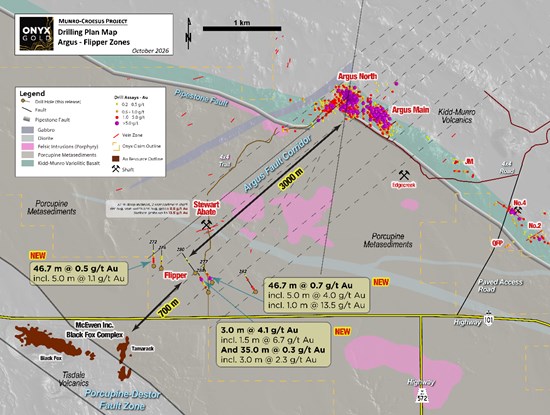
Figure 1 – Plan Map of Flipper Zone Drill Results
To view an enhanced version of this graphic, please visit:
https://images.newsfilecorp.com/files/9800/317333_4ade13ee64de794b_001full.jpg
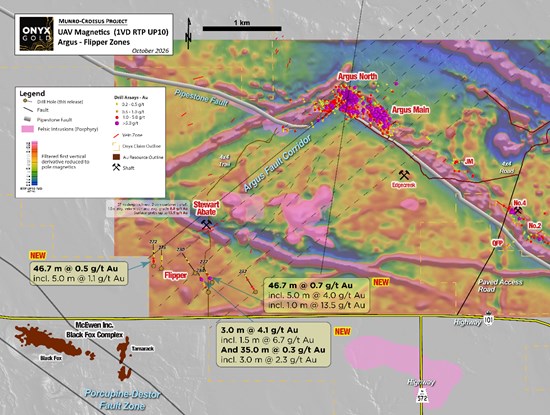
Figure 2 – High-resolution UAV Magnetics Highlighting the Interpreted Argus Fault Corridor and Recent Flipper Drill Results
To view an enhanced version of this graphic, please visit:
https://images.newsfilecorp.com/files/9800/317333_4ade13ee64de794b_002full.jpg
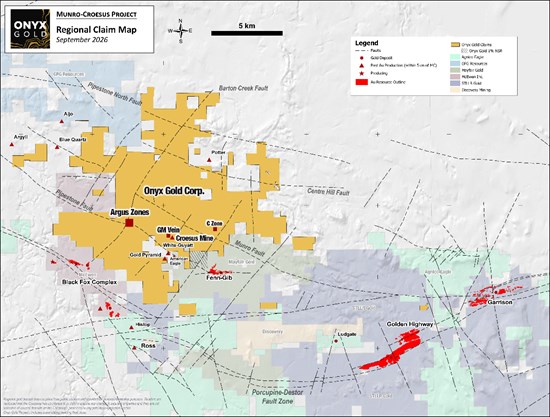
Figure 3 – Location of the Munro-Croesus Gold Project, Ontario
To view an enhanced version of this graphic, please visit:
https://images.newsfilecorp.com/files/9800/317333_4ade13ee64de794b_003full.jpg
Table 1 – Significant Assay Results Reported in this Release
| Target | From | To | Length | Au |
| Drill Hole | (m) | (m) | (m) | (g/t) |
| Flipper Zone |
| MC26-272 | 38.6 | 85.3 | 46.7 | 0.5 |
| Including | 49.5 | 78.3 | 28.8 | 0.6 |
| Including | 49.5 | 54.5 | 5.0 | 1.1 |
| And | 117.6 | 118.6 | 1.0 | 2.4 |
| MC26-276 | 72.5 | 90.2 | 17.7 | 0.2 |
| Including | 72.5 | 79.0 | 6.5 | 0.4 |
| MC26-277 | 55.0 | 101.7 | 46.7 | 0.7 |
| Including | 70.0 | 75.0 | 5.0 | 4.0 |
| Including | 73.0 | 74.0 | 1.0 | 13.5 |
| And | 127.5 | 171.5 | 44.0 | 0.2 |
| Including | 161.0 | 162.5 | 1.5 | 1.2 |
| MC26-280 | No Significant Assays |
| MC26-282 | 58.5 | 60.0 | 1.5 | 1.9 |
| And | 101.0 | 102.0 | 1.0 | 1.3 |
| and | 242.0 | 243.0 | 1.0 | 1.6 |
| MC26-284 | 83.0 | 85.0 | 2.0 | 1.9 |
| And | 241.5 | 244.5 | 3.0 | 4.1 |
| Including | 243.0 | 244.5 | 1.5 | 6.7 |
| And | 264.5 | 299.5 | 35.0 | 0.3 |
| Including | 279.5 | 282.5 | 3.0 | 2.3 |
*All intersections are reported as drilled width; true width is unknown
On Behalf of Onyx Gold Corp.
"Brock Colterjohn"
President & CEO
Neither TSX Venture Exchange nor its Regulation Services Provider (as that term is defined in the policies of the TSX Venture Exchange) accepts responsibility for the adequacy or accuracy of this release.
The Munro-Croesus Project
The Munro-Croesus Project is located along Highway 101 in the heart of the Abitibi greenstone belt, Canada's premier gold mining jurisdiction (Figure 3). This large, 100%-owned land package includes the past-producing Croesus Gold Mine, which yielded some of the highest-grade gold ever mined in Ontario. Extensive land consolidation since 2020 has unified the patchwork of patented and unpatented mining claims surrounding the Croesus Gold Mine into one coherent package and enhanced the project's exploration potential.
The Project covers 114 km2 of highly prospective geology within the influence of major gold-bearing structural breaks. Bulk-tonnage gold deposits located in the immediate region include the Fenn-Gib gold project being developed by Mayfair Gold Corp., and the Tower Gold Project being developed by STLLR Gold Inc.
Qualified Person
Ian Cunningham-Dunlop, P.Eng., Executive Vice President of Onyx Gold Corp. and a Qualified Person as defined by National Instrument 43-101, has reviewed and approved the scientific and technical information contained in this news release.
About Onyx Gold
Onyx Gold Corp. (TSXV: ONYX) (OTCQX: ONXGF) is a Canadian exploration company focused on unlocking district-scale gold opportunities in two of the country's most prolific and proven mining jurisdictions — Timmins, Ontario, and Yukon Territory.
In the Timmins Gold Camp, Onyx controls an extensive portfolio anchored by the Munro-Croesus Property, host to the historic high-grade Croesus Mine and site of the Company's recent Argus North discovery. Complementing Munro-Croesus are two large, early-stage projects - Golden Mile, a 140 km² property situated just 9 km from Discovery Silver's multi-million-ounce Hoyle Pond Mine, and Timmins South, a 187 km² land package strategically positioned around the Shaw Dome structure, offering exceptional discovery potential.
Beyond Ontario, Onyx holds a commanding land position across four properties in Yukon's Selwyn Basin, an area rapidly gaining recognition for new gold discoveries and growing exploration investment. The Company's King Tut Property sits approximately 50 km south of Snowline Gold's Valley deposit and adjacent to Fireweed Metals' MacPass property.
Led by an experienced team with a strong track record of discovery, development, and value creation, Onyx Gold is well-funded and committed to delivering shareholder value through disciplined exploration, strategic growth, and responsible resource development.
Additional Notes:
Starting azimuth, dip and final length (Azimuth/-Dip/Length) for the six (6) drill holes reported today are noted as follows: MC26-272 (000/50/381), MC26-276 (000/50/315), MC26-277 (325/45/351), MC26-280 (325/45/408), MC26-282 (323/45/348), and MC26-284 (325/45/369).
Samples of drill core were cut by a diamond blade rock saw, with half of the cut core placed in individual sealed polyurethane bags and half placed back in the original core box for permanent storage. Sample lengths typically vary from a minimum 0.2-meter interval to a maximum 1.5-meter interval, with an average 0.5 to 1.0-meter sample length. Drill core samples were delivered by truck in sealed woven plastic bags to ALS Geochemistry laboratory facility in Timmins, Ontario for sample preparation with final analysis at ALS Geochemistry Analytical Lab facility in North Vancouver, BC, for the fire assay fusion method and inductively coupled plasma (ICP), with the photon assay method performed at the ALS Geochemistry Analytical Lab facility in Thunder Bay, Ontario. ALS Geochemistry operates meeting all requirements of International Standards ISO/IEC 17025:2017 and ISO 9001:2015
Drill core samples were crushed to 70% passing 2mm, then a representative split was taken and pulverized to 85% passing 75μm. For the RUSH portion of all drill holes, gold was determined by the photon assay method (Au-PA01) of a 500-gram crush split sample providing a true bulk reading. The photon assay method utilizes high-energy X-rays that cause excitation of atomic nuclei, allowing enhanced analysis for gold.
For all drill holes (including the RUSH mineralized portion), gold was also determined by the fire-assay fusion method (Au-AA26) of a 50-gram sub-sample with atomic absorption spectroscopy (AAS). Samples that returned values >10 ppm gold from fire assay and AAS were determined by using fire assay and a gravimetric finish. Various metals, including silver, gold, copper, lead, and zinc, were analyzed by inductively coupled plasma atomic emission spectroscopy (ME-ICP61), following multi-acid digestion. The elements copper, lead and zinc were determined by ore grade assay for samples that returned values >10,000 ppm by ICP analysis. Silver was determined by ore-grade assay for samples that returned>100 ppm.
All ALS Geochemistry sites operate under a single Global Geochemistry Quality Manual that complies with ISO/IEC 17025:2017. ALS Geochemistry follows the quality management and operational guidelines set out in the international standards ISO/IEC 17025 – "General Requirement for the Competence of Testing and Calibration Laboratories" and ISO 9001 – "Quality Management Systems".
The Company maintains a robust QA/QC program that includes the collection and analysis of duplicate samples and the insertion of blanks and standards (certified reference material).
Cautionary and Forward-Looking Statements
Forward-looking statements include predictions, projections, and forecasts and are often, but not always, identified by the use of words such as "seek", "anticipate", "believe", "plan", "estimate", "forecast", "expect", "potential", "project", "target", "schedule", "budget" and "intend" and statements that an event or result "may", "will", "should", "could" or "might" occur or be achieved and other similar expressions and includes the negatives thereof. All statements other than statements of historical fact included in this release, including, without limitation, statements regarding the interpretation, significance and potential continuity of gold mineralization at the Flipper Zone; the interpretation and potential continuity of the Argus Fault and associated structural corridor between Argus, recently acquired ground, the Stewart-Abate area, Flipper and adjoining properties; the potential for sedimentary rocks and porphyritic intrusive rocks to host additional gold mineralization; the identification, prioritization and future testing of exploration targets along the interpreted corridor; the potential applicability of geological models or analogues from elsewhere in the Abitibi; planned surface exploration, geophysical interpretation and drilling activities; and the potential for additional discoveries at Munro-Croesus are forward-looking statements. Geological interpretations remain subject to change as additional drilling, mapping, geophysical and analytical information becomes available. There can be no assurance that such statements will prove to be accurate and actual results and future events could differ materially from those anticipated in such statements. Forward-looking statements are based on a number of material factors and assumptions. Important factors that could cause actual results to differ materially from Company's expectations include actual exploration results, changes in project parameters as plans continue to be refined, results of future resource estimates, future metal prices, availability of capital, and financing on acceptable terms, general economic, market or business conditions, uninsured risks, regulatory changes, defects in title, availability of personnel, materials, and equipment on a timely basis, accidents or equipment breakdowns, delays in receiving government approvals, unanticipated environmental impacts on operations and costs to remedy same, and other exploration or other risks detailed herein and from time to time in the filings made by the Company with securities regulators. Although management of the Company has attempted to identify important factors that could cause actual results to differ materially from those contained in forward-looking statements or forward-looking information, there may be other factors that cause results not to be as anticipated, estimated, or intended. There can be no assurance that such statements will prove to be accurate, as actual results and future events could differ materially from those anticipated in such statements. Accordingly, readers should not place undue reliance on forward-looking statements and forward-looking information. Readers are cautioned that reliance on such information may not be appropriate for other purposes. The Company does not undertake to update any forward-looking statement, forward-looking information or financial outlook that are incorporated by reference herein, except in accordance with applicable securities laws. We seek safe harbor.

To view the source version of this press release, please visit https://www.newsfilecorp.com/release/317333

© 2026 Canjex Publishing Ltd. All rights reserved.