Toronto, Ontario--(Newsfile Corp. - May 12, 2026) - Lavras Gold Corp. (TSXV: LGC) (OTCQX: LGCFF) ("Lavras Gold" or the "Company) is pleased to announce it has successfully concluded the previously announced specialist technical workshop undertaken to review the geological model, exploration results, and targeting strategy at its Lavras do Sul Project ("LDS Project" or the "Project") in Rio Grande do Sul, Brazil (see news release dated April 14, 2026). The Company's exploration team, led by Interim Vice President of Exploration, Jonathan Hill, worked alongside independent geoscience specialists, has advanced the Company's understanding of the mineral system and highlights areas where exploration approaches can be refined.
"We are excited to have hosted this expert site visit at the LDS Project in Brazil as a number of valuable findings have emerged," commented Interim Vice President of Exploration, Jonathan Hill. "The primary targets remain large-scale, bulk tonnage systems, which leverages the Project's district-scale presence, with numerous targets showing the potential to be incorporated into a unified economic model. The identification of shallow high-grade vein style mineralization, though limited in scale relative to the bulk tonnage mineralization, also represent attractive targets in the context of potential early-stage mine development and cash flow generation."
Workshop Highlights and Key Findings:
The workshop focused on database interrogation and integration; core sample review and in-field verification; and collaborative interpretation and target generation, which was designed to transition from high-level data review to identification of priority targets and confirmation of the Project's geological framework (see Fig. 1 for targets on the LDS Project).
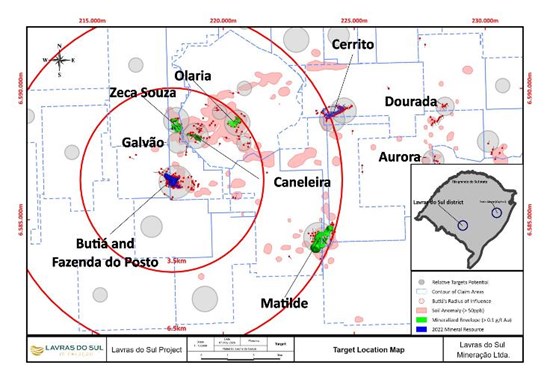
Figure 1 Map showing the relative location of the mineral resources, drill defined mineralized envelopes and exploration targets, Lavras do Sul.
To view an enhanced version of this graphic, please visit:
https://images.newsfilecorp.com/files/10429/297008_98ebc16cf403dbd2_002full.jpg
Findings confirmed the LDS Project geology is interpreted as a large alkaline intrusive system developed within an extensional, post-orogenic tectonic setting with significant mantle contribution. This environment is considered permissive for the formation of alkalic intrusion-related gold/base metals systems as well as iron oxide copper gold (IOCG) style mineralization.
Key insights from each phase of the workshop include:
1. Database Interrogation and Data Integration
- Creating consistent geological concepts and standardizing technical terminology across all internal teams will ensure alignment and allow for more pointed and data driven exploration decisions.
- Integrating over 20 years of legacy data into a unified district-scale model will provide a comprehensive view of the LDS Project to ensure all exploration opportunities are identified, ranked and prioritized.
- Focusing on leveraging multi-element geochemistry including key pathfinder elements such as gold, copper, molybdenum, lead and zinc in parallel with spectral and geophysical/ structural datasets is considered important or vectoring toward potentially larger mineralized systems.
- Utilization of spectral data to identify key alterations such as mica (phengite), chlorite and other phyllosilicates that are central to the mineral system, will allow better discrimination between alteration intensity and mineral chemistry and will provide a clearer understanding of the geological pathways, which controlled the flow of gold-bearing fluids.
2. Field Verification and Core Review
Mineralization at the LDS Project is associated with a complex, multi-stage magmatic-hydrothermal system, where alteration is developed in multiple temperature-dependent pulses. These phases commonly overlap, resulting in both mineralized and barren assemblages occurring in close spatial association.
- The earliest alteration phase is a high temperature potassic assemblage which is widespread impacting most of the intrusive phases within the Lavras Igneous Complex.
- Overprinting this potassic assemblage, the principal gold mineralizing stage is associated with the introduction of high-temperature hydrothermal fluids and the development of quartz veining accompanied by phengite (white mica) alteration. This important mineralizing stage is typically associated with disseminated pyrite.
- Contemporaneous with, or slightly later than, the phengite-associated mineralization, zones of iron-rich (black) chlorite alteration are developed. These occur as broad alteration domains with relatively minor quartz veining and disseminated sulphides and are generally associated with lower-grade (approximately 0.3-2.0 g/t Au) but bulk-tonnage style mineralization. In some areas, chlorite alteration partially overprints earlier phengite assemblages, while in others it may be locally replaced by phengite, reflecting a dynamic and evolving hydrothermal system.
- As hydrothermal fluids continued to cool, quartz-phengite vein systems locally evolved to become enriched in base metals, with the development of sphalerite-galena-pyrite assemblages. These zones can host elevated gold grades, locally exceeding 20 g/t Au, but are typically restricted to discrete vein systems rather than broader alteration zones.
- A later-stage mineralization style observed in parts of the system, particularly at Caneleira, is characterized by black chlorite with sphalerite and locally visible gold. These occurrences can host very high gold grades (locally exceeding 50 g/t Au), but to date are generally observed to be limited in scale and continuity.
- Lamprophyre dykes are interpreted as a late intrusive phase. Gold-silver-base metal veins are locally developed along structures associated with these dykes, commonly along hanging wall contacts.
- Late albite alteration represents a cooler, largely barren phase related to the waning stages of the system and is only partially preserved. No epithermal-style mineralization has been identified, consistent with the current level of erosion exposing deeper portions of the system.
- Findings confirmed that mineralization does not occupy simple planar features but may lie within plunging structural zones.
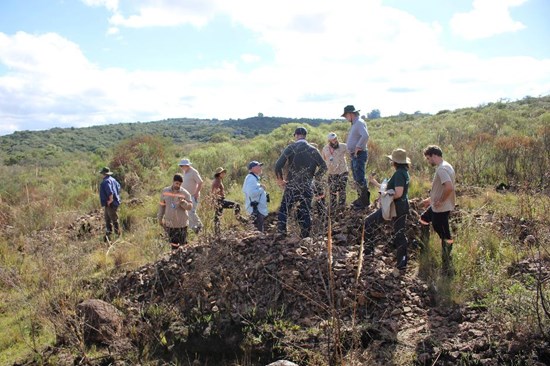
Photo 1 Specialist Group and Lavras Gold's Geological team visiting historical surface excavations and outcrop near Butia / Fazenda Target, Lavras do Sul.
To view an enhanced version of this graphic, please visit:
https://images.newsfilecorp.com/files/10429/297008_98ebc16cf403dbd2_003full.jpg
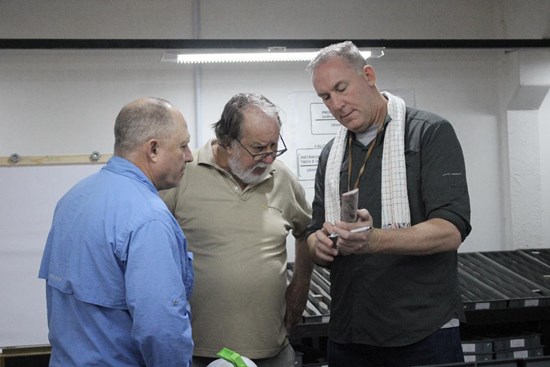
Photo 2 Paul Linton, Joao Moller and Chris Grainger inspecting drill-core during the Specialist Workshop, Lavras do Sul.
To view an enhanced version of this graphic, please visit:
https://images.newsfilecorp.com/files/10429/297008_98ebc16cf403dbd2_004full.jpg
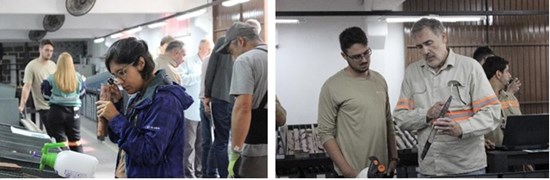
Photo 3 Mariana Soares (left), Roberto Souza and Diego Ramos (right) inspecting diamond drill core during Specialist Workshop, Lavras do Sul.
To view an enhanced version of this graphic, please visit:
https://images.newsfilecorp.com/files/10429/297008_lavras%201.jpg
3. Collaborative Interpretation and Target Generation
- The primary structural control on mineralization appears to be NW-SE trending structures and perhaps to a lesser extent an E-W structural control. The team identified a need for improved three-dimensional targeting to account for the potential for plunging structural geometries that were not consistently tested in previous programs with the aim of leveraging and optimising continued drilling success.
- Findings suggested that the primary target remains large-scale, bulk tonnage systems, focusing the strategy on the Project's district-scale potential.
- The identification of shallow high-grade vein style mineralization, while likely to be of limited scale relative to the bulk tonnage mineralization, represents attractive targets in the context of potential early-stage mine development and cash flow generation.
- Overall, the most prospective mineralized zones are those exhibiting strong overprinting of multiple alteration and veining events, particularly where sheeted or stockwork quartz veining is well developed in association with phengite and/or chlorite alteration. These zones are interpreted to represent the main fluid pathways and offer the greatest potential for robust mineralized systems.
- Findings confirmed that magnetic lows associated with magnetite destruction during hydrothermal alteration remain as a key indicator for identifying new mineralized systems .
- Mineralized zones exhibiting strong overprinting of multiple alteration and veining events, particularly where sheeted or stockwork quartz veining is well developed, are the most prospective.
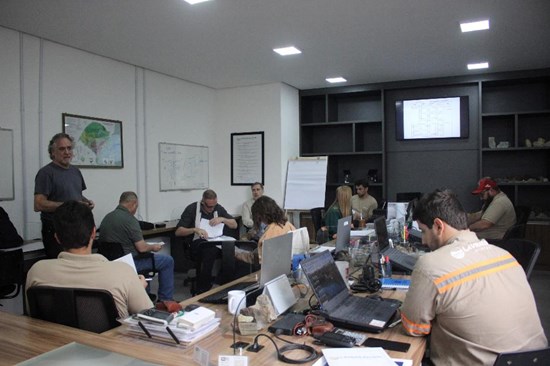
Photo 4 Jon Hill leads an interactive workshop discussion with the Specialist Group and Lavras Gold Geological Team, Lavras do Sul.
To view an enhanced version of this graphic, please visit:
https://images.newsfilecorp.com/files/10429/297008_98ebc16cf403dbd2_007full.jpg
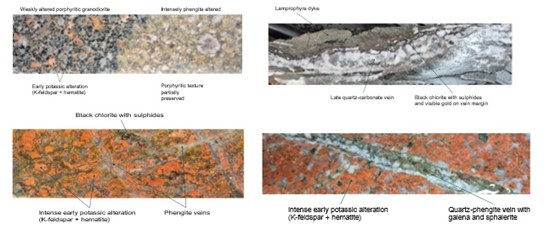
Photo 5 Examples of Alteration, Veining and Mineralization styles observed during the Specialist's workshop, Lavras do Sul.
To view an enhanced version of this graphic, please visit:
https://images.newsfilecorp.com/files/10429/297008_lavras2.jpg
Next Steps
These technical insights will allow the Company to prioritize several key areas within the complex that exhibit characteristics of large-scale, bulk-tonnage systems.
Specific priority target areas and sequencing include:
- Cerrito, which hosts an existing mineral inventory and remains open along strike.
- Matilde, which remains open in multiple directions and shows potential for scale with associated copper and molybdenum credits; and
- Butia/Fazenda do Posto, bottom of the planned pit, where additional potential may exist at depth.
To date, high grade vein mineralization occurring near lower grade, potentially bulk mineable mineralization has been identified at Caneleira. Further exploration in this area is justified based on widespread gold in soil anomalism, favourable alteration and structural vectors in drill core and its proximity to the mineral resource footprint at Butia/Fazenda.
In looking at these target areas, the Company intends to:
- refine structural and geological models;
- improve drill planning and 3D targeting methodologies;
- focus on bulk-tonnage mineralized systems (while evaluating shallow high-grade opportunities where present);
- expand integration of geochemical, geophysical and spectral datasets; and
- reassess earlier-stage targets to better understand their scale and structural controls.
Qualified Person
Jonathan Hill, non-Independent Director and Interim Vice President of Exploration for Lavras Gold Corp., is the "Qualified Person" as defined under National Instrument 43-101, Standards of Disclosure for Mineral Projects, and has reviewed and approved the technical information contained in this release.
About Lavras Gold Corp.
Lavras Gold Corp.is a Canadian exploration company focused on realizing the potential of its LDS Project situated in a highly prospective gold district in southern Brazil. The LDS Project is located near the town of Lavras do Sul in the state of Rio Grande do Sul, Brazil and is primarily an intrusive hosted gold system of possible alkaline affinity. More than 24 gold prospects centred on historic gold workings have been identified on the LDS Project properties, which span more than 21,000 hectares. For more information on Lavras Gold visit www.lavrasgold.com.
On Behalf of Lavras Gold Corp.
"Hemdat Sawh"
Interim CEO and CFO
Disclaimer: Neither TSX Venture Exchange nor its Regulation Services Provider (as that term is defined in the policies of the TSX Venture Exchange) accepts responsibility for the adequacy or accuracy of this release.
Forward looking statements: This news release includes certain "forward-looking information" within the meaning of Canadian securities legislation and "forward-looking statements" within the meaning of the United States Private Securities Litigation Reform Act of 1995 (collectively "forward-looking statements"). Forward-looking statements include predictions, projections and forecasts and are often, but not always, identified by the use of words such as "seek", "anticipate", "believe", "plan", "estimate", "forecast", "expect", "potential", "project", "target", "schedule", "budget" and "intend" and statements that an event or result "may", "will", "should", "could" or "might" occur or be achieved and other similar expressions and includes the negatives thereof. All statements other than statements of historical fact included in this release, are forward-looking statements that involve various risks and uncertainties, including regarding the Company's plans to carry out work, complete a technical report and a PEA. There can be no assurance that such statements will prove to be accurate and actual results and future events could differ materially from those anticipated in such statements. Forward-looking statements are based on a number of material factors and assumptions. Important factors that could cause actual results to differ materially from Company's expectations include actual exploration results, changes in project parameters as plans continue to be refined, results of future resource estimates, future metal prices, availability of capital and financing on acceptable terms, general economic, market or business conditions, uninsured risks, regulatory changes, defects in title, availability of personnel, materials and equipment on a timely basis, accidents or equipment breakdowns, delays in receiving government approvals, unanticipated environmental impacts on operations and costs to remedy same, and other exploration or other risks detailed herein and from time to time in the filings made by the Company with securities regulators. Although the Company has attempted to identify important factors that could cause actual actions, events or results to differ from those described in forward-looking statements, there may be other factors that cause such actions, events or results to differ materially from those anticipated. There can be no assurance that forward-looking statements will prove to be accurate and accordingly readers are cautioned not to place undue reliance on forward-looking statements.
To view the source version of this press release, please visit https://www.newsfilecorp.com/release/297008

© 2026 Canjex Publishing Ltd. All rights reserved.