(see highlights below for details)
Vancouver, British Columbia--(Newsfile Corp. - March 16, 2026) - Great Pacific Gold Corp. (TSXV: GPAC) (OTCQX: GPGCF) (FSE: 0B3) ("Great Pacific Gold," "GPAC," or the "Company") reports high-grade results from follow-up channel, rock-chip sampling and mapping completed at the Magiabe West vein discovery and the emerging Morgan Vein system at its flagship Wild Dog Project ("Wild Dog" or the "Project"), located on the island of New Britain, East New Britain Province, Papua New Guinea ("PNG").
A channel sampling program was designed to follow up the recently announced Magiabe West vein discovery, where exceptionally high-grade rock-chip samples returned up to 137 g/t Au, 3.97% Cu and 76 g/t Ag, confirming the presence of high-grade polymetallic epithermal vein mineralization within the southern portion of the Wild Dog Structural Corridor (see news release dated February 19, 2026). In addition, field work in preparing the Morgan Vein for upcoming drill testing was conducted, including trenching and vein mapping.
Highlights - Magiabe West Vein
- 8 metres at 18.12 g/t AuEq (17.10 g/t Au, 7.63 g/t Ag and 0.60% Cu), including 3 metres at 48 g/t AuEq (45.26 g/t Au, 20.33 g/t Ag and 1.59% Cu) from channel sampling.
- New rock-chip sampling 85m southwest of the Magiabe West discovery yielded 1.3 g/t Au, 20 g/t Ag and 0.93% Cu from a newly identified quartz-sulphide outcrop, indicating the Magiabe West vein system is significantly more extensive than previously recognized.
Highlights - Morgan Vein
- Morgan Vein channel sampling returned 19.30 metres at 4.13 g/t AuEq (4.01 g/t Au, 6.0 g/t Ag and 0.03% Cu), including 2.5 metres at 30.68 g/t AuEq (29.90 g/t Au, 46 g/t Ag and 0.16% Cu).
- Mapping and sampling have expanded the Morgan Vein system from a historically defined ~200 m long quartz vein to an approximately 850 m long NNE-SSW trending mineralized corridor, representing more than a four-fold increase in the interpreted strike extent of the system.
"These results continue to demonstrate the scale and exploration potential of the Wild Dog Structural Corridor. Ongoing mapping and sampling around Sinivit are revealing that the system is significantly larger and more structurally complex than previously recognized, with multiple fertile parallel vein systems emerging along this underexplored corridor," stated Callum Spink, VP Exploration.
"Our team has been systematically revisiting historically mineralized areas through detailed field mapping and sampling, and the discoveries at Magiabe West Vein and the emerging Morgan Vein System west of Sinivit are direct outcomes of that work. Importantly, these targets share key geological characteristics with the Sinivit target, including structural orientation, vein style and sulphide mineralization, reinforcing the broader district-scale potential of the corridor."
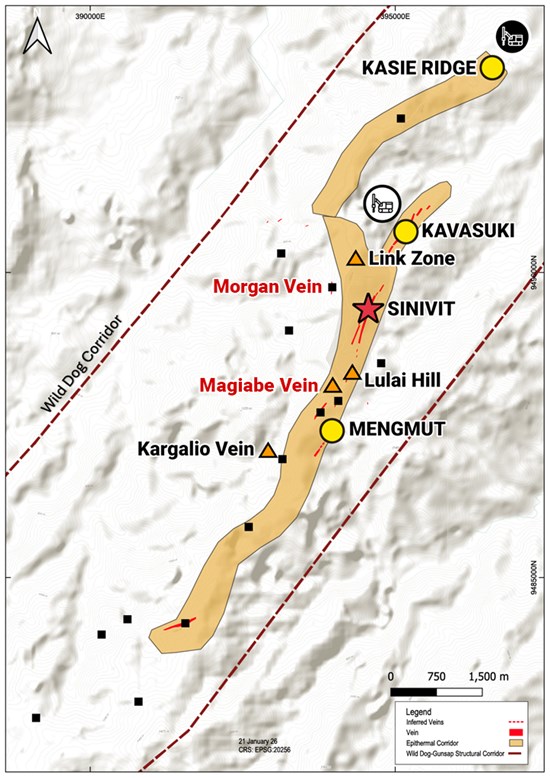
Figure 1: Pipeline of epithermal gold-copper targets on the Wild Dog Structural Corridor and the location of the Magiabe Vein and Morgan Vein systems. Diamond drilling is continuing with Rig #1 deployed at the Kavasuki target and Rig #2 at Kasie Ridge.
To view an enhanced version of this graphic, please visit:
https://images.newsfilecorp.com/files/11018/288635_d49c550cb4c2eb06_002full.jpg
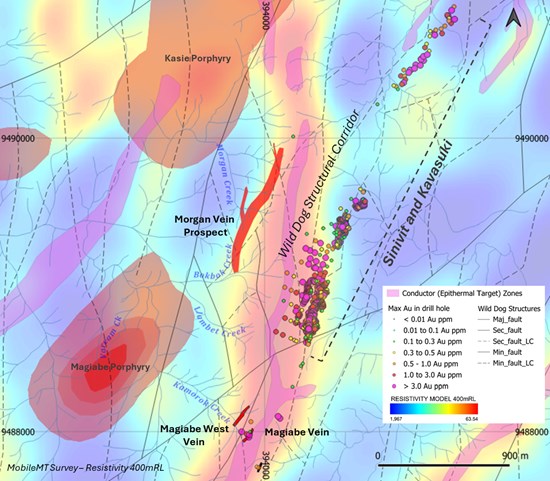
Figure 2: Plan map of the Magiabe and Morgan Vein prospects along the Wild Dog Structural Corridor, showing surface geochemical results, mapped and inferred vein extensions, and their relationship to Sinivit and Kavasuki.
To view an enhanced version of this graphic, please visit:
https://images.newsfilecorp.com/files/11018/288635_d49c550cb4c2eb06_003full.jpg
Magiabe West Vein System - Follow-Up Mapping and Sampling
Recent fieldwork by the Company's geological team focused on follow-up mapping and systematic sampling south of the Magiabe West discovery, where previous rock-chip sampling (see news release dated February 19, 2026) returned exceptional grades including:
- 137 g/t Au, 3.97% Cu, 76 g/t Ag;
- 123 g/t Au, 4.01% Cu, 66 g/t Ag, and
- 113 g/t Au, 2.47% Cu, 71 g/t Ag.
These earlier results demonstrated the presence of high-grade polymetallic epithermal mineralization hosted within steeply dipping quartz-sulphide veins located approximately 700 metres southwest of the Sinivit Deposit within the Wild Dog Structural Corridor (Figure 2).
To further evaluate the extent and geometry of the Magiabe system, the Company completed systematic channel and rock-chip sampling along strike and across adjacent structures. Channel sampling across a trench exposure intersected an approximately 8-metre-wide zone of quartz-sulphide veining and silicification. Within this interval, three consecutive one-metre channel samples returned 3.77 g/t Au, 41.1 g/t Au and 90.9 g/t Au, defining a high-grade mineralized shoot within the broader structural corridor. The composite channel sample across the 8-metre interval returned 17.10 g/t Au, 7.63 g/t Ag and 0.60% Cu (18.12 g/t AuEq).
These results are consistent with epithermal vein systems, where high-grade mineralization commonly occurs in discrete shoots within broader zones of quartz veining and hydrothermal alteration, and where multiple high-grade shoots may occur within a single mineralized corridor.
Significant assay results from the Magiabe follow-up sampling include:
- WDGS260099: 41.1 g/t Au, 31 g/t Ag, 4.3% Cu
- WDGS260100: 90.9 g/t Au, 30 g/t Ag, 0.45% Cu
- WDGS260098: 3.77 g/t Au, 0 g/t Ag, 0.02% Cu
- WDGS260124: 1.3 g/t Au, 20 g/t Ag, 0.93% Cu
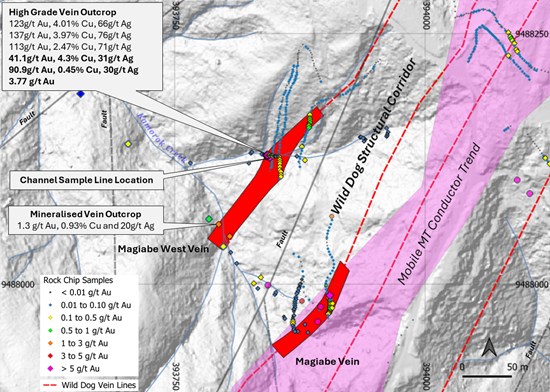
Figure 3: Plan map of the Magiabe and Magiabe West vein systems showing rock-chip sample locations, interpreted vein trends and associated fault structures within the Wild Dog Structural Corridor.
To view an enhanced version of this graphic, please visit:
https://images.newsfilecorp.com/files/11018/288635_d49c550cb4c2eb06_004full.jpg
Structural interpretation indicates that the Magiabe vein system occurs at the intersection of northeast-southwest and northwest-southeast structural corridors, where zones of dilation likely focused hydrothermal fluid flow and led to the development of quartz-sulphide veins and associated silicified structural zones.
These results confirm that quartz-sulphide mineralization continues along strike and within adjacent structures, supporting the interpretation that the Magiabe area represents a broader mineralized structural corridor rather than a single isolated vein, and highlighting the potential for additional high-grade shoots along strike and at depth.
In addition, grab sample WDGS260124 (1.3 g/t Au, 20 g/t Ag and 0.93% Cu) indicates the vein extends at least 85 metres to the south, with limited sampling highlighting potential for further discoveries along this emerging structural corridor.
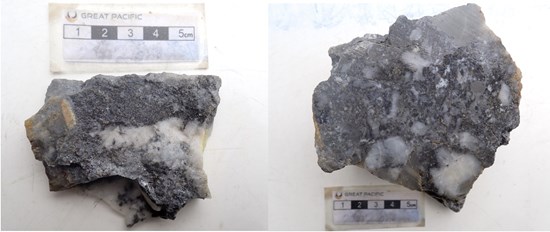
Figure 4: Hand specimen from the Magiabe West vein comprising a ~1 m thick quartz-sulphide vein hosted within intensely sericite-illite-pyrite altered wall rock. Mineralization consists of approximately 9-10% disseminated to locally semi-massive chalcopyrite, pyrite and bornite with minor chalcocite.
To view an enhanced version of this graphic, please visit:
https://images.newsfilecorp.com/files/11018/288635_d49c550cb4c2eb06_005full.jpg
The Magiabe West Vein System is characterized by:
- Northeast-striking, steeply dipping quartz-sulphide veins forming a coherent mineralized structural corridor.
- Polymetallic sulphide mineralization including chalcopyrite, pyrite and bornite.
- Broad silicified structural zones locally exceeding several metres in width.
- Multiple intersecting vein sets developed along north-south and east-west trending structures.
- Location along the interpreted Magiabe caldera margin, a favourable structural setting for epithermal mineralization.
Representative samples collected from the Magiabe West Vein Prospect are shown in Table 1 and the photos in Figures 5 and 6.
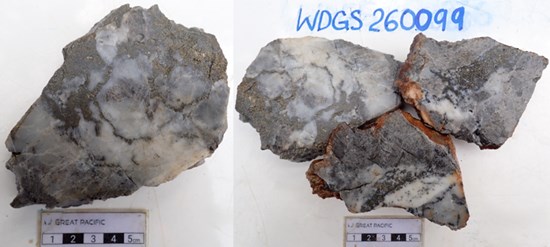
Figure 5: Rock-chip sample WDGS260099 from the Magiabe West Vein showing a clay-filled fault zone with disseminated to locally massive pyrite, bornite and chalcopyrite (41.1 g/t Au, 31 g/t Ag, 4.3% Cu).
To view an enhanced version of this graphic, please visit:
https://images.newsfilecorp.com/files/11018/288635_d49c550cb4c2eb06_006full.jpg
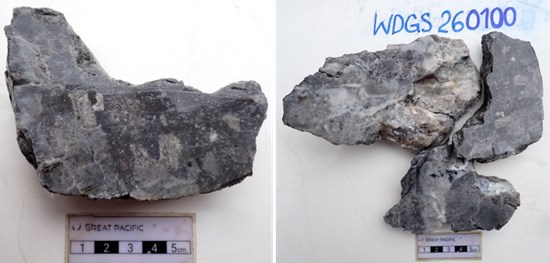
Figure 6: Rock-chip sample WDGS260100 from the Magiabe West Vein showing a fault-hosted, clay-filled zone with disseminated to locally massive pyrite, bornite, and chalcopyrite (90.9 g/t Au, 30 g/t Ag, 0.45% Cu).
To view an enhanced version of this graphic, please visit:
https://images.newsfilecorp.com/files/11018/288635_d49c550cb4c2eb06_007full.jpg
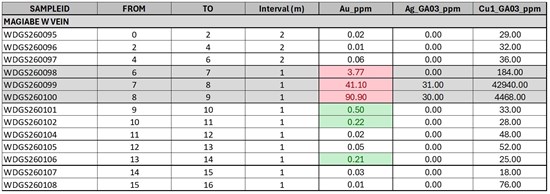
Table 1: Channel sampling results from the Magiabe West Vein and Morgan Vein system showing an 8-metre-wide vein zone containing a high-grade shoot defined by three consecutive 1-metre samples grading up to 90.9 g/t Au.
To view an enhanced version of this graphic, please visit:
https://images.newsfilecorp.com/files/11018/288635_gptable1.jpg
Morgan Vein - Emerging Epithermal Corridor
Recent reconnaissance mapping and systematic sampling have expanded the Morgan Vein system into a much larger mineralized corridor than previously recognised within the Wild Dog Structural Corridor.
Previously interpreted as an approximately 200-metre-long north-south striking quartz vein, recent geological mapping, rock-chip and channel sampling indicates that the Morgan structure represents a broader mineralized fault-shear corridor developed within the Wild Dog structural architecture. To date, field mapping completed by the exploration team has delineated an approximately 850-metre-long NNE-SSW trending mineralized corridor, representing more than a four-fold increase in the interpreted strike extent of the system.
Channel sampling across the Morgan vein returned locally high-grade gold values, including 29.9 g/t Au, 46 g/t Ag and 0.16% Cu from channel sample WDGS250178 (Figure 7).
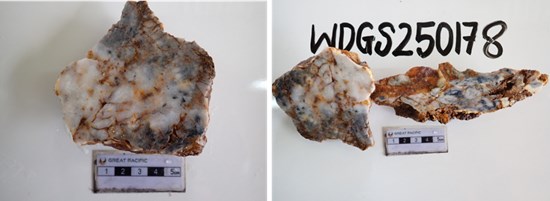
Figure 7: Rock-chip sample WDGS250178 from the Morgan Vein Prospect showing moderately oxidized vein material comprising milky white and grey sulphidic quartz with limonitic iron oxide staining localised along vein margins and fracture surfaces. The sample returned 29.9 g/t Au, 46 g/t Ag, and 0.16% Cu.
To view an enhanced version of this graphic, please visit:
https://images.newsfilecorp.com/files/11018/288635_d49c550cb4c2eb06_009full.jpg
In addition to this high-grade result, multiple adjacent channel samples returned anomalous gold values, including 0.54 g/t Au (WDGS250175), 0.16 g/t Au (WDGS250180), 0.15 g/t Au (WDGS250179) and 0.12 g/t Au (WDGS250173). These results demonstrate that gold mineralization occurs across a broader structural corridor, with higher-grade shoots developed within the system.
Recent mapping also demonstrates the continuation of this structure toward the Kavasuki area, where associated parallel vein sets and cross-cutting structures have been identified within the main fault-shear corridor.
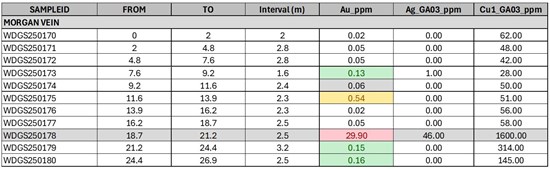
Table 2: Channel sampling results from the Morgan Vein showing a 19.30 metre-wide vein zone containing a high-grade shoot defined by a 2.5 metre sample grading up to 29.90 g/t Au.
To view an enhanced version of this graphic, please visit:
https://images.newsfilecorp.com/files/11018/288635_gptable12.jpg
Located approximately 600 metres northwest of the Wild Dog Deposit, early geological interpretation suggests the Morgan system represents a parallel mineralized structure to the Wild Dog vein system, supported by several key geological similarities:
- Comparable strike orientation and structural geometry.
- Curvilinear vein geometries typical of epithermal vein systems.
- Spatial association with a coincident west-dipping resistivity lineament defined by MobileMT geophysics.
Together, these characteristics suggest the Morgan Vein system forms part of a larger hydrothermal system developed along the Wild Dog Structural Corridor, reinforcing the interpretation that the district hosts multiple parallel epithermal vein systems developed along the 15-kilometre corridor.
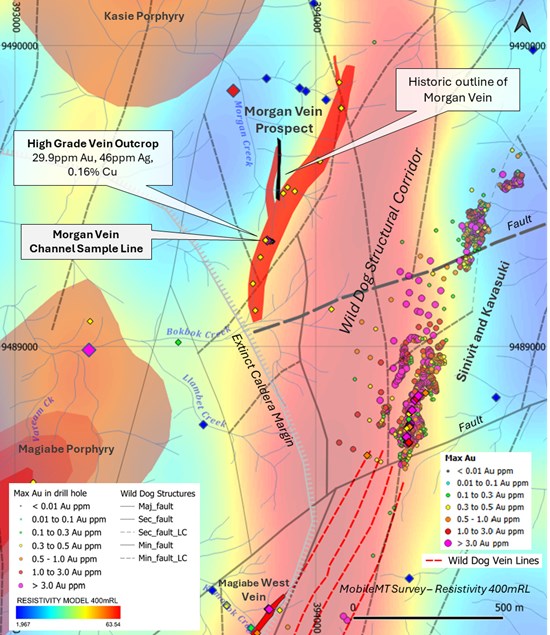
Figure 8: Plan view of the Morgan Vein Prospect showing the significant expansion of the mineralized footprint beyond the historically mapped vein, as defined by recent mapping and trench sampling returning up to 29.9 g/t Au, 46 g/t Ag and 0.16% Cu.
To view an enhanced version of this graphic, please visit:
https://images.newsfilecorp.com/files/11018/288635_d49c550cb4c2eb06_011full.jpg
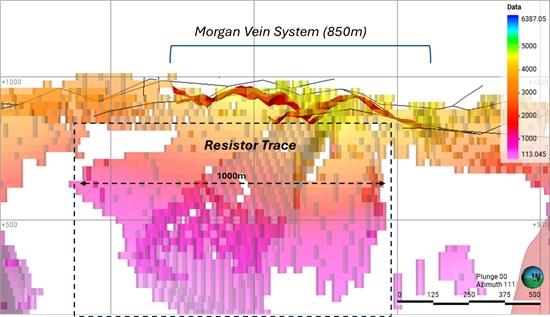
Figure 9: Strike-parallel long section of the Morgan Vein System, illustrating the spatial coincidence between the ~850 m mineralised corridor and the underlying resistivity anomaly defined by the MobileMT geophysical survey.
To view an enhanced version of this graphic, please visit:
https://images.newsfilecorp.com/files/11018/288635_d49c550cb4c2eb06_012full.jpg
The MobileMT resistivity section shown in Figure 9 highlights a strong spatial correlation between the mapped Morgan Vein corridor and a prominent subsurface resistivity anomaly extending to depth. Elevated resistivity responses in epithermal environments are commonly associated with zones of silicification and quartz veining, which can form as hydrothermal fluids move through structurally controlled pathways. The coincidence of the ~850 m long surface mineralized corridor with this deeper resistive feature suggests that the Morgan Vein system may represent the shallow expression of a larger hydrothermal structure. This relationship provides an important exploration vector, indicating potential for additional veining and high-grade mineralization along strike and at depth within the broader Wild Dog Structural Corridor.
Advancing the Wild Dog Structural Corridor Target Pipeline
Systematic mapping, sampling and structural interpretation across the Wild Dog Structural Corridor continue to identify and expand multiple mineralized vein systems beyond the Sinivit and Kavasuki targets. These results reinforce the Company's interpretation that the Wild Dog area represents a district-scale epithermal gold-copper system, characterized by multiple parallel mineralized structures along the 15-kilometre corridor, with emerging indications of porphyry-style mineralization at depth, supported by evidence of intrusive bodies, associated alteration halos and complementary geophysical and geochemical anomalies.
The Company's exploration strategy is focused on systematically expanding and advancing this pipeline of high-priority targets through integrated historic data review, detailed geological mapping, geochemical sampling, geophysics, remote sensing, structural analysis, and targeted drilling. This integrated approach aims to refine structural interpretations, vector toward high-grade mineralization, identify additional parallel or subsidiary vein systems, and further evaluate the potential for deeper porphyry-related targets.
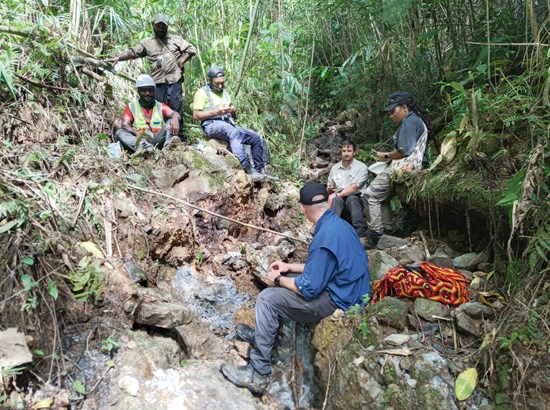
Figure 10: Exploration team conducting geological mapping and rock-chip sampling at the Magiabe West Vein within the southern portion of the Wild Dog Structural Corridor, East New Britain, Papua New Guinea.
To view an enhanced version of this graphic, please visit:
https://images.newsfilecorp.com/files/11018/288635_d49c550cb4c2eb06_013full.jpg
Notes:
- Rock-chip samples are selective by nature and may not represent underlying mineralization.
- Channel sample intervals represent measured sample lengths; true widths are unknown at this stage.
- Gold equivalent (AuEq) exploration results are calculated using longer-term commodity prices with a copper price of US$4.50/lb, a silver price of US$27.50/oz and a gold price of US$2,000/oz. No metallurgical testing has been carried out on Wild Dog mineralized samples. For AuEq calculations, recovery assumptions of Au 92.6%, Ag 78.0%, and Cu 94.0% were used based on K92 Mining's stated recovery results in an Updated Definitive Feasibility Study for the Kainantu mine.
Qualified Person
The technical content of this news release has been reviewed, verified and approved by Callum Spink, the Company's Vice President, Exploration, who is a member of the Australian Institute of Geoscientists, MAIG, and a Qualified Person as defined by National Instrument 43-101 Standards of Disclosure for Mineral Projects. Mr. Spink is responsible for the technical content of this news release. Mr. Spink is not independent of the Company.
Quality Assurance / Quality Control (QAQC)
The Company follows industry-standard Quality Assurance and Quality Control (QA/QC) procedures. Rock-chip and channel samples were collected by the Company's geological team and submitted to Intertek Minerals Ltd. in Lae, Papua New Guinea, an ISO 9001-certified independent analytical laboratory with internationally recognized quality standards.
Gold analyses were completed by fire assay, with copper and silver initially determined by aqua regia digestion and atomic absorption and subsequently updated using four-acid digestion (MS48) multi-element analysis.
Certified reference materials (standards) and blanks were inserted into the sample stream at industry-standard frequencies, including routine insertion of blanks following mineralised intervals. All assay batches received to date have passed QA/QC review and fall within acceptable tolerance limits.
About Great Pacific Gold
Great Pacific Gold's vision is to become the leading gold-copper development company in Papua New Guinea ("PNG"). The Company has a portfolio of exploration-stage projects in PNG, as follows:
- Wild Dog Project: the Company's flagship project is located in the East New Britain Province of PNG. The project consists of a large-scale epithermal target, the Wild Dog structural corridor, stretching 15 km in strike length and potentially over 1,000 metres deep based on a recent MobileMT geophysics survey. The survey also highlighted the Magiabe porphyry target, adjacent to the epithermal target and potentially 1,000 metres in diameter and over 2,000 metres deep. Drilling of the epithermal structure on the Sinivit target has yielded high-grade results, including WDG-08 which intercepted 8.4 metres at 50 g/t AuEq from 154 metres. The 2026 exploration program includes two diamond drill rigs and multiple field exploration crews.
- Kesar Project: located in the Eastern Highlands Province of PNG and contiguous with the mine tenements of K92 Mining Inc. ("K92"), the Kesar Project is a greenfield exploration project with several high-priority targets in close proximity to the property boundary with K92. Multiple epithermal veins at Kesar are on strike and have the same orientation as key K92 deposits, such as Kora. Exploration work to date by the Company at the Kesar Project has shown that these veins have high grades of gold present in outcrop and very elevated gold in soil grades, coincident with aeromagnetic highs. The Company conducted a diamond drill program on key target areas at the Kesar Project from November 2024 to May 2025 and have developed a follow-up Phase 2 program for 2026.
- Arau Project: also located in the Eastern Highlands Province of PNG, the Arau Project is south of and contiguous to the mine tenements of K92. Arau contains the highly prospective Mt. Victor exploration target with potential for a high sulphidation epithermal gold-base metal deposit. A Phase 1 Reverse Circulation drilling program was completed at Mt. Victor in August 2024, with encouraging results. The Arau Project includes the Elandora licence, which also contains various epithermal and copper-gold porphyry targets.
The Company also holds the Tinga Valley Project in PNG.
Forward-Looking Statements
Information set forth in this news release contains forward-looking statements that are based on assumptions as of the date of this news release. These statements reflect management's current estimates, beliefs, intentions and expectations. They are not guarantees of future performance. Great Pacific Gold cautions that all forward-looking statements are inherently uncertain and that actual performance may be affected by many material factors, most of which are beyond their respective control. Such factors include, among other things: risks and uncertainties relating to Great Pacific Gold's limited operating history, its exploration and development activities on its mineral properties and the need to comply with environmental and governmental regulations. Accordingly, actual and future events, conditions and results may differ materially from the estimates, beliefs, intentions and expectations expressed or implied in the forward-looking information. Except as required under applicable securities legislation, Great Pacific Gold does not undertake to publicly update or revise forward-looking information.
Mineralization at the properties held by K92 Mining Inc. and at the Wafi-Golpu deposit is not necessarily indicative of mineralization at the Wild Dog Project.
Neither TSX Venture Exchange nor its Regulation Services Provider (as that term is defined in the policies of the TSX Venture Exchange) accepts responsibility for the adequacy or accuracy of this release.

To view the source version of this press release, please visit https://www.newsfilecorp.com/release/288635

© 2026 Canjex Publishing Ltd. All rights reserved.