(via TheNewswire)
Vancouver, British Columbia – April 16, 2026 – TheNewswire – Fitzroy Minerals Inc. (TSXV: FTZ, OTCQX: FTZFF, FSE: C3Y ) (“ Fitzroy ” or the “ Company ”) is pleased to provide an update on definition drilling, metallurgical test work for the Pre-Feasibility Study (“ PFS ”), and the Ambient Noise Tomography (“ ANT ”) geophysical survey at the Buen Retiro Copper Project, Copiapó, Chile.
Highlights
Drill hole BRT-DDH048 returned 92.5 m @ 0.53% Cu from 3.5 m, including 46.0 m @ 0.82% Cu from 36.0 metres.
Drill hole BRT-DDH049 returned 83.0 m @ 0.57% Cu from 95.0 m, including 43.0 m @ 0.90% Cu from 95.0 metres.
Metallurgical test work at SGS Laboratories started on a 2,900 kg representative sample.
Fleet Space Technologies’ passive seismic ANT geophysical survey has been completed across a 5 km x 5 km area, with processing and interpretation underway.
Merlin Marr-Johnson, President and CEO of Fitzroy Minerals, commented: “ The resource definition drilling is advancing quickly and has intersected many samples that exceed the ALS laboratory 1% Cu maximum limit for ‘exploration’ assay methods in the southwest area. Although these samples have to be re-assayed using ‘ore grade’ assay methods, and many results are pending, it shows there is plenty of copper in the system. The start of metallurgical test work for the PFS is a milestone event.
The ANT geophysical survey is a step forward in the hunt for a major sulphide discovery at Buen Retiro. Our aim is to leverage potential future cash flow from the Buen Retiro Heap Leach copper operation to fund the continued exploration for major copper deposits in Chile (including Buen Retiro and Caballos) with minimal dilution.”
Overview
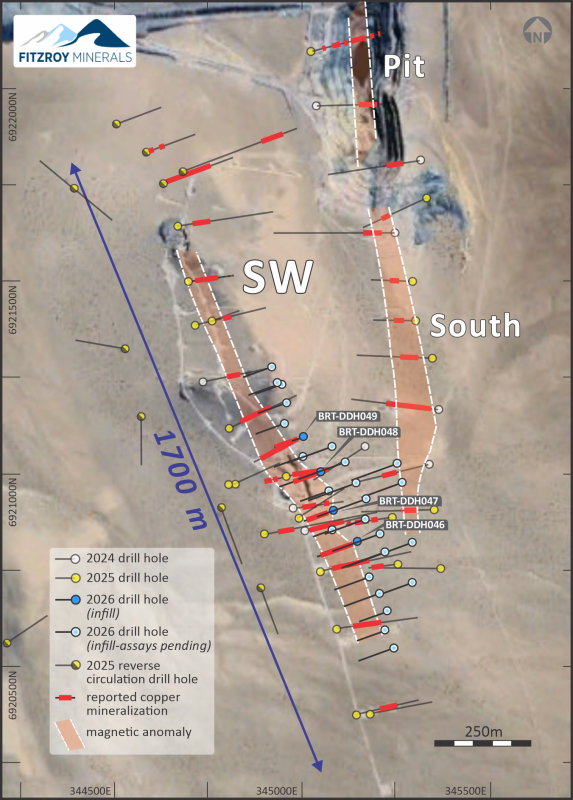
A definition drilling program for a maiden mineral resource estimate is underway, using two drill rigs. Building on mineralization identified in previous drill holes, 32 new diamond drill holes (5,143 metres) in the southwest area have been completed and assays are pending. The drill hole plan is being expanded as fresh zones of shallow mineralization are intersected to the east, towards the southern area. The aim is to delineate sufficient material in the Measured and Indicated Resource categories (as such terms are defined under National Instrument 43-101 Standards of Disclosure for Mineral Projects (“ NI 43-101 ”)) to provide a robust life-of-mine production plan for the Heap Leach project, and inclusion in the PFS. Additional definition drilling aims to delineate Inferred Resources (as such term is defined under NI 43-101) that may represent a source of future plant feed subject to conversion to higher-confidence resource classifications through subsequent drilling .
Figure 1. Plan map with location of definition drill holes, Buen Retiro, Copiapó, Chile (UTM WGS 84 19S). |
Click Image To View Full Size
|
Both drill rigs will continue with definition drilling while step-out drilling continues to intersect mineralization. Given current progress rates, it is anticipated that definition drilling will be completed in May; at that point, the two drill rigs will be re-allocated. One drill rig will start with a minimum of 8,000 metres of Phase 3 exploration drilling, to explore for sulphide mineralization and test the ANT targets. The other drill rig will execute a 2,000 metre geotechnical drilling program prior to be switched for a smaller rig that will carry out definition drilling in the bottom of the historical open pit.
Representative samples totalling 2,900 kg have been selected for metallurgical test work. Three primary geo-metallurgical domains have been defined: a higher-grade oxide domain (≥ 0.5% Cu), a lower-grade oxide domain (0.10-0.5% Cu), and a mixed supergene transition domain that typically matches the higher-grade oxide domain in grade. The classification reflects both the geometry of the deposit and the metallurgical response expected from the principal mineral assemblages. Initial test work for the PFS is underway at SGS Laboratories. The metallurgical program includes variability analysis across key lithological controls; targeted testing of hydrothermal breccia and iron-rich units; permeability and column leach testing; and evaluation of acid consumption behaviour.
The regional Fleet Space Technologies passive seismic ANT geophysical survey has been completed across a 5 km x 5 km area. Data processing and interpretation is underway. A higher-resolution survey over a central 2 km x 3 km area, covering priority targets, will be carried out once information from the first survey is interpreted.
Drilling, Assaying, and Geology Update
Fitzroy is currently carrying out definition drilling of known mineralized trends with two drill rigs, to delineate Measured and Indicated Resources, as per NI 43-101 standards. The resource work is solely focused on the oxide, mixed and supergene material down to a maximum depth of 150 metres below surface, for inclusion in a planned PFS which will incorporate the Heap Leach project. Elsewhere, wider-spaced shallow drilling is aiming to delineate Inferred Resources. Although not to be included in the PFS life-of-mine plan, these additional resources may, subject to further work, contribute to future mine-life.
Drill holes BRT-DDH046 to BRT-DDH077 (32 drill holes) have been completed, for a total of 5,143 metres, drilled with HQ core (63.5 mm diameter), and evenly spaced across the southwest area to provide representative coverage of the prospective resource area.
The HQ drill core was cut in half with a diamond saw, and then one half was quartered. Half core was accumulated to generate samples for metallurgical test work. To date, 2,900 kg of metallurgical samples has been sent to SGS laboratories. One quarter was sent for assay, and one quarter remains in the core tray.
Core is analysed at ALS-Patagonia laboratory by multi-element ICP (ME-ICP41) suitable for exploration geochemistry. Samples with more than 1,000 ppm Cu are automatically sent for Sequential Copper analysis (CuS%, CuCN% and CuR%), Au Fire Assay, and Total Copper (CuT%) (Cu-AA62) via Atomic Absorption (“AAS”). Cu-AA62 is assay of “Ore grade Cu by HF-HNO3-HClO4 digestion, HCl leach and AAS”.
The high-grade copper samples are predominantly found close to the central axis of the dominant structure that controls the ferric breccias. The high-grade copper samples can be either oxide in the oxide zone, or secondary minerals in the mixed supergene transition zone.
Of the 32 drill holes, 19 complete drill holes have been submitted for assay and 13 are currently being logged and processed. Full results from four drill holes have been returned, four drill holes have partial results (with >1% Cu results pending), and 11 drill holes are pending assay.
The drill holes reported herein show a relatively consistent thickness of the copper-mineralized package in the southwest area, that is about 80-90 m thick, with lower grade shoulders around a central core of higher grade copper material. The intersections of these holes represent 80-90% of the true thickness of the copper-mineralized zone.
This package dips approximately 75 o to the east-northeast. Logging of the other drill holes confirms this broad geometry, with variable thickness of the higher grade central zone. Drill hole BRT-DDH048, for example, returned a higher grade zone of 46 metres at 0.82% Cu, while drill hole BRT-DDH049 returned 43 metres at 0.90% Cu. Typically, the upper 60-100 m are oxidized, with oxidation depths mostly a function of fracture density, before entering the upper supergene-mixed zone.
Table 1. Definition Drilling core assay results* for drill holes BRT-DDH046 to BRT-DDH049, Buen Retiro, Copiapó, Chile (UTM WGS84 19S). |
Drill Hole | UTM East (m) | UTM North (m) | Azimuth / Dip | From (m) | To (m) | **Interval (m) | Cu (%) |
BRT-DDH046 | 345146 | 6920832 | 250/-45 | 28.5 | 109.0 | 80.5 | 0.44 |
including | | | | 28.5 | 102.0 | 73.5 | 0.47 |
BRT-DDH047 | 345084 | 6920916 | 250/-48 | 20.5 | 114.0 | 93.5 | 0.28 |
including | | | | 22.0 | 88.0 | 66.0 | 0.33 |
BRT-DDH048 | 345049 | 6921010 | 250/-45 | 3.5 | 96.0 | 92.5 | 0.53 |
including | | | | 36.0 | 82.0 | 46.0 | 0.82 |
BRT-DDH049 | 345012 | 69210989 | 250/-45 | 71 | 154 | 83 | 0.57 |
including | | | | 95 | 138 | 43.0 | 0.90 |
* Calculated on a minimum thickness of 5 m and minimum average grade of 0.20% Cu
**Estimated to be 80-90% of true thickness
Geo-Metallurgical Domains
Fitzroy has defined a practical and operationally robust geo-metallurgical classification framework that reflects both the geometry of the deposit and the metallurgical response expected from the principal copper oxide mineral assemblages. This classification reflects the mineralogical controls on recovery behaviour and supports the design of differentiated treatment strategies across the leachable resource envelope. Three primary geo-metallurgical domains have been defined:
1. Higher-Grade Oxide Domain (≥ ~0.5% Cu)
Material associated with the central iron-rich structural corridor and hydrothermal breccias, containing a higher proportion of recoverable copper hosted within limonite and oxide assemblages. This domain is expected to respond favourably to enhanced leaching conditions.
2. Lower-Grade Oxide Domain (0.1% to ~0.5% Cu)
Peripheral mineralized host rocks containing stockwork-style oxide copper mineralization. This domain is expected to support shorter leach cycles.
3. Higher-Grade Mixed Supergene Transition Domain
Material containing copper oxide and secondary sulphide mineral assemblages, including native copper, cuprite and chalcocite. This domain is metallurgically distinct and will be evaluated separately due to its differing oxidation requirements and chloride-assisted leaching response potential.
Conceptual modelling suggests that domain-specific treatment conditions may deliver meaningful improvements in overall copper recovery relative to a single blended oxide treatment strategy. The Company will also evaluate remnant material from the bottom of the historical Manto Negro pit area as part of the variability sampling framework to determine whether this zone represents a distinct metallurgical domain or can be incorporated within one of these three geo-metallurgical domains.
Metallurgical Test Work
Testing will evaluate the impact of mineralogy, alteration intensity, and host lithology on copper extraction kinetics and heap performance; acid consumption; leach cycle duration; possibilities for enhanced copper recoveries from higher-grade material; and flexibility in having staged development scenarios. The metallurgical program includes variability analysis across key lithological controls; targeted testing of hydrothermal breccia and iron-rich units; permeability and mini-column leach testing; and evaluation of acid consumption behaviour
Test work at SGS Laboratories, Quilicura, Santiago is underway.
Buen Retiro Core Sampling Procedures, Laboratory and QA/QC
Buen Retiro HQ drill core, in labelled and secured wooden core trays, is picked up from the drilling site by Company personnel and transported by truck from the drill rig to the core processing facility in Copiapó . Core lengths are checked, after which geotechnical logging is performed.
Using an electric core cutting diamond blade saw, primary half-core samples are collected from HQ- or NQ-sized drill core with the remaining half-core stored in the original wooden core trays at the rented core storage warehouse in Cuesta Cardones, south of Copiapó.
A silica blank is inserted every 20 samples (approximately every20 m); a blank is always inserted immediately after a section that contains native copper. Pulp duplicates are randomly selected in proportion to the number of samples from each drill hole and inserted into the sample stream along with high-, medium-, and low-grade copper standards. Sample identifications are changed and coded by the Company.
The Quality Assurance (QA) and Quality Control (QC) samples prepared by the Company represent about 12% of the total primary core samples. The three certified copper standards (both oxide and sulphide), acquired from Chilean company Instituto Nacional de Tecnología Estandarización y Metrología Ltda. (“ INTEM ”), have international standard certification. The certified standards are used to evaluate the accuracy (approximation versus true value) of the laboratory analysis. Blanks are used to evaluate the quality of the laboratory preparation and identify possible contamination. Pulp duplicates are used to test analytical accuracy (repeatability). No secondary laboratory (referee lab) samples were completed in this round of drilling; however, the next stage and subsequent stages of drilling will see a secondary laboratory introduced to replicate procedures.
Once prepared, the core samples are bagged, tagged, and transported to the laboratory by the project team. At the laboratory reception, the samples and their identification codes are verified and accepted once the physical inventory matches the assay request form.
The pulps and rejects of crushed samples are collected from the ALS-Patagonia laboratory in Copiapó every 3 months. The rejects are stocked in closed drums, identified with the corresponding batches and sample ranges, while the pulps are stocked in boxes and in shelves inside a container separated for this purpose. Both are located in the same Company warehouse facilities in Copiapó.
A visual review of the QA/QC results from the standards and blanks inserted by the Company and the laboratory’s internal QA/QC information was completed by the Company and no significant issues were identified.
The Company and Qualified Person are independent of the assay laboratories disclosed in this news release.
Qualified Person
Dr. Scott Jobin-Bevans (P.Geo., Ph.D., PMP), a QP as defined by NI 43-101 and independent geological consultant to the Company, has reviewed and approved the technical information provided in this news release and verified the data disclosed, including the sampling, analytical and test data underlying the technical information contained in this news release. Specifically, the QP verified selected laboratory assay results against the reported drill core intervals as well as drill core logs against the geology, as supplied by the Company .
Dr. Scott Jobin-Bevans has not been able to independently verify the Candelaria mineralization and as such the mineralization described is not necessarily indicative of the mineralization on the Buen Retiro Copper Project.
About Fitzroy Minerals
Fitzroy Minerals is focused on exploring and developing copper-focused mineral assets with substantial upside potential in the Americas. The Company’s current property portfolio includes the Buen Retiro Copper Project located near Copiapó, Chile, the Caballos Copper and Polimet Gold-Copper-Silver projects located in Valparaiso, Chile, the Taquetren Gold Project located in Rio Negro, Argentina, and the Caribou Project in British Columbia, Canada. Fitzroy Minerals’ shares are listed on the TSX Venture Exchange under the symbol FTZ and on the OTCQX under the symbol FTZFF.
On behalf of the board of Fitzroy Minerals Inc.
Merlin Marr-Johnson
President and CEO
For further information, please contact:
Merlin Marr-Johnson
+447803712280
mmj@fitzroyminerals.com
For more information on Fitzroy Minerals, please visit the Company's website: www.fitzroyminerals.com
Neither Exchange nor its Regulation Services Provider (as that term is defined in the policies of the Exchange) accepts responsibility for the adequacy or accuracy of this release.
CAUTIONARY STATEMENT REGARDING FORWARD-LOOKING INFORMATION
This news release includes certain statements and information that constitute forward-looking information within the meaning of applicable Canadian securities laws. All statements in this news release, other than statements of historical facts are forward-looking statements. Such forward-looking statements and forward-looking information specifically include, but are not limited to, statements that relate to the potential mineralization on the Company’s mineral properties, future exploration plans on the Company’s mineral properties and the timing and results of future exploration.
Statements contained in this release that are not historical facts are forward-looking statements that involve various risks and uncertainty affecting the business of the Company. Such statements can generally, but not always, be identified by words such as "expects", "plans", "anticipates", "intends", "estimates", "forecasts", "schedules", "prepares", "potential" and similar expressions, or that events or conditions "will", "would", "may", "could" or "should" occur. All statements that describe the Company's plans relating to operations and potential strategic opportunities are forward-looking statements under applicable securities laws. These statements address future events and conditions and are reliant on assumptions made by the Company's management, and so involve inherent risks and uncertainties, as disclosed in the Company's periodic filings with Canadian securities regulators, including without limitation, the dangers inherent in exploration, development and mining activities; actual exploration or development plans and costs differing materially from the Company’s estimates; the ability to obtain and maintain any necessary permits, consents or authorizations required for mining activities; environmental regulations or hazards and compliance with complex regulations associated with mining activities; climate change and climate change regulations; fluctuations in exchange rates; the availability of financing; operations in foreign and developing countries and the compliance with foreign laws, remote operations and the availability of adequate infrastructure; fluctuations in price and availability of energy and other inputs necessary for mining operations; shortages or cost increases in necessary equipment, supplies and labour; regulatory, political and country risks, including local instability or acts of terrorism and the effects thereof; the reliance upon contractors, third parties and joint venture partners; challenges to title or surface rights; the dependence on key personnel and the ability to attract and retain skilled personnel; the risk of an uninsurable or uninsured loss; adverse climate and weather conditions; litigation risk; and competition with other mining companies. As a result of these risks and uncertainties, and the assumptions underlying the forward-looking information, actual results could materially differ from those currently projected, and there is no representation by the Company that the actual results realized in the future will be the same in whole or in part as those presented herein. the Company disclaims any intent or obligation to update forward-looking statements or information except as required by law. Readers are referred to the additional information regarding the Company's business contained in the Company's reports filed with the securities regulatory authorities in Canada. Although the Company has attempted to identify important factors that could cause actual actions, events, or results to differ materially from those described in forward-looking statements, there may be other factors that could cause actions, events or results not to be as anticipated, estimated or intended. For more information on the Company and the risks and challenges of its business, investors should review the Company's filings that are available at www.sedarplus.ca.
Copyright (c) 2026 TheNewswire - All rights reserved.
© 2026 Canjex Publishing Ltd. All rights reserved.