(via TheNewswire)
Vancouver, BC – TheNewswire - October 16, 2026 – Global Stocks News - Sponsored content disseminated on behalf of Oceanic Iron Ore. On October 14, 2026, Oceanic Iron Ore (TSXV: FEO) issued a message to shareholders entitled, “What We Learned from the Hopes Advance Re-Scoped PEA.”
Oceanic is focused on the development of its 100% owned Hopes Advance, Morgan Lake and Roberts Lake iron ore projects located on the coast, in the Labrador Trough in Québec, Canada.
The flagship Hopes Advance Project has a NI 43-101 Measured & Indicated resource of about 1.36 billion tonnes at a head grade of 32.1% Fe. The project is located at tidewater. The PEA highlights that Oceanic will not require a railroad to get its iron ore to market, significantly reducing capital expenses and operating costs.

Click Image To View Full Size
What We Learned from the Hopes Advance Re-Scoped PEA
Chris Batalha
CEO of Oceanic Iron Ore
Because Oceanic Iron Ore was in strategic hibernation for over a decade, many of our technical studies and engineering reports need to be updated to reflect current input costs and commodity prices. We are now focused on that task.
In November 2012, Oceanic completed a Pre-Feasibility Study (PFS) on the Hopes Advance asset and issued a NI 43-101 report summarizing the results.
For the following two years, Oceanic advanced permitting, process flow sheets, product marketability and shipping optimization. By 2014, as iron ore prices drifted lower, Oceanic entered cash preservation mode.
By 2019, Oceanic concluded that the results of the 2012 PFS, including the cost estimates and economic analysis, were no longer reflective of the current market environment and should not be relied upon. We commissioned a Hopes Advance Re-Scoped PEA.
The main rationale for the 2019 study was to determine whether it was possible to achieve an acceptable return on investment by scaling down the production profile while reducing up-front capital to bring Hopes Advance to commercial production.
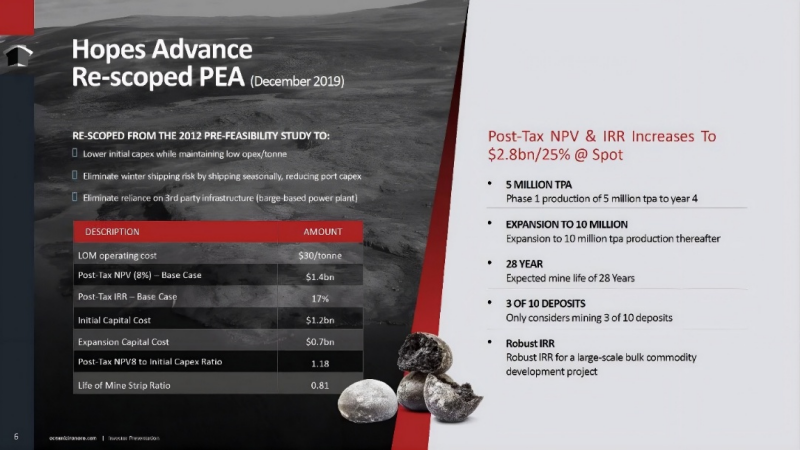
The re-scoped PEA is based on an initial production of 5 million tonnes per year (Mtpa) of dry concentrate, followed by an expansion in Year 5 to 10 Mtpa. The financial analysis was based on a 28-year mine life, targeting only the three main deposits (Castle Mountain, Iron Valley and Bay Zone F) of Hopes Advance.
The technical report noted that “ There is potential to continue the operations beyond 28 years . For both the initial and expansion phases, power is self-generated using diesel fuel by a barge-based power plant. The product is filtered at the concentrator site and transported year-round by truck to the port stockpile . Concentrate is shipped during the summer months and stockpiled during the winter months.”
Seasonal shipping is expected to reduce the cost of port infrastructure and avoid the transshipment of concentrate during the winter months. The re-scoped PEA proposed a modified process flowsheet that is more energy efficient , aimed at reducing power requirements (and fuel storage) and improving the project’s carbon footprint .
The 2019 re-scoped PEA noted an improvement in market conditions “mainly driven by government pressure on Chinese steel mills to reduce air emissions”. This increased demand for iron ore feedstocks having higher Fe grade and lower content of deleterious elements such as silica, alumina and phosphorus resulted in a significant increase in ‘quality premiums’ paid for higher purity iron ore products .
The report noted that, “In the Labrador Trough, previously curtailed operations have been successfully restarted, including Champion Iron’s Bloom Lake Mine.”
The 2019 re-scope accomplished three specific goals: 1. Lowered initial mine capex with no increase in opex. 2. Reduced port capex by shifting to seasonal shipping. 3. Eliminated third-party infrastructure reliance by using a barge-mounted diesel power plant.
The proposed mining method consists of a conventional open-pit, truck-and-shovel, drill-and-blast operation. A 26-kilometre access road will connect the mine to the port. At the port, concentrate is stacked using a common conveyor belt that discharges onto the ship-loading conveyor.
The 2019 re-scope was not a retreat — it was a strategic move that made the project financeable.
In the next message, I will explain more about our capex advantage.
By Chris Batalha
CEO of Oceanic Iron Ore
Click below to learn more about Oceanic Iron Ore.
Click Image To View Full Size
Contact: guy.bennett@globalstocksnews.com
Disclaimer: Oceanic Iron Ore paid Global Stocks News (GSN) $1,200 for the dissemination of this content.
Full Disclaimer: GSN researches and fact-checks diligently, but we cannot ensure our publications are free from error. Investing in publicly traded stocks is speculative and carries a high degree of risk. GSN publications may contain forward-looking statements such as “project,” “anticipate,” “expect,” which are based on reasonable expectations, but these statements are imperfect predictors of future events. When compensation has been paid to GSN, the amount and nature of the compensation will be disclosed clearly.

Copyright (c) 2026 TheNewswire - All rights reserved.
© 2026 Canjex Publishing Ltd. All rights reserved.