Saskatoon, Saskatchewan--(Newsfile Corp. - April 16, 2026) - 1844 Resources Inc. (TSXV: EFF) ("1844" or the "Company") is pleased to provide a follow-up on its recent geological disclosure, further refining the understanding of mineralization styles and controls at its flagship SV2 copper project in the Gaspé Peninsula, Québec.
The Company has integrated historical data, stratigraphic interpretation, and alteration models to better characterize the distribution of copper mineralization across multiple horizons within the system.
Key Geological Developments
The discovery of porphyry- and skarn-style copper deposits in Gaspé, associated with felsic to intermediate porphyritic intrusions, requires a detailed understanding of the geological units present. The Mont Copper porphyry copper deposit, together with the cupriferous skarns at Mont Needle and Sullipek, provides a strong illustration of this style of mineralization.
All of these deposits share common characteristics: they developed within the same stratigraphic unit, the Gaspé Superior Limestones, and are linked to a deep heat source responsible for hydrothermal activity. This activity produces an alteration halo which, under favorable conditions, can lead to the formation of significant mineral deposits. This extensive alteration system includes unaltered sedimentary rocks, as well as skarns, porcelanites, hornfels, marbles, and porphyritic intrusive rocks. Copper may occur throughout the alteration halo, but it is primarily associated with skarns, porcelanites, and retrograde vein systems (stockworks) formed during the cooling of the intrusive units.
Several factors favor the emplacement of mineralization within this alteration halo:
- Host rock lithogeochemistry: The chemical composition of the host rocks plays a key role, as it may favor the precipitation of sulfide minerals. Suitable geochemistry allows mineralizing elements to migrate and accumulate.
- Fracture zones and porosity: Fractures, faults, and rock porosity facilitate the circulation of mineralizing fluids, increasing the probability of mineralization. These zones act as preferential pathways for the transport of the elements required to form deposits.
- Heterogeneity of sedimentary formations with impermeable strata: The alternation of permeable and impermeable layers creates natural traps for minerals, promoting their movement and accumulation. This heterogeneity helps retain mineralizing fluids in specific areas, maximizing deposit formation.
- Upward-dipping strata: Upward-dipping beds facilitate the vertical migration of mineralizing fluids, promoting the movement of mineralizing elements toward favorable zones of concentration.
- Folds: Anticlinal and monoclinal folds create structural traps where fluids may accumulate and mineralization may concentrate. Secondary parasitic folds associated with major regional folds may also locally focus mineralization and create priority exploration targets.
The Gaspé Superior Limestones include several sedimentary formations capable of hosting metamorphic and metasomatic alteration zones related to the emplacement of felsic to intermediate porphyritic intrusions. At Murdochville, these formations include Indian Cove, Shiphead, and Forillon (Figure 1).
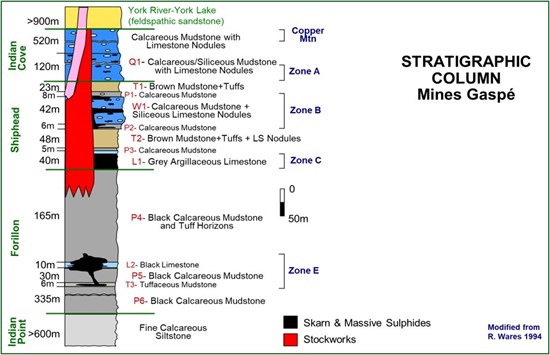
Figure 1
To view an enhanced version of this graphic, please visit:
https://images.newsfilecorp.com/files/8892/292853_gaspe_strat.jpg
At Sullipek and Sullipek East, the prospective units, which occur lower in the sedimentary sequence, are the Forillon, IP1, and West Point formations (Figure 2).
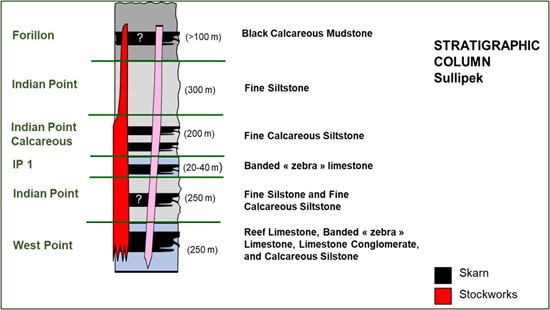
Figure 2
To view an enhanced version of this graphic, please visit:
https://images.newsfilecorp.com/files/8892/292853_sullipek_strat.jpg
Management Commentary
Sylvain Laberge, President & CEO, added:
"What is particularly compelling is the direct correlation between surface mineralization at SV2 and the deeper horizons observed in the Murdochville district. This positions our project within the same mineralized system and provides a clear geological framework to guide exploration. With permits secured and targets advancing, we are now moving toward a focused drill program designed to test this model."
Next Steps
The Company is incorporating this refined mineralization model into its 2026 exploration program. Upcoming work will focus on:
- Final targeting of priority drill zones
- Integration of historical drilling with modern geophysics
- Systematic testing of key stratigraphic and alteration-controlled targets
Further updates will be provided as the Company advances toward its planned drill campaign in late summer / early fall 2026.
About 1844 Resources Inc.
1844 is a Canadian exploration company focused on unlocking the value of strategic and energy-transition metals in the underexplored region of the Gaspé Peninsula, Québec. The Company is committed to disciplined exploration and long-term value creation through discovery.
Qualified Person
Bernard-Olivier Martel, P.Geo, Director of Exploration, is a Qualified Person as defined by National Instrument 43-101 and has reviewed and approved the technical information contained in this news release.
Forward-Looking Information
This press release contains forward-looking statements and information within the meaning of applicable securities laws. These statements relate to future exploration plans, geological interpretations, and potential mineralization. Forward-looking statements are subject to risks and uncertainties that could cause actual results to differ materially from those expressed or implied. Readers are cautioned not to place undue reliance on forward-looking statements. The Company undertakes no obligation to update such statements except as required by law.
To view the source version of this press release, please visit https://www.newsfilecorp.com/release/292853

© 2026 Canjex Publishing Ltd. All rights reserved.