(via TheNewswire)
Vancouver, BC – TheNewswire - June 30, 2026 – Global Stocks News - Sponsored content disseminated on behalf of Crossroads Gold. On June 25, 2026 Crossroads Gold (TSXV: CRG) (OTCQB: CRGCF) (FSE: FI1) announced that it has compiled mining records, Geological Survey Data, structural interpretations and historical production data into a modern exploration framework at the Pambula Gold Project in New South Wales, Australia, in preparation for its maiden drill program.
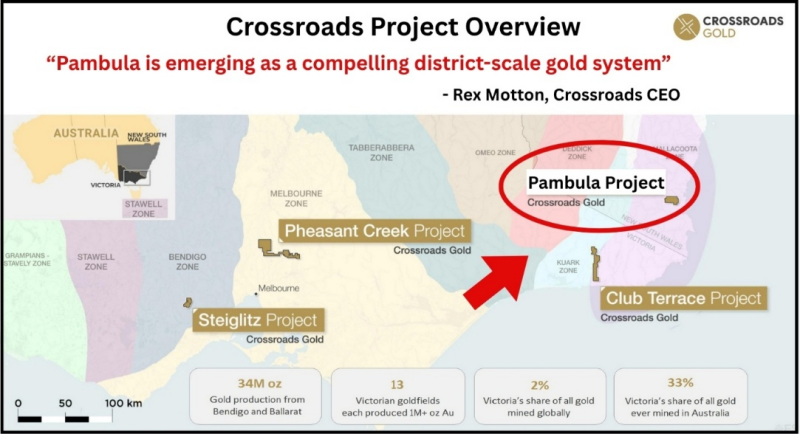
Crossroads Gold is developing multiple gold projects in southeastern Australia, a metal-rich Tier-1 mining jurisdiction. The Company’s portfolio includes the Pambula Gold Project , the Steiglitz Gold Project, the Pheasant Creek Project, and the Club Terrace Project.
Click Image To View Full Size
“I first visited Pambula in 2013 while I was on holiday with my family,” Rex Motton, Crossroads CEO & Director, told Guy Bennett, the CEO of Global Stocks News (GSN). “I noticed that it had been staked. Over the years, I kept my eye on it, watched different operators come and go. The property has not been drilled for 46 years. After more than a century of mining history and four decades without drilling, Crossroads believes Pambula represents one of Australia's most overlooked gold exploration opportunities."
The New South Wales government has a Mines & Resources website, where Crossroads has been downloading archival exploration licenses, reports, maps and drill data. Some of the data dates back to the 1890s.
Although historical mining in the 1890’s achieved recovered grades estimated at 30 g/t gold, modern exploration has been minimal , with most work in the 1980s focused on shallow, open-pit concepts. As a result, Motton believes that significant potential remains for deeper drilling targeting sulphide-hosted mineralization.
“Historical evidence suggests the field's decline was driven more by metallurgical limitations and lack of capital — not because the geological system was depleted,” stated Motton. “Modern exploration methods and contemporary sulphide-processing technologies offer the potential to unlock substantial value across this underexplored district."
Key findings from historical data compilation:
Broad, continuous gold mineralization at depth, highlighted by hole DDH-P7 returning 16m at 2.36 g/t Au from 94m, including 5m at 6.62 g/t Au , with no follow-up drilling completed on the main Victory ore shoot.
Untested deep structural targets , including a feeder-zone target at 400m depth and a shallower similar style Crossroads-defined target at approximately 250-300m depth.
Evidence of a large, structurally controlled hydrothermal system , including east-dipping lodes, brecciated corridors, sulphide-associated mineralization and north-plunging high-grade shoots.
Increasing sulphide and arsenopyrite mineralization with depth , consistent with deeper sulphide-hosted gold systems in southeastern Australia.
Uncharacterized silver and antimony potential , with historical references to electrum, silver sulphosalts and stibnite, but no systematic modern analysis.
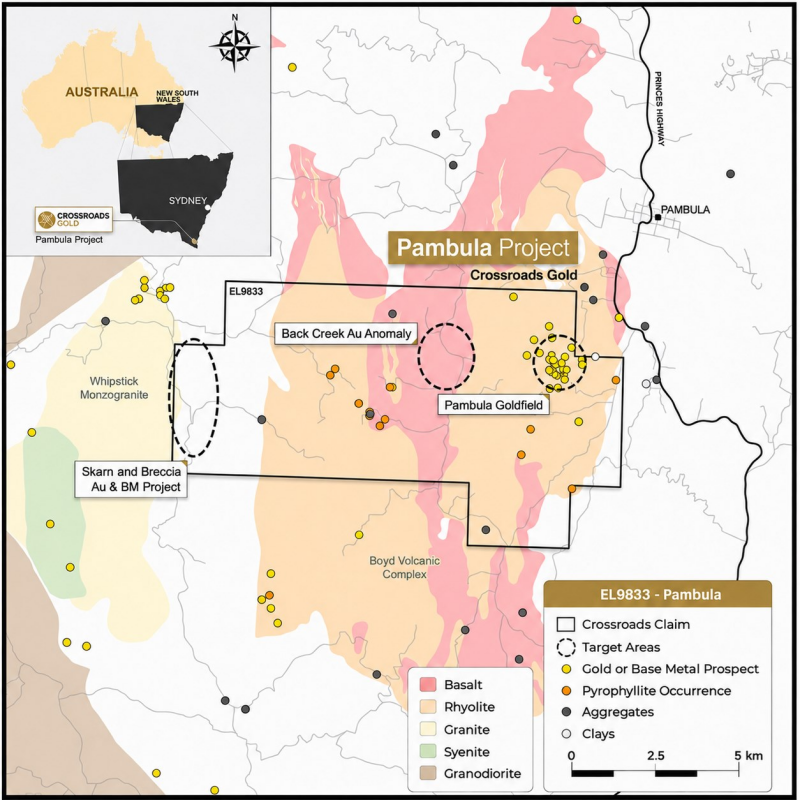
The reinterpretation suggests continuity between several major historical mines and highlights multiple district-scale targets beyond the historical workings, including the PRC32 magnetic anomaly, Hidden Treasure, Morning Star, Diorite structures and the Southern Yowaka corridor. These structures are in close proximity and could be mined from a central underground facility.
Crossroads’ integration of the compiled modern and historical dataset is well advanced with GIS mapping layers and 3D models developed to support systematic exploration, including structural modelling and proposed deeper drilling.
Click Image To View Full Size
The first Department of Mines report in 1890 stated that, “There is a newly discovered goldfield. A large number of claims have been taken up along the ridges, and on these leases numerous shafts have been sunk, the deepest being 50 feet.”
A year later, eleven companies were actively operating at Pambula, with 350 miners and a total population of 2,000 men, women & children living in the area.
From 1888-1914, the Pambula Goldfield supported numerous operating mines. When production at Pambula halted at the start of World War I, the price of gold was $20/ounce – about $650/ounce in today’s dollars. By this time, the easily accessible surface gold was largely depleted.
Limited deep mining had occurred. The deepest shaft was at the Mt Gahan mine, which went down to 152 metres. The other mines were all generally less than 60 metres deep and within the weathered zone.
Only 32 historical drill holes (2,515m total) have tested the Pambula Goldfield, with the deepest hole reaching 271m (DDH-P7) and no drilling below 230m vertical depth at the hole end.
“Back in the 1980s, with the gold price heading north, explorers were still looking for shallow near-surface bulk mining gold deposits,” Motton told GSN. “Stuff you could extract with excavators. That was easy pickings. For the most part, they weren’t thinking about deep underground mines.”
“Our drill permit application has gone through the resources department approval process. The final step is to be issued a forest permit. There is an access road that goes through the Pambula Goldfield, giving us multiple opportunities to set up drill pads along the old track.”
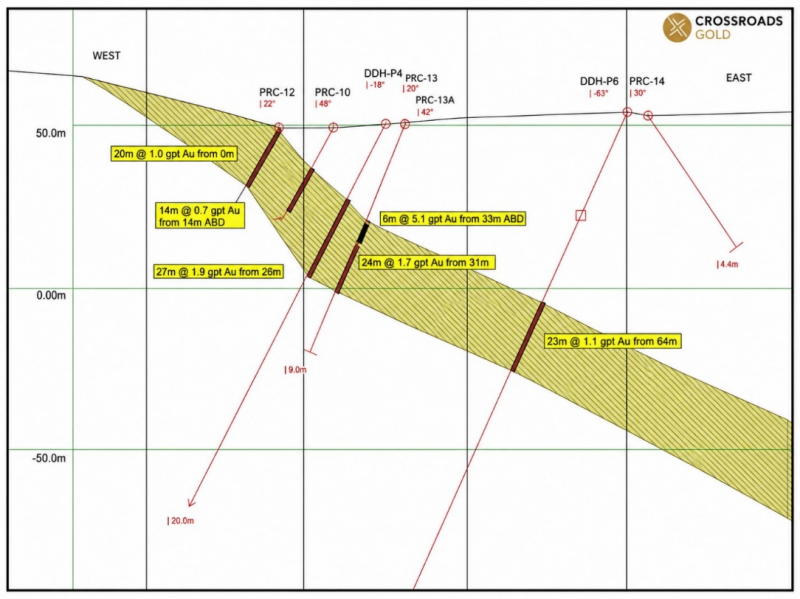
“We anticipate that the permitting process will be completed in the next few weeks and that we will start drilling once that permit has been issued. We’ll be focused on the Pilot Fissure, also some of the other parallel and linking structures.”
Click Image To View Full Size
Above: Pilot Fissure Cross Section from previous drilling.
“We're fully capitalized for this program,” Motton told GSN. “We can drill year-round. Autumn or Spring are the best because it’s not too hot, cold or wet. The property is hilly, but has good road access.”
"Pambula is emerging as a compelling district-scale gold system , with strong indications of structural continuity and sulphide-hosted mineralization that present an excellent opportunity for systematic exploration,” concluded Motton.
The scientific and technical information contained in this news release was reviewed and approved by Mr. Neil (Rex) Motton, who is a "Qualified Person" (as defined in National Instrument 43-101 - Standards of Disclosure for Mineral Projects ). Mr. Motton is the CEO and a Director of the Company and therefore is not considered independent of the Company in accordance with National Instrument 43-101 - Standards of Disclosure for Mineral Projects. Mr. Motton has visited the Pambula Project discussed in the June 25, 2026 press release.
Disclaimer: Crossroads Gold paid GSN $1,750 for the research, creation and dissemination of this content.
Contact: guy.bennett@globalstocksnews.com
Full Disclaimer: Global Stocks News (GSN) researches and fact-checks diligently, but we cannot ensure our publications are free from error. Investing in publicly traded stocks is speculative and carries a high degree of risk. GSN makes no recommendation to purchase any individual stock. There may be forward-looking statements such as “project,” “anticipate,” “expect,” which are based on reasonable expectations, but these statements are imperfect predictors of future events. When compensation has been paid to GSN, the amount and nature of the compensation will be disclosed clearly.
Copyright (c) 2026 TheNewswire - All rights reserved.
© 2026 Canjex Publishing Ltd. All rights reserved.