(via TheNewswire)
Vancouver, British Columbia – TheNewswire - September 21, 2026 — Canadian GoldCamps Corp. (CSE: CAMP) (FSE: A68) announces results from its completed quarter-core re-sampling and data-verification program at the Mercator Gold Project in northeastern Québec.
The program returned 2.05 g/t gold over 8.65 metres in drill hole MCT-22-08, including a peak value of 15.46 g/t gold over 0.20 metre. Multi-element analysis of the same samples also identified manganese-enriched banded iron formation, with values of up to 19,644 ppm manganese (1.96% Mn), providing an important critical-mineral component and additional geological vectors for future exploration. The Company has also filed an independent NI 43-101 Technical Report for the Mercator Gold Project.
The 111 quarter-core sub-samples have now all been placed back into their original drill-hole positions and composited in holes MCT-22-08, MCT-22-11 and MCT-22-03 (Table 1). The best composite returned 2.05 g/t Au over 8.65 m (55.60–64.60 m) in MCT-22-08, inside the historical envelope of 2.62 g/t Au over 17.80 m, and includes 4.64 g/t Au over 1.00 m, a 25 cm sample grading 8.53 g/t Au and 4.51 g/t Au over 1.00 m containing the program peak of 15.46 g/t Au.
George Yordanov, P.Geo., President and CEO, commented: “Putting every 25 cm sample back in its place in the core is what turns a list of high grades into something a geologist can use. Segment by segment, the 2026 quarter-core reproduces the 2022 assay pattern in MCT-22-08 — including the 15.46 g/t sample, which sits exactly where the 2022 core returned 4.3 g/t over 0.95 m — and inside those segments we now see the individual bands of 4.5 to 8.5 g/t over 25 cm to one metre that carry the grade. Together with the copper, manganese and arsenic signatures from the multi-element work, this gives us much sharper vectors for the drill program recommended in the Technical Report.”
Gold Results — Composited Intercepts from the 2026 Quarter-Core Re-sampling
Hole | Interval (m) | Length (m) | Au (g/t) | Including / comment |
MCT-22-08 | 55.60 – 64.60 | 9.00 (8.65 sampled) | 2.05 | 4.64 g/t Au over 1.00 m (57.55–58.55 m); 8.53 g/t Au over 0.25 m (59.55–59.80 m); 4.51 g/t Au over 1.00 m (61.95–62.95 m) including 15.46 g/t Au over 0.20 m; 3.22 and 2.93 g/t Au in adjacent 25 cm samples (63.25–63.70 m) |
MCT-22-08 | 47.05 – 51.40 | 4.35 | 0.65 | 3.40 g/t Au over 0.25 m (48.30–48.55 m); 0.86 g/t Au over 2.75 m (47.55–50.30 m) |
MCT-22-08 (whole 2022 envelope) | 47.05 – 64.60 | 17.55 (13.00 sampled) | 1.58 | All 55 positioned sub-samples; 51.40–55.60 m was not re-sampled. 2022 half-core: 2.62 g/t Au over 17.80 m (47.15–64.95 m) |
MCT-22-11 | 103.00 – 107.55 | 4.55 (4.35 sampled) | 1.35 | 6.77 g/t Au over 0.25 m (106.40–106.65 m; laboratory duplicate 6.99 g/t) |
MCT-22-11 | 188.50 – 192.80 | 4.30 | 0.95 | 6.30 g/t Au over 0.25 m (190.50–190.75 m) |
MCT-22-03 | 33.30 – 37.90 | 4.60 (4.50 sampled) | 0.62 | Peak 1.48 g/t Au over 0.25 m (35.05–35.30 m) |
Table 1. Composited gold intercepts from the 2026 quarter-core re-sampling program. Composites are length-weighted averages of the 25 cm sub-samples with no top cut; short unsampled gaps inside an interval are excluded from the weighting (sampled length shown). Intervals are core lengths; true widths are not known at this stage. Thirty sub-samples that had been submitted to the laboratory under interim bag numbers were repositioned in MCT-22-08 (55.60–62.95 m) using the 2022 sample tags recorded at reception; their positional uncertainty is about ±0.25 m. The composites have been verified directly against the laboratory certificate and supersede the provisional composites in Table 9 of the Technical Report. Comparison with the original 2022 half-core assays over the same core: MCT-22-08 4.38 g/t / 7.30 m (55.60–62.90 m) and 1.76 g/t / 3.55 m (47.15–50.70 m); MCT-22-11 1.61 g/t / 5.00 m and 1.77 g/t / 4.10 m; MCT-22-03 1.25 g/t / 4.45 m.
Program Highlights
The program consisted of 111 sub-samples cut at nominal 25 cm intervals from the quarter-core of previously mineralized intervals in drill holes MCT-22-08, MCT-22-11 and MCT-22-03, drilled by Stelmine Canada Ltée in 2022. Following the June 8, 2026 release, the thirty sub-samples that had been submitted under interim bag numbers were tied back to their drill-hole positions using the 2022 sample tags recorded at reception and the original 2022 assay sequence; all thirty belong to MCT-22-08 between 55.60 and 62.95 m, the core of the historical 17.80 m intersection. All samples were analyzed by IGS Impact Global Solutions Inc. (IGS) in Delson, Québec using Pb-fusion fire assay with an ICP-OES finish (RDL 0.006 ppm Au). The results confirm a stratiform, high-grade gold system hosted within granulite-facies silicate-sulphide banded iron formations (BIFs) of the Meridian Zone.
Click Image To View Full Size
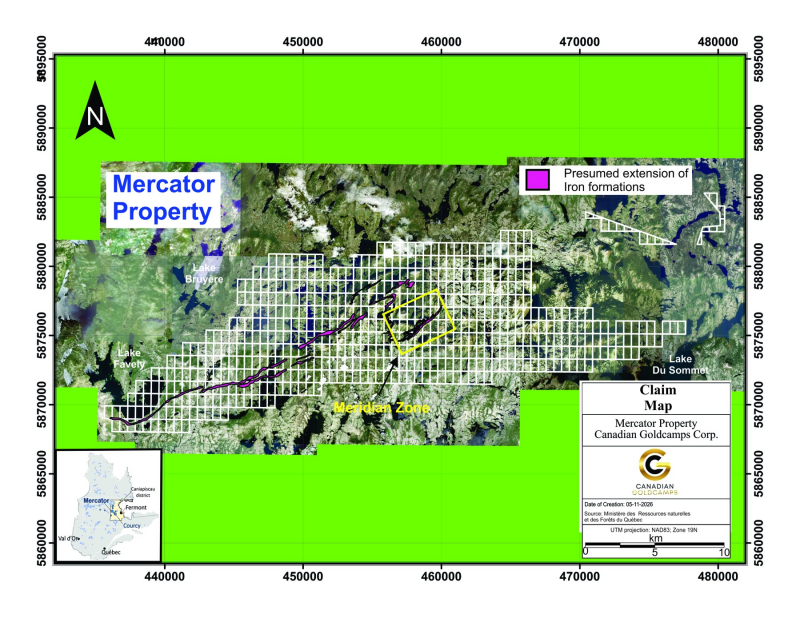
Figure 1. Mercator Property claim map — 574 active mineral claims covering 291.3 km² in the Caniapiscau district of northeastern Québec. Canadian GoldCamps Corp. holds an option to earn up to an aggregate 80 %.
MCT-22-08 returned 2.05 g/t Au over 8.65 m (55.60–64.60 m) , including 4.64 g/t Au over 1.00 m, a separate 25 cm sample grading 8.53 g/t Au, and 4.51 g/t Au over 1.00 m that contains the program peak of 15.46 g/t Au over 0.20 m. The upper part of the hole returned 0.65 g/t Au over 4.35 m (47.05–51.40 m), including 3.40 g/t Au. Taken together, the 55 positioned sub-samples average 1.58 g/t Au over 13.00 m of the historical 2022 intersection of 2.62 g/t Au over 17.80 m.
MCT-22-11 returned 1.35 g/t Au over 4.55 m (103.00–107.55 m) , including 6.77 g/t Au over 0.25 m (laboratory duplicate 6.99 g/t Au), and 0.95 g/t Au over 4.30 m (188.50–192.80 m), including 6.30 g/t Au over 0.25 m.
MCT-22-03 returned 0.62 g/t Au over 4.60 m (33.30–37.90 m) , with a peak of 1.48 g/t Au.
The 2026 quarter-core reproduces the 2022 half-core assay pattern segment by segment in MCT-22-08 : 4.64 g/t versus 4.37 g/t Au at 57.55–58.55 m, 0.44 g/t in both years at 58.60–59.35 m, and 4.51 g/t versus 4.32 g/t Au at 61.95–62.90 m, while the 25 cm resolution isolates the bands (7.49, 8.53 and 15.46 g/t Au) that the metre-scale 2022 samples had averaged out.
80 of the 111 sub-samples (72%) returned gold above the 0.006 g/t detection limit and 52 (47%) returned at least 1.0 g/t Au , demonstrating that gold is distributed through the BIF horizons rather than confined to isolated bands.
Quarter-core composites are generally lower than the 2022 half-core composites over the same core (Technical Report, Figure 21, R² = 0.64). The Company interprets this as the expected effect of irregular, non-symmetric sulphide–gold banding around the core axis and of the smaller analytical support, which is characteristic of high-nugget BIF-hosted systems and is the reason larger-diameter drilling and channel sampling are recommended going forward.
The multi-element program on the same 111 sub-samples returned copper up to 240.5 ppm, manganese up to 19,644 ppm (1.96% Mn) and arsenic up to 534 ppm, associated with the gold-bearing horizons.
Geochemical Support for Targeting
The gold results are supported by a 56-element analytical program completed by IGS on the same 111 sub-samples by sodium peroxide fusion with an ICP-OES/ICP-MS finish. Copper returned values up to 240.5 ppm and manganese up to 19,644 ppm (approximately 1.96% Mn). Arsenic reached 534 ppm and remains a useful pathfinder to gold within the Mercator BIF system. These multi-element relationships are interpretive exploration vectors and do not, by themselves, define or quantify gold mineralization.
Geological Setting — Mercator’s Granulite-Facies BIF System
Click Image To View Full Size
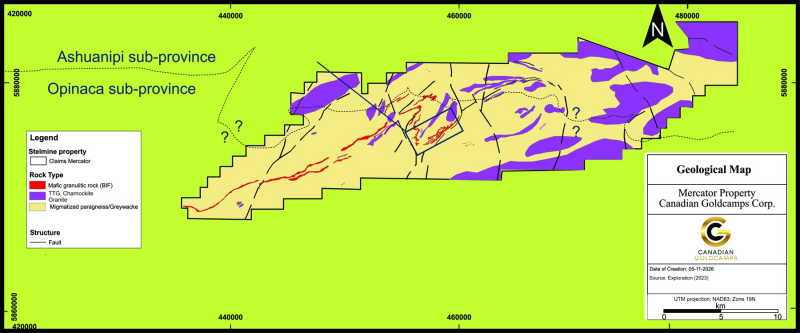
Figure 2. Bedrock geology of the Mercator Property showing the NE-trending metasedimentary belt hosting the granulite-facies silicate-sulphide banded iron formation (BIF) the host rock for the confirmed high-grade gold mineralization along the Meridian Zone corridor.
The Mercator Property is positioned in the southeastern Churchill Province of the Canadian Shield, in the Caniapiscau district of northeastern Québec, approximately 170 km west of Fermont. The property covers 574 active mineral claims (≈291.3 km²) along a regional NE-trending metasedimentary belt characterized by strong magnetic and electromagnetic responses attributed to iron-rich metasediments and silicate-sulphide-bearing banded iron formations (BIFs) metamorphosed to the granulite facies.
Gold mineralization at Mercator is hosted within stratiform silicate-sulphide BIF horizons intercalated with paragneiss, pyroxene-bearing gneiss and minor mafic intrusive units. These iron formations consist of finely banded layers of (i) quartz ± chert; (ii) garnet-pyroxene assemblages dominated by iron-rich ferrosilite (orthopyroxene) and hedenbergite (clinopyroxene); and (iii) pyroxene-sulphide layers carrying variable proportions of pyrrhotite (typically 1–65 vol.%), arsenopyrite, löllingite, pyrite and chalcopyrite. Accessory minerals include grunerite (Fe-amphibole), stilpnomelane, pentlandite, nickeline, sphalerite and native gold
Click Image To View Full Size
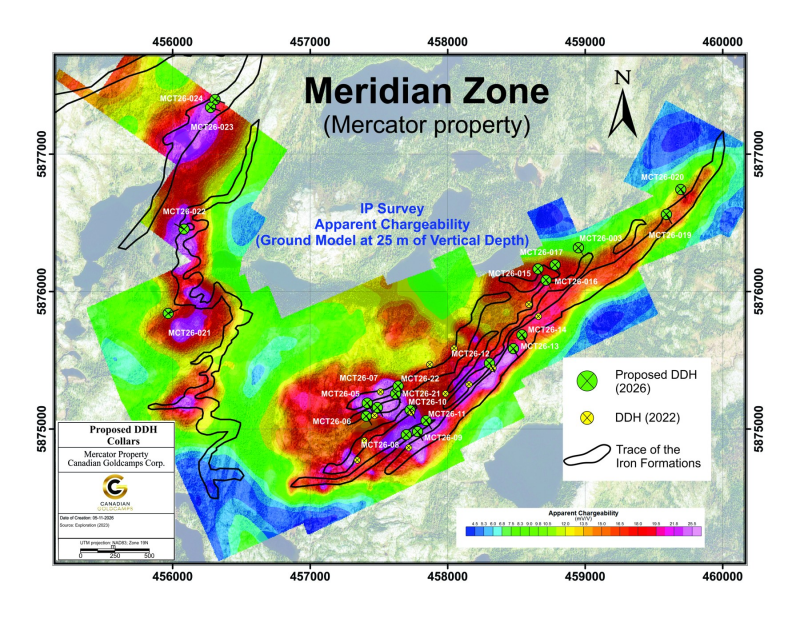
Figure 3. Mercator drill-hole location map showing the 13 heliborne diamond drill holes completed by Stelmine Canada Ltée in 2022 along the Meridian Zone corridor. The 2026 quarter-core re-sampling program targeted mineralized intervals in holes MCT-22-08 (best composite 2.05 g/t Au over 8.65 m), MCT-22-11 (1.35 g/t Au over 4.55 m) and MCT-22-03 (0.62 g/t Au over 4.60 m), highlighted along the NE–SW gold-mineralized trend.
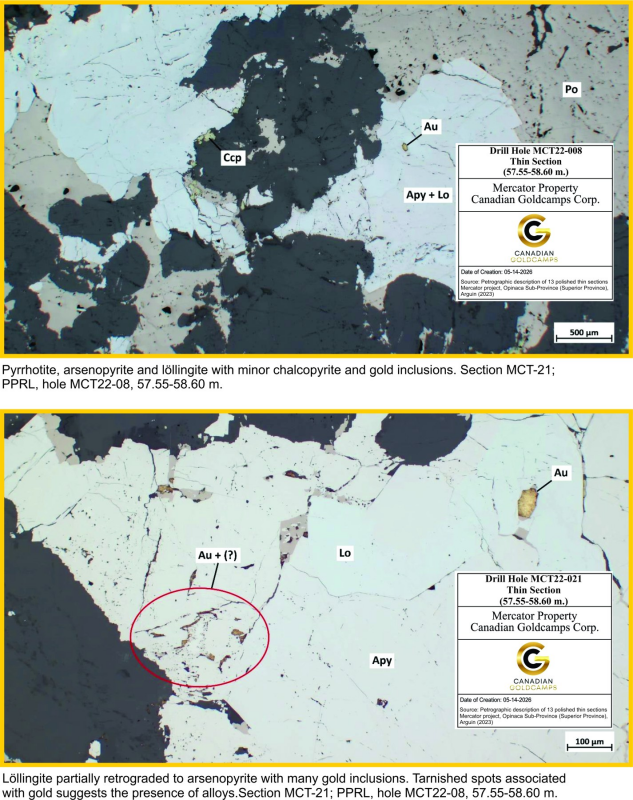
Petrographic studies completed on representative drill core and channel samples (Arguin, 2022, 2023; reproduced in the Mercator NI 43-101 Technical Report) demonstrate that visible native gold occurs in four distinct microenvironments: (a) as inclusions filling porosities within arsenopyrite–löllingite intergrowths; (b) associated with amphibole + carbonate + tourmaline alteration in proximity to pyrrhotite mineralization; (c) in late microfractures cross-cutting silicate gangue; and (d) within composite epidote–pyrrhotite ± chalcopyrite ± graphite assemblages. This four-fold textural occurrence is consistent with a syn- to post-metamorphic remobilization of an originally stratabound (BIF-hosted) gold endowment, and it explains the highly variable gold distribution observed at the centimetre scale — precisely the rationale for the 25 cm sub-sampling program now being reported.
Click Image To View Full Size
Figure 4. Photomicrographs of native gold (Au) grains in polished thin sections of Mercator drill core, illustrating the four microenvironments of gold occurrence within the granulite-facies silicate-sulphide BIF system — a direct petrographic validation of the high-grade sub-sample results.
Whole-rock geochemistry on previously analyzed Meridian Zone material indicates a clear positive correlation of gold with arsenic, copper, total iron (as Fe₂O₃), manganese (MnO) and sulphur, and a negative correlation with Al₂O₃, TiO₂ and CaO. Arsenopyrite and löllingite together form a pervasive trace-to-1.5 vol.% sulphide population throughout mineralized intervals, and elevated arsenic concentrations (>200 ppm As) serve as a reliable pathfinder for gold targeting. The multi-element results now available allow this geochemical fingerprinting to be applied directly to the high-grade bands identified by the re-sampling program.
Surface and shallow-drilling work completed by Stelmine Canada Ltée between 2020 and 2023, and now under option to Canadian GoldCamps, established a 1.7 km gold-mineralized corridor along the Meridian Zone, with channel and grab samples returning weighted-mean values of 0.55 to 5.10 g/t Au over channel lengths of 1.2 to 27.5 m, and individual bands of rusted pyroxene–garnet–arsenopyrite material reproducibly returning 1–10 g/t Au. The 2022 heliborne drilling campaign (13 holes, 1,937 m) tested the down-dip continuity of this corridor; the most relevant intersections are listed below.
Historical 2022 drill intercepts most relevant to the current re-sampling program include 2.62 g/t Au over 17.80 m in hole MCT-22-08, 1.13 g/t Au over 9.00 m and 1.12 g/t Au over 4.25 m in hole MCT-22-11, and 1.13 g/t Au over 9.75 m in hole MCT-22-03 (Mercator NI 43-101 Technical Report, Section 6.2.4). The 25 cm sub-sampling results confirm that these composite intervals contain individual sub-metre BIF bands grading well above the composite weighted mean, a finding with direct implications for future resource modelling and for the choice of sampling support in the next drill program.
Methodology, Sampling, Analytical Methods and QA/QC
The re-sampling program was designed to refine the spatial distribution of gold within historically mineralized drill-core intervals by reducing the sampling support from the original 0.5–1.5 m core lengths to a uniform 25 cm support. This resolution is appropriate to the centimetric–decimetric banding of the BIF protolith and is consistent with industry practice for high-nugget systems hosted in iron formations. The 2022 half-core was split into two quarter-cores; because sulphide–gold banding is irregular and non-symmetric around the core axis, the two quarters are not expected to carry identical grades, and the 2026 results are therefore a verification of the 2022 data rather than a replacement of it.
The 111 sub-samples were collected on April 28, 2026 from holes MCT-22-08 (55 samples, of which 30 were submitted under interim bag numbers and subsequently repositioned at 55.60–62.95 m from their 2022 sample tags), MCT-22-11 (35 samples) and MCT-22-03 (19 samples), plus two small samples of cutting rejects that carry no position and are excluded from all composites. Samples were submitted to IGS Impact Global Solutions Inc. (“IGS”), an independent commercial laboratory in Delson, Québec operating an ISO-grade quality-management system. Gold was determined by lead-collection fire assay on a 40 g charge with an ICP-OES finish under IGS procedure FC-MP-SAA/ICP, with gravimetric finish (FA-GRAV-Au) available for high-grade samples and a reported detection limit of 0.006 ppm Au (certificate CA-CAMP-LA-2026-01, May 22, 2026).
The laboratory inserted one certified reference material (Oreas 236, certified value 1.85 ppm Au), one preparation blank and one replicate per fire-assay batch, for six of each across the run. All six CRMs returned recoveries between 97.1% and 105.4% of the certified value (mean 101.5%), within 2σ of the certificate. All six blanks returned gold below the reportable detection limit (<0.006 ppm Au). Replicate analyses, including the 6.77 g/t Au sample 22-011-14 (replicate 6.99 g/t Au, RPD 3%), showed the reproducibility expected of a system known to host centimetre-scale high-grade bands and visible gold; relative differences of 28–40% on three lower-grade pairs are consistent with that nugget effect. The Company has verified the sample chain of custody and the analytical certificate, and the results are summarized in Section 12 and Appendix III of the Technical Report.
Multi-Element Analysis Strengthens Geological Understanding
Beyond confirming high-grade gold mineralization, the Company's comprehensive multi-element analytical program has significantly enhanced the understanding of the Mercator mineralizing system.
The analyses demonstrate that gold mineralization is consistently associated with manganese-enriched banded iron formations, with individual samples returning values of up to 19,644 ppm manganese (1.96% Mn). Elevated copper values of up to 240.5 ppm Cu were also identified within the same mineralized horizons.
While Canadian GoldCamps' primary exploration focus remains the discovery and delineation of gold mineralization, the presence of manganese and copper within the gold-bearing BIF provides important geological information regarding the evolution of the mineralizing system. Both manganese and copper are recognized as critical minerals by the Government of Canada due to their importance in steel production, electrification, advanced manufacturing and energy transition technologies.
The Company emphasizes that, at this stage, these results are being used primarily to strengthen the geological interpretation of the Mercator Project and to improve exploration targeting. No assessment has yet been completed regarding the economic significance of manganese or copper mineralization.
Arsenic Provides an Important Pathfinder
The analytical program also confirmed arsenic values of up to 534 ppm, reinforcing its association with the gold-bearing system.
Arsenic is widely recognized as an important pathfinder element in many orogenic and BIF-hosted gold systems. The Company believes that integrating arsenic with gold, manganese and copper distributions will improve the identification of prospective structural corridors and higher-grade mineralized zones throughout the Mercator property.
Strengthening the Geological Model
The completion of the analytical verification program provides Canadian GoldCamps with one of the most comprehensive geochemical datasets assembled to date for the Mercator Project.
The integration of gold assays together with multi-element analytical results is expected to significantly improve the Company's three-dimensional geological model and assist in prioritizing future drill targets across the more than eight-kilometer prospective iron formation.
Management believes these results represent another important step toward unlocking the district-scale exploration potential of the Mercator Gold Project.
NI 43-101 Technical Report Filed
The Company has filed an independent technical report prepared in accordance with National Instrument 43-101 Standards of Disclosure for Mineral Projects for the Mercator Gold Property. The report, titled “NI 43-101 Technical Report, Mercator Gold Property, Caniapiscau District, Northeastern Québec, NTS 23C/13, 23F/03, 23F/04” (the “Technical Report”), has an effective date of July 28, 2026 and was filed on September 8, 2026. It is available under the Company’s issuer profile on SEDAR+ at www.sedarplus.ca and on the Company’s website at www.canadiangoldcamps.com. Section 12 of the Technical Report documents the 2026 re-sampling program as a data-verification exercise and concludes that the 2022 exploration data are sufficiently reliable to support the geological interpretations and exploration recommendations presented therein.
The Technical Report was prepared by Marty G. Henning, P.Geo., an independent Qualified Person as defined under NI 43-101, with contributions from Michel Boily, Ph.D., P.Geo. It recommends a sequential, three-phase exploration program estimated at C$4.895 million, including approximately 5,000 metres of NQ diamond drilling. Each phase is to be evaluated before the Company proceeds to the next phase. The Technical Report does not contain a mineral resource estimate or mineral reserve estimate.
Qualified Person
The scientific and technical information contained in this news release has been reviewed and approved by George Yordanov, P.Geo., M.Sc., a “Qualified Person” as defined under National Instrument 43-101 Standards of Disclosure for Mineral Projects. Mr. Yordanov has personally verified the sample chain of custody, the analytical certificates issued by IGS Impact Global Solutions Inc. and the underlying QA/QC data summarized in this release.
On behalf of the Board of Directors
“George Yordanov”
President & Chief Executive Officer
Canadian GoldCamps Corp.
About Canadian GoldCamps Corp.
Canadian GoldCamps Corp. is a Vancouver-based mineral exploration company focused on the discovery and advancement of gold and critical-metals projects in Québec. The Company's flagship asset is the Mercator Gold Project, comprising 574 mineral claims covering approximately 291.3 km² in the Caniapiscau district of northeastern Québec, optioned from Stelmine Canada Ltée. Mercator hosts a confirmed, stratiform high-grade gold system within granulite-facies silicate-sulphide banded iron formations along a 1.7 km confirmed mineralized corridor, situated within a prospective iron formation trend extending more than 8 km across the property. The Company is listed on the Canadian Securities Exchange, CSE, under the symbol CAMP.
g.yordanov@canadiangoldcamps.com
www.canadiangoldcamps.com
Neither the Canadian Securities Exchange nor its Regulation Services Provider (as that term is defined in the policies of the CSE) accepts responsibility for the adequacy or accuracy of this release.

Copyright (c) 2026 TheNewswire - All rights reserved.
© 2026 Canjex Publishing Ltd. All rights reserved.