Vancouver, British Columbia--(Newsfile Corp. - September 24, 2026) - Atlantico Energy Metals Corp. (CSE: ATLA) (FSE: 1CJ1) ("Atlantico" or the "Company") reports that titanium, niobium and vanadium were each detected in nearly all 114 follow-up surface samples from its flagship Novo Cruzeiro Project in Brazil's Lithium Valley. Analysis also identified strong links with gallium: samples with higher reported gallium concentrations generally contained more niobium, titanium and vanadium, revealing a recurring four-metal pattern across the sample set.
Of the 114 follow-up samples, 108 came from the Rio Bravo area. All 108 returned detectable gallium, titanium and rare earth elements, with niobium and vanadium detected in nearly all. These findings build on Novo Cruzeiro's gallium and rare earth results and highlight three additional metals used in aerospace, advanced steels and energy storage.
Detection Results Across the 114 Follow-Up Surface Samples
Gallium and rare earths: detected in all 114 samples.
Titanium: detected in 113 of 114.
Niobium: detected in 108 of 114.
Vanadium: detected in 109 of 114.
"A cleaner energy future cannot be built on innovation alone. It also needs the materials that turn invention into infrastructure," said Bonn Smith, President and CEO of Atlantico. "Gallium, titanium, niobium and vanadium serve different industrial needs, from semiconductors and aerospace to advanced steels and energy storage. Their association at Novo Cruzeiro gives us a broader geological story to investigate. Our ambition is to determine whether that story can develop into an opportunity that matters to future supply."
Gallium Tracks Three Industrial Metals Beyond Standout Samples
The relationships remained positive when the two larger laboratory batches were analysed separately and when high-value samples were excluded. This indicates that the overall pattern was not driven solely by the highest reported values.
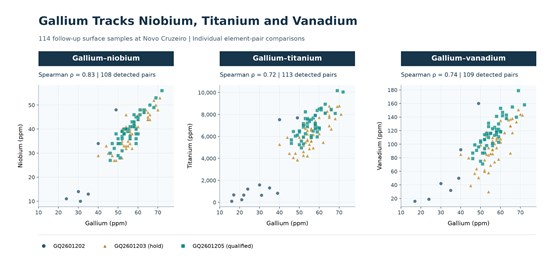
Figure 1. Gallium tracks niobium, titanium and vanadium in Novo Cruzeiro's follow-up surface samples. Each panel compares reported elemental concentrations in parts per million (ppm); Spearman rank correlations and detected-pair counts are shown. Below-detection results are excluded from each comparison, not plotted as zero. Source: SGS ICM90A assays, certificates GQ2601202, GQ2601203 and GQ2601205. Results remain subject to the analytical qualifications discussed in this release.
To view an enhanced version of this graphic, please visit:
https://images.newsfilecorp.com/files/4290/315825_3a46b8b2f4873857_001full.jpg
The closest gallium relationship among these four elements was with niobium. Spearman rank correlations, which compare how samples rank from lower to higher concentrations, were approximately 0.83 for gallium-niobium, 0.72 for gallium-titanium and 0.74 for gallium-vanadium. These calculations used 108, 113 and 109 sample pairs, respectively, for which both elements were detected. Values approaching +1 indicate closely matching sample rankings.
Titanium and vanadium also tracked closely with one another, with a rank correlation of approximately 0.90 across 109 detected pairs.
Highest-Gallium Sample Also Contains Niobium, Titanium and Vanadium
The highest-gallium sample, NCZ-CR-0175, contained 72 ppm gallium, 56 ppm niobium, 10,056 ppm titanium and 158 ppm vanadium, all reported as elemental concentrations. Its field description records brown sandy soil with schist fragments. NCZ-CR-0175 belongs to certificate GQ2601205 and remains subject to the analytical qualifications below.
Gallium was detected in all 114 follow-up samples at 16-72 ppm. The median gallium concentration across the 114 follow-up samples was 55.5 ppm.
Gallium, Titanium and Rare Earths Detected in All 108 Rio Bravo Follow-Up Samples
Within the 108 mapped Rio Bravo follow-up samples, niobium was detected in 105 and vanadium in 106.
At Rio Bravo, the March integrated report associated elevated gallium mainly with saprolite, or deeply weathered rock, developed over granite near the boundary with schists of the Ribeirão da Folha Formation, layered rocks formed by heat and pressure.
Figure 2 shows these 108 Rio Bravo samples. The remaining six follow-up samples lie outside the map's geographic extent; their results and coordinates are included in the accompanying schedule.
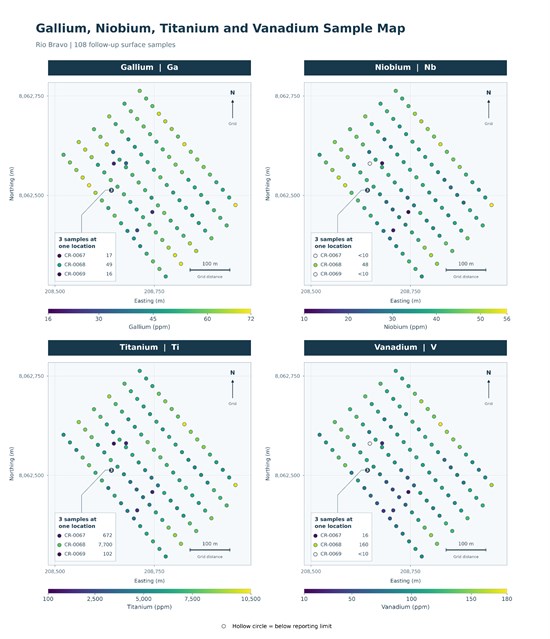
Figure 2. Gallium, niobium, titanium and vanadium in 108 follow-up surface samples from the Rio Bravo area. The four panels show the same sample locations, with colours representing reported elemental concentrations in ppm on separate scales. Hollow circles indicate results below the reporting limit, not zero. The marker labelled "3" identifies three samples sharing the same recorded coordinates; their individual results are shown in each callout. Coordinates are SIRGAS 2000 / UTM zone 24S. Results remain subject to the analytical qualifications discussed in this release.
To view an enhanced version of this graphic, please visit:
https://images.newsfilecorp.com/files/4290/315825_3a46b8b2f4873857_002full.jpg
The follow-up samples include sand and silt, clay-rich material and soils containing schist fragments, rather than one uniform type of fresh rock. Gallium also varies with iron and aluminium in the dataset.
Four Metals Behind Semiconductors, Aerospace and Energy Storage
The technologies behind a cleaner, more efficient economy depend on materials with specialised properties. Gallium, titanium, niobium and vanadium each serve a different part of that demand.
Gallium: Used in compound semiconductors for defence, high-performance computing and telecommunications.
Niobium: Used in stronger steels and high-temperature alloys for demanding industrial applications.
Titanium: Lightweight, strong and corrosion-resistant metal used in aerospace; titanium dioxide also has extensive pigment applications.
Vanadium: Used in stronger steels and vanadium flow batteries for large-scale energy storage.
The USGS reports that gallium is generally recovered as a byproduct of processing other mineral commodities, predominantly bauxite and, to a lesser extent, zinc ores.
Sources: U.S. Geological Survey, Mineral Commodity Summaries 2026 (https://pubs.usgs.gov/publication/mcs2026).
China's Gallium Dominance Highlights the Strategic Importance of Exploration Outside China
China accounted for 99% of worldwide primary low-purity gallium production in 2025, according to the U.S. Geological Survey. The USGS notes that no effective substitutes exist for gallium arsenide and gallium nitride in many defence-related applications.
China introduced export licensing requirements for specified gallium and germanium products in August 2023, followed by additional US-specific restrictions covering gallium, germanium and antimony in December 2024. Those additional restrictions were suspended in November 2025 through November 27, 2026, while the underlying licensing requirements remain in place. The combination of concentrated production, export controls and specialised uses underscores the strategic importance of diversifying gallium supply, adding weight to the investigation of gallium occurrences outside China, including at Novo Cruzeiro.
Sources: U.S. Geological Survey, Mineral Commodity Summaries 2026 (https://pubs.usgs.gov/periodicals/mcs2026/mcs2026-gallium.pdf); Reuters, November 9, 2025 (https://www.reuters.com/world/china/china-suspends-ban-exports-gallium-germanium-antimony-us-2025-11-09/); Ministry of Commerce of China, Announcement No. 72, November 9, 2025 (https://www.mofcom.gov.cn/zwgk/zcfb/art/2025/art_5c68985a6b1a46778e2e8dbff1bb1601.html).
Following the Four-Metal Pattern Into the Geology
The next step is to identify which minerals carry gallium, niobium, titanium and vanadium, and test how their occurrence varies between sampled materials and through the weathering profile.
The March report recommends mapping, additional sampling and investigation of the weathering profile. Comparing representative materials at different depths would help distinguish the effects of original rock composition and weathering, and assess whether the four-metal relationship can help prioritise follow-up locations.
Four-Metal Results and Associations Schedule
Elemental gallium, niobium, titanium and vanadium results for all 114 follow-up surface samples, together with sample locations, correlation summaries and analytical qualifications, are available in the Four-Metal Results and Associations Schedule (PDF).
Sampling and Analytical Context
This release draws on the March 2026 report and associated assay data, not subsequent sampling. The evidence base comprises 231 first-pass samples (170 stream sediments and 61 samples recorded as rock chips) and 114 follow-up surface samples with laboratory results issued in March 2026. These are distinct populations, not one dataset used in every map or interpretation. First-pass results were discussed in the August 20, 2026 release and follow-up assays in the September 11, 2026 release. The follow-up work centred on a 50 × 25 metre grid within tenement 831.453/2023 in western Novo Cruzeiro, with additional reconnaissance locations. Field descriptions include strongly weathered, saprolitic, soil-, sand- and silt-rich material; a rock-labelled sample is not necessarily fresh bedrock.
SGS Geosol, an independent laboratory in Vespasiano, Minas Gerais, received the follow-up samples on January 30, 2026. Certificates GQ2601202 and GQ2601203 were issued March 5, and GQ2601205 March 8, 2026. Twelve samples underwent rock/core preparation, including crushing, splitting and pulverisation; 102 underwent soil/sediment preparation, including disaggregation and 80-mesh sieving. Analysis used sodium peroxide fusion with ICP-OES/ICP-MS for 56 elements (ICM90A).
Concentrations are reported on an elemental basis; 1 ppm equals 1 g/t.
Analytical and Quality-Control Qualifications
The correlation calculations describe relationships in the reported assay values; they do not independently validate assay accuracy. Reference-material screening identifies low niobium and titanium control results in GQ2601203 and GQ2601205, which require clarification alongside the batch qualifications below. Results reported below detection limits were excluded from the quoted pairwise correlations, not treated as measured zeroes.
The gallium-niobium-titanium-vanadium interpretation in this release remains subject to the QA/QC qualifications disclosed on September 11, 2026, including the GQ2601203 hold pending laboratory clarification of OREAS460 performance. These qualifications apply to affected results used here. This release does not report clearance of the hold.
Quality assurance and quality control ("QA/QC") for the analytical batches included SGS Geosol laboratory preparation blanks, laboratory replicates and certified reference materials, including AMIS0683, AMIS0684 and OREAS460.
A material QA/QC exception was identified in certificate GQ2601203, where OREAS460 returned lithium below the 10 ppm detection limit against a certified value of approximately 19.6 ppm and showed negative bias for several rare earth and related elements. The subsequent OREAS460 result in certificate GQ2601205 returned approximately 20 ppm lithium and showed improved agreement for several analytes, although negative bias remained for selected elements, including niobium.
Selected multi-element results, particularly those affected by OREAS460 bias and low-level copper blank/replicate performance, should be interpreted with caution. The Company intends to request SGS confirmation of its applicable CRM acceptance criteria, internal QC review and any rerun or corrective-action data associated with the affected batch.
Important Early-Stage Exploration Context
Novo Cruzeiro is an early-stage surface-exploration project with no mineral resources or mineral reserves. Results describe the sampled materials, not representative fresh-bedrock or property-wide grades. Surface assays and interpreted targets do not establish mineralised continuity, grade over width, tonnage or economic viability. Mineral hosts and metallurgical recovery remain unestablished. Further work may not define a mineral resource or mineral reserve. Figure 2 represents individual sample locations, not mineralised boundaries.
Qualified Person
Andrew Lee Smith, P.Geo., a Qualified Person as defined by National Instrument 43-101: Standards of Disclosure for Mineral Projects, has reviewed the ratified analytical schedule, supporting technical information, the SGS analytical certificates and the QA/QC controls reported for certificates GQ2601202, GQ2601203 and GQ2601205, and has reviewed and approved the scientific and technical information contained in this news release. Mr. Smith is not independent of the Company within the meaning of NI 43-101 due to his role as a member of the Company's Advisory Board.
The QP verified the analytical data used in this release by reviewing the applicable SGS Geosol analytical certificates, comparing the reported analytical results with the Company's compiled analytical schedule, reviewing available sample descriptions and locations, and reviewing the laboratory QA/QC information associated with certificates GQ2601202, GQ2601203 and GQ2601205. The verification identified the QA/QC qualifications described in this release, including the outstanding GQ2601203 laboratory clarification. Accordingly, the QP's verification does not constitute resolution of those outstanding laboratory QA/QC matters, and the affected analytical results should be interpreted subject to those qualifications.
About Atlantico Energy Metals Corp.
Atlantico Energy Metals Corp. is a Canadian mineral exploration company built around a simple belief: a cleaner energy future needs critical minerals. The Company's flagship project is the Novo Cruzeiro Lithium and Rare Earth Elements Project, located in northeastern Minas Gerais, Brazil, within Brazil's Lithium Valley. Atlantico is advancing Novo Cruzeiro through disciplined technical work, transparent disclosure and responsible exploration, with a focus on creating long-term value for shareholders while contributing positively to the local communities and regions where the Company operates.
The Canadian Securities Exchange has neither approved nor disapproved the contents of this news release.
Forward-Looking Information
This news release contains "forward-looking information" and "forward-looking statements" within the meaning of applicable securities legislation, including statements regarding exploration potential, the interpretation and testing of target areas, recommended follow-up work, the Company's intended request for clarification from SGS and related technical review, further exploration at Novo Cruzeiro and future updates. These forward-looking statements are made as of the date of this news release. Forward-looking information is based on assumptions management considers reasonable as of the date of this news release, including the availability of financing, project access, required permits and approvals, qualified personnel and contractors, and the reliability of current technical information. Although management considers these assumptions reasonable, there can be no assurance that they will prove accurate.
Forward-looking information is subject to known and unknown risks, uncertainties and other factors that may cause actual events or results to differ materially, including risks related to mineral exploration, technical interpretation, commodity prices, capital markets, the availability of financing, permitting, environmental and regulatory matters, political and economic conditions in Brazil, and title and access matters. There may be other factors that cause actual results to differ from those anticipated, and there can be no assurance that forward-looking statements will prove accurate. No undue reliance should be placed on forward-looking information. The Company undertakes no obligation to update forward-looking information except as required by applicable law.
To view the source version of this press release, please visit https://www.newsfilecorp.com/release/315825

© 2026 Canjex Publishing Ltd. All rights reserved.