Highlights:
- West Feeder of Main Zone
- LMD-137: 2.3 metres grading 500 g/t silver and 1.46 g/t gold from 115 metres including
- 0.5 metres grading 2,197 g/t silver and 6.23 g/t gold at 116.8 metres
- LMD-137: 1.0 metres grading 310 g/t silver and 0.49 g/t gold from 11.55 metres
- LMD-136: 3.0 metres grading 263 g/t silver and 0.95 g/t gold at 100.0 meters
- Newly drilled block northwest of post-mineral A fault (Figure 1) confirms a group of shallow Au and Ag-rich veins and veinlets, further opening the system along strike and at depth
- Confirmation of the continuous vein in the Eastern Zone, consistently mineralized with gold and silver also at depth
- The Company is fully funded for a minimum of 5,000 metres of DDH drilling, for which field crews and equipment are currently being mobilized
Vancouver, British Columbia--(Newsfile Corp. - April 15, 2026) - Astra Exploration Inc. (TSXV: ASTR) (OTCQB: ATEPF) (FSE: S3I) ("Astra" or the "Company") is pleased to announce the final batch of assays consisting of five DDH holes from the Phase II drill program at the La Manchuria Gold and Silver Project in Santa Cruz, Argentina. Going forward, the 5,000 metres completed to date will be referred to as Phase II and the upcoming 5,000 metre program will be referred to as Phase III. The Company will be providing a detailed summary update in the coming days to outline the results of Phase II and the plan for Phase III.
Astra's CEO, Brian Miller, commented:
"High-grade mineralization continues to be intersected along strike and at depth in the Main Zone, which adds to the prospectivity of the high-grade feeder targets, and continues to expand the bulk-tonnage system near surface. The lower unit of andesite rocks, previously interpreted to be barren of mineralization, have again hosted high-grade veins, which provides more evidence that they may contain a meaningful portion of the mineralized system. Astra has completed ~7,500 metres of drilling at La Manchuria to date, which has more than doubled the near-surface footprint of the vein system which remains open in all directions. We expect continued rapid growth as we ramp up drilling in 2026."
Astra's Exploration Director, Diego Guido, commented:
The ~5,000 metre Phase II drill program at La Manchuria has validated the current geological model, confirming a low-sulphidation epithermal system consisting of at least four subparallel mineralized vein sets. Drilling highlights strong continuity of Au-Ag mineralization and suggests that the West, Central and East feeder structures remain open along strike, including within downthrown structural blocks, with potential for extension at depth beneath the andesitic sills. The geometry of these structures indicates possible convergence at depth, representing a key exploration target. Integration of drilling and 3D geophysics has also identified additional structurally controlled blocks and parallel vein systems, including the high-grade Basalto Zone, creating an expanded exploration footprint and reinforcing the potential for deeper, higher-grade feeder zones.
Program Details
A total of 25 drill holes were completed in late 2025 totaling 5,119 metres. The Phase II drill program focused on expanding the near-surface footprint of mineralization with shallow (<200m vertical depth) drill holes.
The five drill holes reported herein were focused on the Main Zone, with one hole in the Eastern Zone and one hole in the Road Zone (Figure 1 and Table 1).
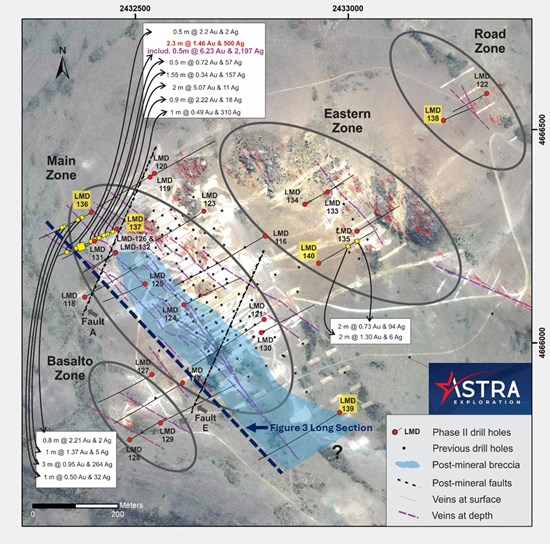
Figure 1: Phase II holes drilled to date with assays for the five holes in this news release highlighted in yellow. Location for long section in Figure 3 in dark blue dashed line.
To view an enhanced version of this graphic, please visit:
https://images.newsfilecorp.com/files/8951/292626_cb697a15d494a832_002full.jpg
West Feeder at Main Zone
The West Feeder, has been outlined by drilling along a strike length of approximately750 metres and contains some of the thickest veins and highest grades currently known at La Manchuria. It remains open in all directions.
LMD-136 and LMD-137 were designed to test the northwestern extension of the West Feeder beyond the post-mineral A fault (Figure 1) in a downthrown block identified by 3D geophysics beneath the shallow cover.
LMD-136 intersected multiple intervals of Au-Ag mineralization, including West Feeder-related mineralization between ~30 and 100 metres below surface within a continuous group of veins and veinlets hosted in the pyroclastic sequence. The most significant interval returned 3 metres grading 263.6 g/t Ag and 0.95 g/t Au from 100 metres downhole. This is the furthest step-out to the northwest and confirms mineralization remains open along strike and down dip.
LMD-137 (Figure 2) intersected multiple intervals of Au-Ag mineralization between 70 and 130 meters below surface and beneath hole LMD-131. The most significant interval in this group of veins and veinlets returned 2.3 metres grading 500 g/t silver and 1.46 g/t gold, including 0.5 metres grading 2,197.3 g/t silver and 6.23 g/t gold and was hosted in andesites, which was previously interpreted to be unmineralized. In addition, the hole intersected multiple mineralized banded quartz veins and veinlets at shallower depth interpreted to be the Central Feeder NW extension, highlighted by 1 metre grading 310 g/t Ag and 0.49 g/t Au. All of these veins remain open at depth.
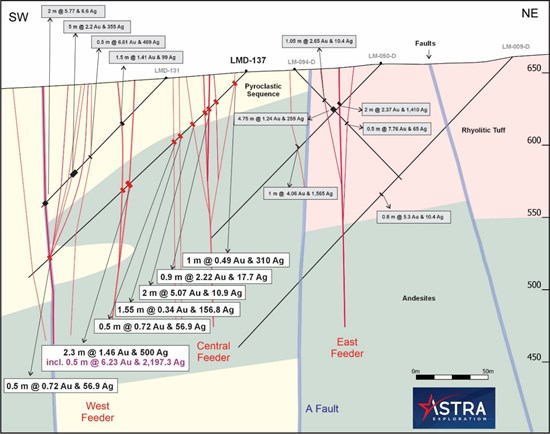
Figure 2: Cross section of hole LMD-137 showing the several mineralized areas at the NW extension of the West and Central Feeder in the Main Zone. Gold and silver results are in grams per tonne (g/t).
To view an enhanced version of this graphic, please visit:
https://images.newsfilecorp.com/files/8951/292626_cb697a15d494a832_003full.jpg
The results from LMD-136 and LMD-137 confirm the shallow system elevation and suggest strong potential to extend mineralization at depth. They also show that the system remains open along strike to the northwest, including an unexplored target in an interpreted deeper block as revealed by the 3D geophysics (Figure 3).
LMD-139 tested the SE extension of the vein beneath the post-mineral breccia and was drilled 75 metres south of the southernmost hole at the West Feeder (Figure 1 and Figure 3). It was intended to test the resistivity anomaly below the post-mineral breccia. The hole crosscut several quartz veins and fault breccias with vein clasts, but without economic mineralization. The most important veins, two parallel veins containing quartz, adularia, bladed calcite and sulfides, were intercepted at 200 metre deep hosted in andesite rocks. This portion of the andesite host rock appears to be unproductive, however the lower portion of the hole cut through the andesite sill and intersected a unit of welded rhyolites, suggesting the potential for mineralization at depth.
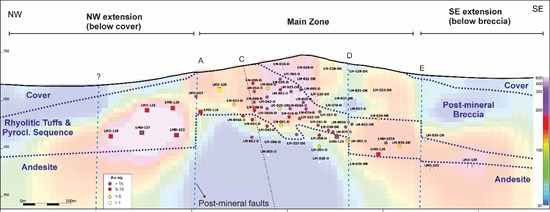
Figure 3: Long section of the West Feeder in the Main Zone (location shown in Figure 1 by dark blue dashed line) showing Au equivalent grades (squares are holes from Phase II). The section shows interpreted downthrown target areas effectively extended to the NW and SE. Resistivity values expressed in ohm-m.
To view an enhanced version of this graphic, please visit:
https://images.newsfilecorp.com/files/8951/292626_cb697a15d494a832_004full.jpg
Eastern and Road Zone
LMD-140, in the Eastern Zone, was designed to test the main vein at 150 metres below the surface, and 100 metres below hole LMD-135. LMD-140 intersected two mineralized structures (Figure 1 & Table 1), the shallower of the two is a parallel structure to the main vein and it is composed by quartz-oxide veinlets and oxide-rich breccias, and the deeper structure represents the main vein hosted into the andesitic rocks.
LMD-138, in the Road Zone, was designed to intersect veining 100 metres below previously drilled hole LMD-122, and also confirm the dip of the vein by drilling from a different direction. LMD-138 crosscut some calcite infilled hydrothermal breccias, but no significant veining. More drilling is necessary in this new zone to understand the potential of the parallel vein system.
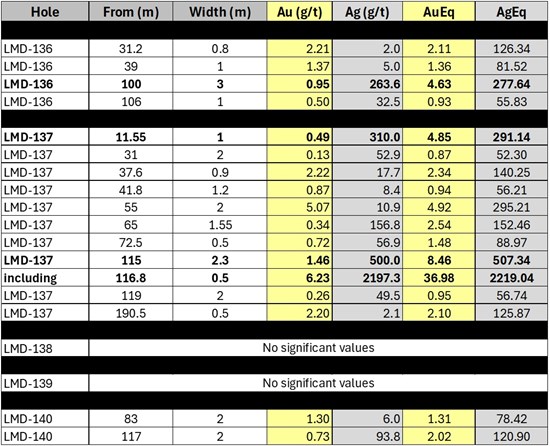
Table 1: Assays from the last five holes of Phase II drilling at La Manchuria using cutoff grade of 0.5 g/t AuEq. Ag:Au ratio of 60 using $3,600 Au and $60 Ag. Recoveries of 94% for Au and 85% for Ag is an average based on three regional mine operations1 and are reflected in AuEq and AgEq values above. Estimated true widths are approximately 85% of widths reported herein for the holes reported in this news release.
To view an enhanced version of this graphic, please visit:
https://images.newsfilecorp.com/files/8951/292626_astra%20table.jpg
Phase II Summary & Expanded Geophysics for Phase III
The 5,000 metre Phase II drill program demonstrates that shallow bulk disseminated mineralization is open in all directions, with 23 of the 25 Phase II drill holes intersecting potentially economic gold and silver grades. Many of the high grades intersected in Phase II were concentrated in the West Feeder of the Main Zone, with initial indications of high grades for expanding the East Feeder of the Main Zone, as well as the newly discovered vein at the Basalto Zone. Phase II more than doubled the drilled area at La Manchuria, and expanded the system to four parallel systems of veins with approximately 750 metres of strike length (Figure 4).
Concurrently with Phase II, field crews completed geophysical surveys to extend the 3D resistivity model to the south and west beneath post-mineral cover. The survey consists of 60 linear kilometers of gradient IP and 14 linear Km of Pole-Dipole lines, made even below the basaltic cover (Figure 4). This will provide additional drill targets for the upcoming 5,000 metre (minimum) Phase III program expected to commence imminently.
Phase III will test the depth extensions of the veins discovered at the West Feeder of the Main Zone, intending to prove the presence of high-grade veins coalescing below the andesitic sills (Figure 5).
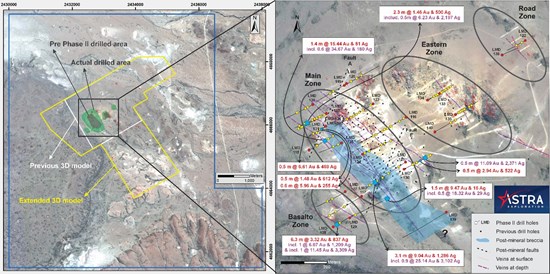
Figure 4: Left: Manchuria project map with extension of the new 3D geophysics model and the area with drill hole information. Right: compilation of the best grades from Phase 2 initial part of the program.
To view an enhanced version of this graphic, please visit:
https://images.newsfilecorp.com/files/8951/292626_cb697a15d494a832_006full.jpg
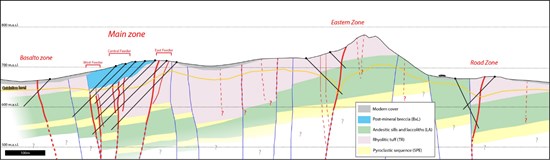
Figure 5: Schematic section of the four systems of veins found in Manchuria with Phase II initial drill program.
To view an enhanced version of this graphic, please visit:
https://images.newsfilecorp.com/files/8951/292626_cb697a15d494a832_007full.jpg
Sampling Procedures
Drill samples consisted of HQ core which were split in half, sampled, bagged, and tagged by Astra's geological team and then delivered to the Alex Stewart International Argentina laboratory in Mendoza. Drill samples were prepared with P5 code and then analyzed with fire assay for gold (Au4-50) and multi-elements by ICP (ICP-AR 39). Silver (>200 g/t) over-limits were analyzed by gravity method (Ag4A-50). A total of 131 Blanks and 154 standards (4 different Au and Ag grades) were used as QAQC for the group of 2,831 samples.
About the Company
Astra Exploration Inc. is a precious metals exploration company based out of Vancouver, BC that is actively building a portfolio of high-quality projects in some of the most important mining jurisdictions in Latin America.
The La Manchuria gold-silver project in Santa Cruz, Argentina, over which Astra has an option to acquire 90% interest from the owner, Patagonia Gold Corp, is a high-grade gold and silver low sulphidation epithermal (LSE) deposit located in the prolific Deseado Massif which hosts multiple world-class LSE precious metals deposits including Cerro Vanguardia and Cerro Negro, Santa Cruz, Argentina.
The 100% owned Pampa Paciencia gold and silver project in northern Chile is located in the Paleocene mineral province in proximity to such major operating mines as Spence and Sierra Gorda. The project shares several important geological similarities to other Paleocene LSE gold-silver deposits including Faride and El Peñón.
The 100% owned Don Mario (renamed from Cerro Bayo) project in northern Chile is located in the Maricunga belt approximately 20 km from the Refugio Mine. The project hosts a high sulphidation epithermal (HSE) +/- porphyry gold system with similarities to the Salares Norte deposit to the north in the same belt. The Maricunga belt is one of the most endowed regions in the world for gold and copper deposits.
Qualified Person
The technical data and information as disclosed in this news release has been reviewed and approved by Darcy Marud, who is an Independent Director of Astra. Mr. Marud is a Practicing Member of the Association of Professional Geoscientists of Ontario and is a qualified person as defined under the terms of National Instrument 43-101 - Standards of Disclosure for Mineral Projects.
References:
1 Sources:
Steinmann, Michael, March 2006
Manantial-Espejo Project Canadian Standard NI 43-101, Santa Cruz Province, Argentina Prepared for Minera Triton Argentina, S.A.
https://panamericansilver.com/wp-content/uploads/2022/04/Manantial-Espejo-Technical-Report.pdf
Goldcorp – Third Quarter Report, September 30, 2017
https://s24.q4cdn.com/382246808/files/doc_financials/mda/2017/MD-A-FS-2017Q3-Website.pdf
AngloGoldAshanti – Technical Report Summary, Cerro Vanguardia, A Life of Mine Summary Report, December 31, 2021
https://www.sec.gov/Archives/edgar/data/1067428/000162828022007855/a2021_-xcerroxvanguardia.htm
Neither the TSXV nor its Regulation Services Provider (as that term is defined in the policies of the TSXV) accepts responsibility for the adequacy or accuracy of this release.
This news release may contain certain "Forward-Looking Statements" within the meaning of the United States Private Securities Litigation Reform Act of 1995 and applicable Canadian securities laws. When or if used in this news release, the words "anticipate", "believe", "estimate", "expect", "target", "plan", "forecast", "may", "schedule" and similar words or expressions identify forward-looking statements or information. These forward-looking statements or information may relate to the Company's business activities; exploration on the Company's properties including drilling at the La Manchuria project. Such statements represent the Company's current views with respect to future events and are necessarily based upon a number of assumptions and estimates that, while considered reasonable by the Company, are inherently subject to significant business, economic, competitive, political and social risks, contingencies and uncertainties. Many factors, both known and unknown, could cause results, performance or achievements to be materially different from the results, performance or achievements that are or may be expressed or implied by such forward-looking statements. Such factors include, without limitation: development of the industry in which the Company operates; risks associated with the conduct of the Company's business activities; risks relating to reliance on the Company's management team and outside contractors; currency fluctuations; risks regarding the failure to generate sufficient cash flow from operations; laws and regulations governing the industry in which the Company operates; the ability of the communities in which the Company operates to manage and cope with the implications of COVID-19; the economic and financial implications of COVID-19 to the Company; operating or technical difficulties; employee relations, labour unrest or unavailability; stock market volatility; conflicts of interest among certain directors and officers; lack of liquidity for shareholders of the Company; litigation risk; and other risk factors disclosed in the Company's public disclosure documents available on the Company's profile at www.sedarplus.ca. Readers are cautioned against attributing undue certainty to forward-looking statements or forward-looking information. Although the Company has attempted to identify important factors that could cause actual results to differ materially, there may be other factors that cause results not to be anticipated, estimated or intended. The Company does not intend, and does not assume any obligation, to update these forward-looking statements or information to reflect changes in assumptions or changes in circumstances or any other events affecting such statements and information other than as required by applicable laws, rules and regulations.

To view the source version of this press release, please visit https://www.newsfilecorp.com/release/292626

© 2026 Canjex Publishing Ltd. All rights reserved.