NEW YORK, NY, June 24, 2026 (GLOBE NEWSWIRE) -- Fabric.AI, Inc. (Nasdaq: FABC) (“Fabric.AI” or the “Company”), a fabless semiconductor company developing MicroLED-based optical interconnects for AI infrastructure, today announced that at its recent stockholder meeting, stockholders approved a proposal in connection with the Company’s partnership with Kopin Corporation (Nasdaq: KOPN) to jointly develop the Neural I/o™ MicroLED optical interconnect. The Company and Kopin are proceeding with development of the interconnect with updates on strong progress expected within the coming quarter, and an expected demonstrable platform by year’s end.
"This stockholder approval validates our strategic vision and solidifies a unique opportunity to partner with an industry leader, leveraging Kopin's resources to advance an innovation with the potential to reset the standard for the AI data centers of the future," said Josh Silverman, CEO of Fabric.AI. "As AI workloads drive an unprecedented need for faster, more efficient, more scalable data movement, our Neural I/o™ MicroLED optical interconnect is designed to deliver a fundamentally different approach to connectivity — one engineered to improve power efficiency, thermal performance, density, latency, and scalability relative to traditional copper and laser-based architectures, and we look forward to demonstrating that as we advance its development."
Strategic Priorities
In connection with the approval, the Company reaffirmed several strategic priorities for stockholders:
A focused mission. Fabric.AI is committed to becoming a leading provider of MicroLED-based optical interconnects to the AI ecosystem, differentiated from incumbent laser-based and copper/SerDes approaches by its targeted advantages in energy efficiency and interconnect density.
- A platform technology, not just a single product. As part of the program, Fabric.AI is developing not only the interconnect but also the underlying MicroLED transceiver and receiver — components the Company believes could potentially be used in other co-packaged optics (CPO) applications across the AI ecosystem.
- Building an intellectual-property position. The Company is in the process of seeking patent protection for its inventions related to the Neural I/o transceiver, receiver, and interconnect technology.
- Serving a large addressable market. The Company is targeting the AI-infrastructure interconnect opportunity, which third-party analysts estimate could exceed $73 billion in total addressable market by 2030. This figure represents a third-party estimate of total market size and is not a projection of Fabric.AI’s revenue.
- Strengthening leadership. Fabric.AI has engaged executive search firm Egon Zehnder to support the recruitment of senior leadership, including a Chief Revenue Officer and other top management positions.
- Program leadership. The Company’s interconnect program is led by Bill Maffucci, Head of Project Development, who is overseeing [development] of the Neural I/o platform.
- Upcoming investor engagement. Members of Fabric.AI management are scheduled to present at the Canaccord Genuity conference. Details will be available on the Company’s investor relations website.
Technology overview
The Neural I/o platform uses arrays of MicroLED emitters and photodetectors — rather than lasers — to move data optically between GPUs, accelerators, memory, and servers at short reach. The Company believes this approach can deliver meaningful advantages in energy per bit and interconnect density relative to laser-based optics and copper/SerDes electrical links, particularly for the dense, short-reach connections inside AI systems. As previously disclosed, Fabric.AI is targeting a demonstration of the Neural I/o platform by the end of 2026.
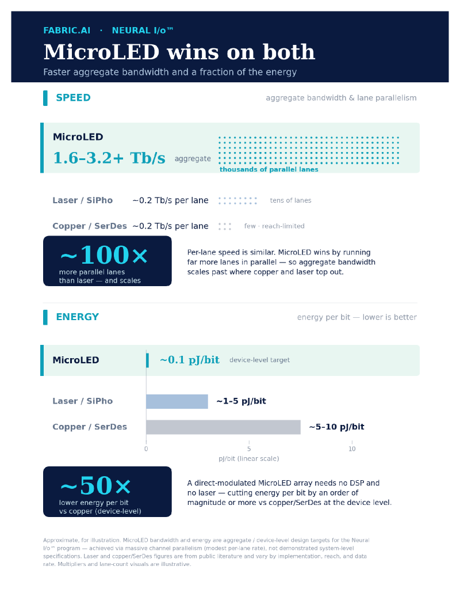
How the Neural I/o MicroLED interconnect compares to laser-based and copper/SerDes approaches on aggregate bandwidth and energy per bit. Figures are aggregate / device-level design targets for illustration; see disclaimer.
About Fabric.AI
Fabric.AI, Inc. (Nasdaq: FABC) is a fabless semiconductor company developing MicroLED-based optical interconnects designed to address the data-movement bottleneck in AI data centers. Its Neural I/o™ program is being developed in partnership with Kopin Corporation. For more information, visit https://fabricai.com/.
About Kopin Corporation
Kopin Corporation (Nasdaq: KOPN) is a leading developer and provider of innovative display and application-specific optical solutions sold as critical components and subassemblies for defense, enterprise, professional and consumer products. Kopin’s portfolio includes microdisplays, display modules, eyepiece assemblies, image projection modules and vehicle mounted and head-mounted display systems that incorporate ultra-small high-resolution Active Matrix Liquid Crystal displays (AMLCD), Ferroelectric Liquid Crystal on Silicon (FLCoS) displays, MicroLED displays (µLED) and Organic Light Emitting Diode (OLED) displays, a variety of optics and low-power ASICs. For more information, please visit Kopin’s website at www.kopin.com. Kopin is a trademark of Kopin Corporation.
Forward-Looking Statements
This press release contains “forward-looking statements” within the meaning of the federal securities laws, including statements regarding the development, performance targets, potential advantages, and commercial prospects of the Neural I/o™ interconnect; the Company’s partnership with Kopin; the anticipated timing and outcome of the planned Neural I/o demonstration; the potential development and broader applicability of the Company’s transceiver and receiver components for other co-packaged optics applications; the Company’s intellectual-property strategy; the Company’s recruitment of senior leadership; the Company’s strategic priorities and competitive positioning; the size and growth of the markets the Company may address; and the Company’s participation in investor conferences. These statements are based on current expectations and assumptions and are subject to significant risks and uncertainties that could cause actual results to differ materially, including the risk that the Neural I/o demonstration is delayed or unsuccessful; that the Company’s technology does not achieve the energy-efficiency, speed, density, or cost advantages it targets; that the Company and Kopin do not successfully develop or commercialize the interconnect; that the transceiver and receiver components are not successfully developed or adopted for other applications; that the Company’s pending patent applications do not result in issued patents or in meaningful protection; that the Company is unable to recruit or retain senior leadership; that the Company does not achieve or maintain a leading market position; that anticipated markets do not develop as estimated by third parties; and that the Company requires additional capital to fund its operations. Performance comparisons referenced herein, including the accompanying graphic, reflect target and/or device-level figures and publicly available estimates for competing technologies, achieved via massive channel parallelism (modest per-lane rate), and are not demonstrated system-level product specifications. Market-size figures are third-party estimates of total addressable markets and are not projections of the Company’s revenue. The Company undertakes no obligation to update any forward-looking statement except as required by law.
For a discussion of additional risks and uncertainties that could affect the Company’s business, financial condition, and results of operations, please refer to the Company’s filings with the U.S. Securities and Exchange Commission, including its most recent Annual Report on Form 10-K, Quarterly Reports on Form 10-Q, Current Reports on Form 8-K, and other filings available at www.sec.gov.
IR Contact:
CORE IR
212-644-0924
ir@fabric-ai.co
Media Contact:
Fabric.AI
press@fabric-ai.co
www.fabricai.com
Attachment


How the Neural I/o MicroLED interconnect compares to laser-based and copper/SerDes approaches on aggregate bandwidth and energy per bit. Figures are aggregate / device-level design targets for illustration; see disclaimer.
How the Neural I/o MicroLED interconnect compares to laser-based and copper/SerDes approaches on aggregate bandwidth and energy per bit. Figures are aggregate / device-level design targets for illustration; see disclaimer.
© 2026 Canjex Publishing Ltd. All rights reserved.