(via TheNewswire)
Vancouver, British Columbia, April 28, 2026 - TheNewswire - Headwater Gold Inc. (CSE: HWG) (OTCQX: HWAUF) (the “Company” or “Headwater”) is pleased to announce results from the recent core drilling program at its TJ Project in Elko County, Nevada. The program was fully funded by OceanaGold Corporation (“OceanaGold”) (TSX: OGC, NYSE: OGC) pursuant to the earn-in agreement announced October 15, 2025.
Highlights:
Highest gold grades to date: Core drilling returned grades up to 5.61 grams per tonne gold (“g/t Au”), confirming the presence of a high-grade epithermal vein system below the surface sinter.
Large, dynamic hydrothermal system confirmed: Drilling intersected 100 m thick hydrothermal breccia intervals, syn-mineral intrusions and multiple phases of epithermal veining across more than 500 metres of strike length. Banded and lattice-bladed quartz veins, together with stacked sinter horizons intercalated with sedimentary units, support the thesis of a long-lived, productive epithermal system.
System open and expanding: Drilling has tested only a small portion of the system, but mineralization remains open at depth and along strike. The Company recently expanded the TJ land position by 88% (to 1,990 hectares) to cover the prospective northern continuation of the TJ graben.
Next phase underway: Gravity and CSAMT geophysical surveys as well as geologic mapping and surface sampling programs are planned within the newly expanded land position to define the lateral extent of the alteration cell and prioritize follow-up drilling.
Caleb Stroup, President and CEO of the Company, states: “The 2025 drilling program at TJ represents a step change in our understanding of the project. What began as a surface sinter anomaly has now been confirmed as a large, structurally controlled hydrothermal system with significant vertical and lateral extent. Core drilling has intersected hydrothermal breccias, multiple phases of veining with clear boiling textures and the highest gold grades seen on the project to date, all of which point to a productive epithermal system at depth. Importantly, we have only tested a small portion of the strike extent of the system beneath the main sinter and the presence of stacked sinter horizons and extensive alteration at depth indicates that it extends well beyond the current drill area. Expanding the land position and completing district-scale geophysics are the critical next steps to define the full footprint of the system before returning with a follow-up drill program.”
Click Image To View Full Size
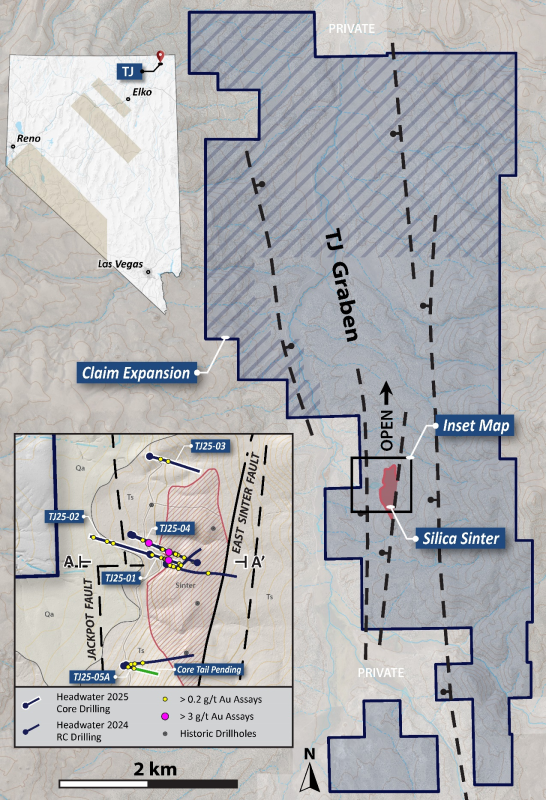
Figure 1 : Plan map of TJ project area showing recent claim expansion. Inset map shows 2025 core drilling and intercepts projected to surface. Cross section A–A’ corresponds to the interpreted geology cross section shown in Figure 2.
2025 TJ Drill Program:
Headwater completed approximately 1,350 metres of core drilling over five holes during the 2025 program (Figure 1), fully funded by OceanaGold through Stage 1 of the earn-in agreement. Four holes targeted the East Sinter fault and associated structures beneath the main sinter exposure. An additional hole targeted the Jackpot fault, characterized by a >2 km-long break in CSAMT resistivity (Figure 1). The final hole of the program, designed as a step-out approximately 300 metres to the south, was suspended prior to reaching target depth due to winter weather conditions and has been cased for future re-entry.
Drilling was designed as a follow-up on the Company’s 2024 RC scout drilling campaign which confirmed the presence of widespread silicification and epithermal veining as well as broad intervals of anomalous gold mineralization in the hanging wall of the East Sinter fault. However, this initial program did not test sufficient depths where potential high-grade mineralization is typically developed (see news releases dated December 20, 2024 and January 16, 2025).
Click Image To View Full Size
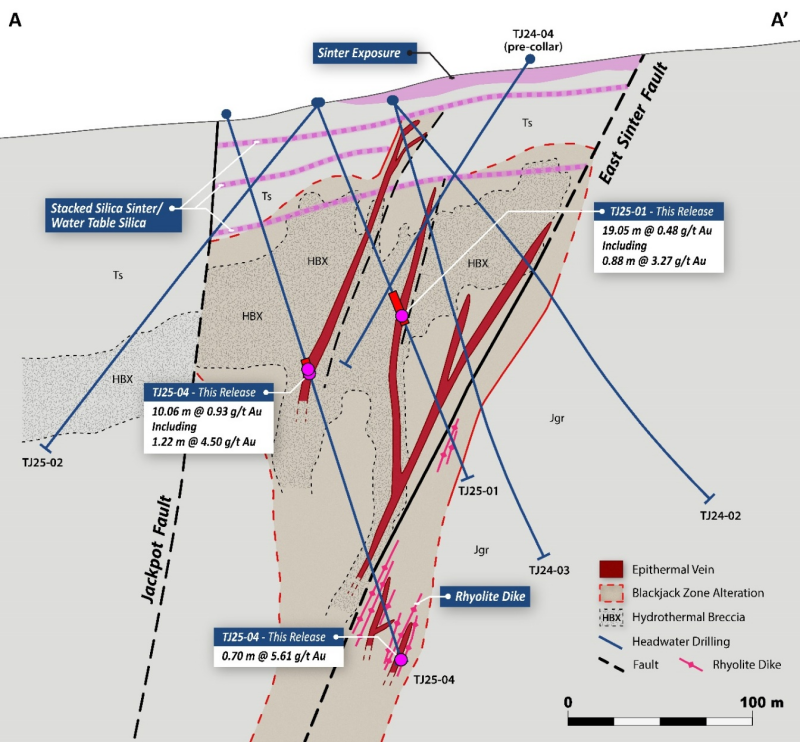
Figure 2: Interpretive geologic cross section A–A’ showing results from 2025 Blackjack Zone drilling.
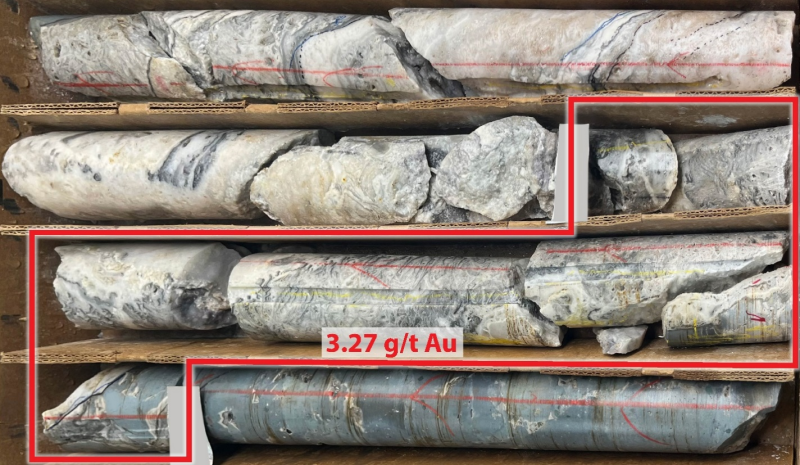
The drill program targeted deeper elevation horizons than previous drilling, between 150 and 200 m below silica sinter exposed at surface and was the first program to utilize diamond core drilling at the property. Drill hole TJ25-01 was the first core hole of the 2025 program and successfully encountered multiple discrete vein zones as well as a broad zone of hydrothermal brecciation in the Blackjack Zone target (Figure 2). TJ25-01 intercepted 0.88 m of 3.27 g/t Au within a wider interval of 19.05 m grading 0.48 g/t Au from 112.17 m to 131.22 m depth (Table 1, Figure 3). Several additional intervals grading greater than 0.5 g/t Au were also encountered.
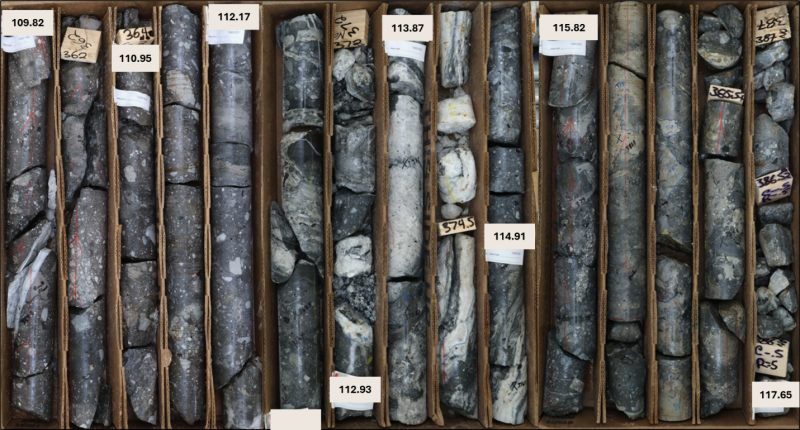
Mineralization in drill hole TJ25-01 consists of crustiform-colloform banded quartz-carbonate-adularia veins with lattice bladed quartz-after-calcite and evidence for multiple overlapping vein phases. An approximate 50–75 m-thick hydrothermal breccia body (Figure 4) was encountered in multiple drill holes and corresponds to increased vein density and thickness. The highest-grade veins were intercepted near the base of the hydrothermal breccia, where it contacts a laterally extensive silicified and propylitic altered sill or dike (Figure 2).
Click Image To View Full Size
Figure 3: Photograph of 3.27 g/t Au over 0.88 m vein intercept in TJ25-01 showing abundant lattice-bladed quartz-after-calcite, vein sediments, and crustiform banding along the wall rock margins.
Drill hole TJ25-04 was planned as a down-dip test of TJ25-01, aimed at intersecting the East Sinter fault approximately 250 m below surface sinter. TJ25-04 intercepted 10.06 m at 0.93 g/t Au, including 1.22 m at 4.50 g/t Au in the hanging wall of the East Sinter fault. This mineralized interval is interpreted as a separate hanging wall vein set from the TJ25-01 intercept (Figure 2). TJ25-04 ended in 2.16 g/t Au over 1.83 m, including 5.61 g/t Au over 0.70 m, within footwall alteration in the East Sinter fault zone. This lower intercept is characterized by thin veining and a series of sub-parallel rhyolite dikes that intrude silicified granite in the footwall of the main structure. Drilling was terminated on TJ25-04 due to difficult drilling conditions and significant intervals of poor recovery within the East Sinter fault zone.
Click Image To View Full Size
Figure 4: Representative photograph of hydrothermal breccias and veining encountered in the upper portions of TJ25-01. Sample break depths shown in metres and core blocks in feet. The interval shown averaged 0.27 g/t Au over 7.83 m and is interpreted as the up-dip extent of the vein zone encountered in drill hole TJ25-04 which intercepted 1.22 m grading 4.50 g/t Au (Table 1).
All 2025 drill holes encountered silica sinter and/or water table silica intercalated with volcaniclastic basin fill; the main fence of drill holes (Figure 2) encountered three main stacked sinter horizons extending to depths of >60 m below surface. The vertical and lateral extent of sinter horizons is indicative of a productive and long-lived geothermal system and suggests the commonly mineralized, main boiling horizon of the system may occur at a greater depth than originally modelled. Complex multi-phase overprinting veins, hydrothermal breccias and syn-mineral intrusions encountered in all 2025 drill holes beneath the thick silica sinter cap point to the intensity of alteration and dynamic nature of the system over at least 500 m of tested strike length. The system remains open in both directions and at depth.
Table 1: Reported Drill Results from Headwater's 2025 TJ Drill Program1 |
Hole ID | Type | From (m)
| To (m) | Interval (m) | Au (g/t) | Az | Inc | TD (m) | Comments |
TJ25-01 | DD | 112.17 | 131.22 | 19.05 | 0.48 | 108 | -68 | 222.35 | Blackjack Zone |
including | DD | 125.76 | 126.64 | 0.88 | 3.27 |
|
|
| | | | |
|
|
|
|
TJ25-04 | DD | 141.43 | 151.49 | 10.06 | 0.93 | 110 | -70 | 316.69 | Blackjack Zone. Hole ended in 2.16 g/t Au over 1.83 m |
including | DD | 149.20 | 150.42 | 1.22 | 4.50 |
and | DD | 314.86 | 315.56 | 0.70 | 5.61 |
|
|
|
|
|
|
|
|
|
|
|
1Reported grades were calculated using a 0.2 g/t Au cut-off grade for primary intervals and 2 g/t Au for included intervals. Intervals correspond to downhole thickness. Unless otherwise stated in the “Comments” field, insufficient information is available to determine true thickness of mineralized intervals. DD signifies diamond drilling. |
Drill hole TJ25-02 targeted the Jackpot fault, which coincides with a steep, >2 km-long, break in CSAMT resistivity. The drill hole encountered a thick interval of argillic altered tuffaceous sedimentary basin fill, lesser hydrothermal breccia, and relatively thin zones of veining (Figure 2). The highest-grade sample in TJ25-02 was 0.38 g/t Au over 1.37 m from 149.05 m to 150.42 m depth in silicified hydrothermal breccia in the hanging wall of the Jackpot fault. The hole was terminated prior to planned target depth due to difficult drilling conditions and poor recovery within clay zones.
Drill holes TJ25-03 and TJ25-05A were designed as 250–300 m along strike step-outs within the East Sinter fault zone. TJ25-03 encountered an approximately 50 m-thick zone of hydrothermal brecciation and veining before intercepting granite basement at 135 m depth. The highest-grade interval encountered in this hole occurred directly above the granite contact and consists of 3.81 m of 0.31 g/t Au from 131.37 m to 135.18 m depth. TJ25-05A was suspended prior to reaching target depth due to weather conditions and has been cased for future re-entry. The upper portion of TJ25-05A encountered argillic altered volcaniclastic sediments intercalated with sinter horizons, which is underlain by a zone of strong silicification and hydrothermal breccia at the bottom of the cased interval. The highest-grade interval in the completed portion of the hole is 2.44 m of 0.42 g/t Au from 67.36 m to 69.80 m depth.
Land Expansion and Work Program:
The intensity and thickness of alteration observed in drilling cannot be explained by a small, localized system and instead point to a much larger hydrothermal footprint. The host graben architecture suggests the system is open to the north beneath an area of thin post-mineral cover. Hyperspectral mapping and initial reconnaissance work by Headwater geologists supports this interpretation. To cover this northern extension, Headwater staked additional unpatented mining claims and expanded the total land position size by 88%. The property now consists of 251 unpatented lode mining claims covering 1,990 hectares.
Gravity and CSAMT surveys are currently being planned to map the basin geometry and delineate potential structural targets across a broad area of the project. Geologic mapping, soil and rock chip sampling and hyperspectral mapping are also planned to further define the alteration footprint prior to detailed drill target selection.
Quality Assurance - Quality Control
PQ-size drill core was generally drilled in the upper portions of drill holes and HQ at depth. All core was logged, cut in half, sampled at specific intervals and sent for laboratory analysis. All drill samples were transported to ALS USA Inc. in Reno, Nevada (ISO/IEC Accreditation # 17025) for sample preparation and gold analysis. Gold was assayed by 30-gram fire assay with Inductively Coupled Plasma with Atomic Emission Spectroscopy finish (ICP-AES; ALS method Au-ICP21). Control samples comprising certified reference and blank materials were systematically inserted into the sample stream and analyzed as part of the Company’s quality assurance and quality control protocol.
About the TJ Project:
The TJ Project is located on Bureau of Land Management land in northeastern Nevada, approximately 25 km southeast of the town of Jackpot. The project hosts a laterally extensive silica sinter and a well-preserved low-sulfidation epithermal system associated with a graben structure filled with Miocene sedimentary rocks. Headwater completed initial RC drilling in 2024, confirming a large epithermal alteration system (see news release dated January 16, 2025). The 2025 core drilling program has now demonstrated that this system hosts high-grade epithermal vein mineralization at depth. The project consists of 251 unpatented mining claims (1,990 hectares) following the expansion announced herein. OceanaGold has satisfied the Minimum Commitment component of Stage 1 and continues to advance toward completion of Stage 1 which would require additional investment of approximately $8,000,000. Headwater holds an option to acquire a 100% undivided interest, subject to retained royalties and OceanaGold's option to earn up to 65% of the project following certain expenditures and delivery of a Pre-Feasibility Study within a designated time frame.
About Headwater Gold:
Headwater Gold Inc. (CSE: HWG, OTCQX: HWAUF) is a technically driven mineral exploration company focused on exploring for and discovering high-grade precious metal deposits in the Western USA. Headwater is actively exploring one of the world's most well-endowed, mining-friendly jurisdictions, with a goal of making world-class precious metal discoveries. The Company has a large portfolio of epithermal vein exploration projects and a technical team with diverse experience in capital markets and major mining companies. Headwater is systematically drill-testing several projects in Nevada and has strategic earn-in agreements with OceanaGold Corporation on its TJ, Jake Creek, and Hot Creek projects, Newmont Corporation on its Spring Peak and Lodestar projects, and Centerra Gold Inc. on its Crane Creek project in Idaho. In August 2022 and September 2024, Newmont and Centerra acquired strategic equity interests in the Company, further strengthening Headwater's exploration capabilities.
For more information about Headwater, please visit the Company's website at www.headwatergold.com.
Headwater is part of the NewQuest Capital Group, a discovery-driven investment enterprise that builds value through the incubation and financing of mineral projects and companies. Further information about NewQuest is available at www.nqcapitalgroup.com.
On Behalf of the Board of Directors
Caleb Stroup
President and CEO
+1 (775) 409-3197
cstroup@headwatergold.com
For further information, please contact:
Brennan Zerb
Investor Relations Manager
+1 (778) 867-5016
bzerb@headwatergold.com
Qualified Person
The technical information contained in this news release has been reviewed and approved by Dr. Stephanie Grocke, P.Geo. (EGBC License #58217), an independent “Qualified Person” (“QP”) as defined in National Instrument 43-101 – Standards of Disclosure for Mineral Projects.
Dr. Grocke has verified the data disclosed in this news release, including a review of the sampling, analytical, and test data underlying the information. Verification included a review of the QA/QC samples (standards, blanks, and duplicates) inserted into the sample stream. No material issues were identified during this review.
Forward-Looking Statements: This news release includes certain forward-looking statements and forward-looking information (collectively, “forward-looking statements”) within the meaning of applicable Canadian securities legislation. All statements, other than statements of historical fact, included herein including, without limitation, statements regarding planned geophysical surveys, surface exploration, and follow-up drilling at the TJ Project, OceanaGold's anticipated continued funding of the earn-in program, the Company's ability to identify drill targets in the northern extension of the TJ system, and the anticipated business plans and timing of future activities of the Company, are forward-looking statements. Although the Company believes that such statements are reasonable, it can give no assurance that such expectations will prove to be correct. Often, but not always, forward-looking information can be identified by words such as “pro forma”, “plans”, “expects”, “may”, “should”, “budget”, “scheduled”, “estimates”, “forecasts”, “intends”, “anticipates”, “believes”, “potential” or variations of such words including negative variations thereof, and phrases that refer to certain actions, events or results that may, could, would, might or will occur or be taken or achieved. Forward-looking statements involve known and unknown risks, uncertainties and other factors which may cause the actual results, performance or achievements of the Company to differ materially from any future results, performance or achievements expressed or implied by the forward-looking statements. Such risks and other factors include, among others, risks related to the anticipated business plans and timing of future activities of the Company, the ability of the Company to obtain sufficient financing to fund its business activities and plans, the risk that OceanaGold will not elect to continue with the earn-in program, the ability of the Company to obtain required permits, changes in laws, regulations and policies affecting mining operations, currency fluctuations, title disputes or claims, environmental issues and liabilities, as well as those factors discussed under the heading “Risk Factors” in the Company's filings with the Canadian Securities Authorities, copies of which can be found under the Company's profile on the SEDAR+ website at www.sedarplus.ca.
Readers are cautioned not to place undue reliance on forward-looking statements. The Company undertakes no obligation to update any of the forward-looking statements, except as otherwise required by law.
Copyright (c) 2026 TheNewswire - All rights reserved.
© 2026 Canjex Publishing Ltd. All rights reserved.