(via TheNewswire)
Victoria, British Columbia, Canada – TheNewswire - January 22, 2026. Teuton Resources Corp. (“Teuton” or “the Company”) (“TUO”-TSX-V) ("TEUTF"- OTCQB) is pleased to report that Joint Venture (“JV”) partner Tudor Gold Resources ("Tudor Gold") has provided an updated mineral resource estimate (“2026 MRE”) for the Treaty Creek Project (with higher-grade sensitivities). The Treaty Creek property, is situated in northwestern British Columbia in the heart of the Golden Triangle.
Following is information from Tudor Gold as reported in their news release of Jan. 22, 2026:
The 2026 MRE was prepared by Garth Kirkham, P.Geo. of Kirkham Geosystems Ltd. (“KGL”) in accordance with National Instrument 43-101, Standards of Disclosure for Mineral Projects (“NI 43-101”).
Treaty Creek 2026 MRE Highlights
2026 MRE at a net smelter revenue (“NSR”) cut-off value of US$50 per tonne
Indicated Mineral Resource of 24 .9 million ounces of gold, 148.7 million ounces of silver and 3.048 billion pounds of copper (912.3 million tonnes grading 0.85 g/t gold, 5.07 g/t silver and 0.15% copper)
Inferred Mineral Resource of 4.0 million ounces of gold, 18.6 million ounces of silver and 327.7 million pounds of copper (86.1 million tonnes grading 1.43 g/t gold, 5.22 g/t silver and 0.17% copper)
US$125 NSR cut-off value sensitivity
Indicated Mineral Resource of 5.8 million ounces of gold, 30.2 million ounces of silver and 607.2 million pounds of copper (102.1 million tonnes grading 1.78 g/t gold, 9.19 g/t silver and 0.27% copper)
Inferred Mineral Resource of 2.6 million ounces of gold, 7.2 million ounces of silver and 67.9 million pounds of copper (21.8 million tonnes grading 3.64 g/t gold, 10.22 g/t silver and 0.14% copper)
US$175 NSR cut-off value sensitivity
Indicated Mineral Resource of 3.4 million ounces of gold, 13.4 million ounces of silver and 167.3 million pounds of copper (45.1 million tonnes grading 2.33 g/t gold, 9.27 g/t silver and 0.17% copper)
Inferred Mineral Resource of 2.4 million ounces of gold, 6.6 million ounces of silver and 65.2 million pounds of copper (18.3 million tonnes grading 4.02 g/t gold, 11.17 g/t silver and 0.16% copper)
“The 2026 MRE increased Indicated Mineral Resources of gold at Treaty Creek’s Goldstorm Deposit by 15% over the 2024 Mineral Resource estimate and demonstrates the higher-grade potential at the Treaty Creek Project with higher NSR cutoff value sensitivities,” commented Joe Ovsenek, President and CEO of Tudor Gold. “Now that we have the 2026 MRE in hand, we can start to advance our strategy for placing Treaty Creek in production with an underground mine initially targeting roughly 300,000 ounces of gold per year. Metallurgical testing is underway, and we have started the process of developing a mine plan around the higher-grade mineralization at the Goldstorm Deposit. As the metallurgical testing and mine planning come together, we will assess the potential for the completion of a preliminary economic assessment later this year.”
Treaty Creek Project 2026 Mineral Resource Estimate
The 2026 MRE was prepared by KGL based on 359 diamond drill holes for a total of 191,466 meters, which includes 332 drill holes completed by Tudor Gold between 2016 and 2025 and 27 drill holes completed by prior Treaty Creek Project operators between 2007 and 2009. The 2026 MRE is reported at a NSR cut-off value of US$50 per tonne. A NI 43-101 Technical Report will be prepared and posted on www.tudor-gold.com and [Tudor Gold’s] profile on www.sedarplus.com within 45 days of the date of this news release.
Table 1: 2026 Treaty Creek Project Mineral Resource Estimate (1) - (11)
Mineral
Resource
Classification
|
Tonnes
(M)
| Gold Grade
(g/t) | Silver Grade
(g/t) | Copper
Grade
(%) |
Gold
(M oz)
|
Silver
(M oz)
|
Copper
(M lbs)
|
Indicated | 912.3 | 0.85 | 5.07 | 0.15 | 24.9 | 148.7 | 3,048.0 |
Inferred | 86.1 | 1.43 | 5.22 | 0.17 | 4.0 | 18.6 | 327.7 |
Notes:
The Mineral Resource statement is subject to the following:
(1) The 2026 MRE has been prepared by Garth Kirkham, P.Geo., an Independent Qualified Person as defined by NI 43-101.
(2) The 2026 MRE has been estimated in accordance with Canadian Institute of Mining and Metallurgy and Petroleum (“CIM”) definitions, as required under NI43-101.
(3) The 2026 MRE is reported on a 100% ownership basis.
(4) The 2026 MRE was prepared for a potential underground mining scenario evaluated within block cave mining shapes and constrained by geological and grade-continuity-defined solids using a NSR cut-off value of US$50/tonne. The NSR value was developed based on initial metallurgical testwork results combined with [Tudor Gold’s] and its consultants’ knowledge of potential smelter terms, royalites and onsite and offsite costs. The NSR calculation assumes a payable gold-silver-copper concentrate will be generated. The NSR calculation assumes metal prices of US$2925/ounce gold, US$34.00/ounce silver and US$4.25/pound copper; metallurgical recoveries of 90% for gold, 80% for silver and 80% for copper; underground mining costs of C$8.50/tonne, processing costs of C$38.50/tonne and G&A of C$1.50/tonne; a CAD:USD exchange rate of 0.72 and rounded to US$50.
(5) The 2026 MRE is reported without applying mining dilution, mining losses, or process losses.
(6) The 2026 MRE is constrained within underground shapes based on reasonable prospects of economic extraction, in accordance with NI43-101. Reasonable prospects for economic extraction were met by applying mining shapes, ensuring grade continuity above the cut-off value, and by excluding non-mineable material prior to reporting.
(7) Mineral resources are classified as Indicated, and Inferred based on geological confidence and continuity, spacing of drill holes, and data quality.
(8) The effective date of the 2026 MRE is November 30, 2025.
(9) Mineral Resources are not Mineral Reserves and do not have demonstrated economic viability. The estimate of Mineral Resources may be materially affected by environmental, permitting, legal, title, taxation, sociopolitical, marketing, or other relevant issues.
(10) The Inferred Mineral Resource in this estimate has a lower level of confidence than that applied to an Indicated Mineral Resource and must not be converted to a Mineral Reserve. It is reasonably expected that the majority of the Inferred Mineral Resource could be upgraded to an Indicated Mineral Resource with continued exploration.
(11) All figures are rounded to reflect the relative accuracy of the estimate and therefore numbers may not appear to add precisely.
Mineral Resource Estimation Methodology
The Mineral Resource estimate was completed using industry-standard commercial modelling and mine planning software, including Leapfrog and MineSight® (Version 16.30). The block model utilizes a parent block size of 10 × 10 × 10 meters, with sub-blocking to 0.5 × 0.5 × 0.5 meters to accurately reflect complex vein geometries.
Assay data were composited to 1.5 meters to ensure consistent sample support. Gold, copper, and silver grades were estimated using ordinary kriging in a single-pass approach, employing capped composites constrained within geologically defined estimation domains. Grade caps were determined through analysis of cumulative frequency plots and the spatial continuity of high-grade vein structures, with cut grade thresholds ranging from:
Hard boundaries were applied to all high-grade vein domains and associated parent domains. Estimation parameters included a minimum of two composites per block, a maximum of 16 composites per block, and a maximum of five composites per drill hole.
Mineral Resource Classification
Mineral Resources are classified as Indicated and Inferred in accordance with the CIM Definition Standards. Classification is based primarily on drill hole spacing, geological confidence, and demonstrated continuity of mineralization:
Indicated Resources are defined by drill hole spacing of less than approximately 100 meters to three drill holes.
Inferred Resources are defined by drill hole spacing of less than approximately 150 meters, subject to additional geological continuity criteria.
All Mineral Resources are constrained by continuous high-grade vein domain solids and enclosing mineralized parent domains.
Reasonable Prospects of Eventual Economic Extraction
The Mineral Resource estimate satisfies the requirement for “reasonable prospects of eventual economic extraction” through demonstrated geological continuity and delineation of mineralized zones amenable to underground mining methods. Reasonable assumptions regarding metal prices and operating costs were applied. Mineralization potentially extractable by underground methods was evaluated within block cave mining shapes and constrained by geological and grade-continuity-defined solids.
Click Image To View Full Size
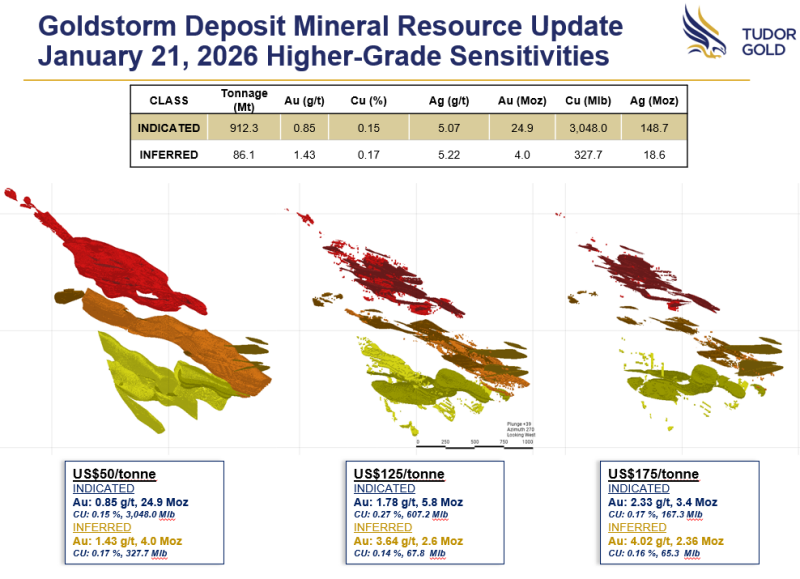
Treaty Creek Project 2026 Mineral Resource Estimate Higher-Grade Sensitivities In addition to the base case NSR cut-off value of $50 per tonne, NSR cut-off values of $125 per tonne and $175 per tonne are reported to demonstrate the potential effect on tonnage, grade and metal content (Table 2). Higher NSR cut-off value sensitivities demonstrate an increase in grade and concomitant decrease in tonnage. The higher cut-off value sensitivities will be evaluated for potential to support an underground mining operation using conventional mining methods. The higher NSR cut-off value sensitivities are for comparison purposes only and should not be considered Mineral Resources.
Table 2: 2026 Treaty Creek Project Mineral Resource Estimate Higher-Grade Sensitivities (1)
NSR Cut-Off Value
| Mineral
Resource
Classification |
Tonnes
(M)
| Gold Grade
(g/t) | Silver Grade
(g/t) | Copper
Grade
(%) |
Gold
(M oz)
|
Silver
(M oz)
|
Copper
(M lbs)
|
US$125/
tonne | Indicated | 102.1 | 1.78 | 9.19 | 0.27 | 5.8 | 30.2 | 607.2 |
Inferred | 21.8 | 3.64 | 10.22 | 0.14 | 2.6 | 7.2 | 67.8 |
US$175/
tonne | Indicated | 45.1 | 2.33 | 9.27 | 0.17 | 3.4 | 13.4 | 167.3 |
Inferred | 18.3 | 4.02 | 11.17 | 0.16 | 2.4 | 6.6 | 65.3 |
(1) See notes to Table 1 above.
Click Image To View Full Size
Geological Framework and Deposit Model
The Treaty Creek Property hosts the Goldstorm Deposit, which is situated within Early Jurassic intrusive rocks and the surrounding Late Triassic to Early Jurassic volcano-sedimentary sequences of the Stikine volcanic island-arc terrane. Regionally, prolonged arc magmatism across Stikinia and Quesnellia resulted in a multi-episodic Late Triassic to Early Jurassic metallogenic event, generating numerous porphyry intrusion-related mineral deposits throughout northwestern British Columbia.
Extensive hydrothermal alteration halos are developed around intrusive complexes in the nearby Mitchell and Sulphurets Deposit areas, and similar alteration assemblages are present at the Treaty Creek property. These alteration systems envelop several mineralized zones, including the Goldstorm Deposit, and are indicative of a large, long-lived hydrothermal system.
Structurally, the Treaty Creek property is influenced by regional-scale contractional faults and associated local dilational fault systems that formed within the Cretaceous Skeena Fold Belt. These structures have played a critical role in controlling magma emplacement, fluid flow, and the localization of mineralization at Goldstorm.
The Goldstorm Deposit is comprised of five distinct mineralized domains, each with unique geological and mineralogical characteristics:
Copper Belle, located at the southwest end of the deposit, represents a gold-dominant, shear-hosted mineralized system.
300H/N, CS-600, and Deep Stockwork 5 (DS5) form the core of the Goldstorm mineral system and consist of tabular bodies dipping approximately 45° to 50° to the northwest.
The 300H domain is a near-surface zone characterized by pervasive disseminated auriferous pyrite and fine gold-bearing pyrite veinlets and stringers.
The underlying CS-600 domain hosts gold- and copper-dominant mineralization associated with quartz veinlet stockworks, hydrothermal breccias, and porphyritic monzodiorite intrusive stocks. This domain contains the majority of the copper mineralization at Goldstorm and represents a well-defined intrusive-related porphyry system.
Beneath both 300H and CS-600, the DS5 domain comprises a gold-dominant quartz–pyrite veinlet stockwork, carrying minor silver values.
The Route 66 (R66) domain is a narrow, 20- to 50-metre-wide, north-striking corridor of high-grade, gold-dominant quartz stockwork mineralization.
All of the zones are gold-dominant with subordinate silver and copper, other than the CS-600 Zone, which is distinguished by its significant gold–copper enrichment. Together, these domains define a large, structurally controlled, intrusion-related mineral system with strong geological continuity.
The updated Mineral Resource estimate incorporates the results of an extensive internal geological review completed in 2024 and 2025, which included detailed drill core relogging, geochemical alteration modelling, and quantitative vein density analysis. This work has resulted in a refined geological framework that significantly improves [Tudor Gold’s] understanding of the Goldstorm mineralized system.
Diamond drilling conducted in 2025 confirmed the presence, continuity, and geometry of a well-defined mineralized corridor comprised of stacked, sub-parallel, structurally controlled stockwork vein systems. Individual vein panels range from approximately 10 to 50 meters in thickness, extend for more than 400 meters along strike, and are oriented approximately 295°/50°. These mineralized structures represent late-stage features that cross-cut and overprint earlier intrusive phases.
Mineralization is hosted within late-stage, cross-cutting quartz–anhydrite–pyrite veins containing accessory sphalerite, chalcopyrite, galena, tetrahedrite–tennantite, and manganoan calcite. These sulphide-bearing veins are associated with discrete decimeter- to meter-scale grey quartz–white mica (muscovite)–pyrite phyllic alteration halos, consistent with the [Tudor Gold’s] updated structural and alteration model.
Treaty Creek Project 2026 Mineral Resource Estimate by Zone
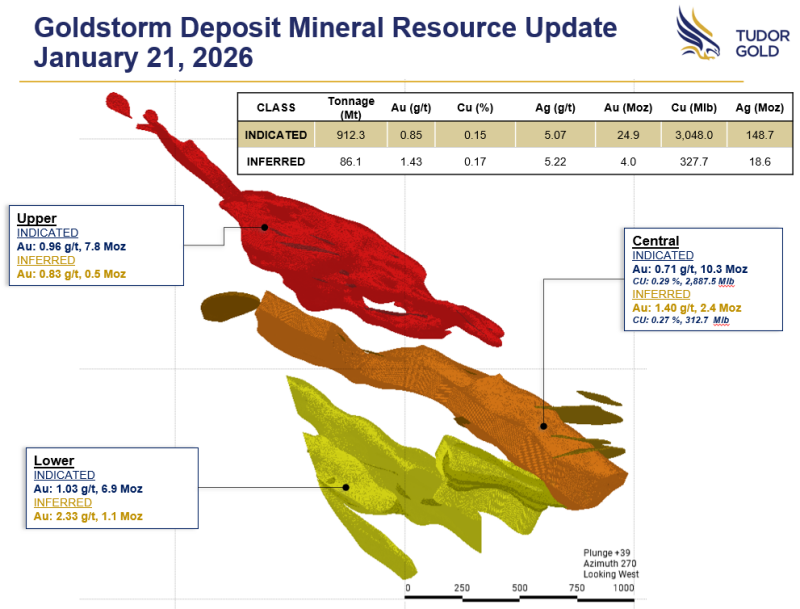
For the 2026 MRE, the Goldstorm Deposit at the Treaty Creek Project is reported as three zones of mineralization: Upper Zone, Central Zone and Lower Zone. The Upper Zone is comprised of the Copper Belle, 300H and 300N domains; the Central Zone is comprised of the CS600, Route 66 and SC-1 domains; and the Lower Zone is comprised of the DS-5 domain.
Table 3: 2026 Treaty Creek Project Mineral Resource Estimate by Zone (1)
Goldstorm
Deposit
Zone | Mineral
Resource
Classification |
Tonnes
(M)
| Gold Grade
(g/t) | Silver Grade
(g/t) | Copper
Grade
(%) |
Gold
(M oz)
|
Silver
(M oz)
|
Copper
(M lbs)
|
Upper | Indicated | 252.5 | 0.96 | 3.60 | 0.02 | 7.8 | 29.2 | 111.3 |
Inferred | 18.9 | 0.83 | 3.20 | 0.02 | 0.5 | 1.9 | 8.3 |
Central | Indicated | 451.6 | 0.71 | 5.49 | 0.29 | 10.3 | 79.7 | 2,887.5 |
Inferred | 52.5 | 1.40 | 7.04 | 0.27 | 2.4 | 11.9 | 312.7 |
Lower | Indicated | 208.2 | 1.03 | 5.95 | 0.02 | 6.9 | 39.8 | 91.8 |
Inferred | 14.7 | 2.33 | 10.17 | 0.03 | 1.1 | 4.8 | 9.7 |
(1) See notes to Table 1 above.
Next Steps
Metallurgical test work is ongoing with initial results expected this quarter. Concurrently with the metallurgical test work, a mine plan is expected to be developed based on the higher-grade mineralization at the Treaty Creek Project. If successful in developing a mine plan and assuming positive metallurgical results, a preliminary economic assessment will be undertaken on placing the Goldstorm Deposit in production. Additional information will be provided as it becomes available with respect to a preliminary economic assessment.
* * *
Qualified Persons
The 2026 MRE was prepared by Garth Kirkham, P.Geo. of KGL, who is an independent Qualified Person, as defined by NI 43-101 and responsible for the 2026 MRE. Mr. Kirkham has reviewed and approved the technical contents of the Tudor Gold news release dated January 22, 2026 relating to the 2026 MRE. Ken Konkin, P.Geo., Tudor’s Senior Vice President, Exploration, is the Qualified Person, as defined by NI 43-101, responsible for the Treaty Creek Project. Mr. Konkin has reviewed, verified, and approved the scientific and technical information in the Tudor Gold January 22, 2026 news release.
D. Cremonese, P. Eng., is the Qualified Person for Teuton Resources. Technical data presented in today’s Teuton news release is consistent with that presented in the Tudor Gold news release dated January 22, 2026. As Mr. Cremonese is President and also director of Teuton, he is not independent of the Company.
About Treaty Creek
Teuton was the original staker of the Treaty Creek property, host to the large Goldstorm deposit, assembling the core land position in 1984-5. It presently holds a 20% carried interest in the Treaty Creek Project (Tudor Gold is responsible for paying all exploration costs up until such time as a production decision is made and owns an 80% interest). Additionally, Teuton owns a 0.98% Net Smelter Royalty in the Goldstorm deposit area as well as in the northern portion of the Perfectstorm zone; within the southern portion of the Perfectstorm zone, Teuton owns a 0.49% NSR with an option to increase that to 1.49% by paying $1 million to the current owner. It also owns numerous additional royalty interests within the Sulphurets Hydrothermal system on formerly 100%-owned properties such as the King Tut, Tuck, High North, Orion, Delta and Fairweather properties (King Tut and Tuck now owned by Newmont Mining; High North, Orion, Delta and Fairweather properties now owned by Goldstorm Metals).
The Treaty Creek Project not only contains the Goldstorm Deposit (a large gold-copper porphyry system) it also hosts several other prospective zones of mineralization lying along a north-northeast trending axis following the trace of the Sulphurets thrust fault. This thrust fault is spatially related to all of the porphyry deposits on the neighbouring KSM property (owned by Seabridge Gold) as well as the Treaty Creek property.
About Teuton
Teuton owns interests in more than twenty-three properties in the prolific “Golden Triangle” area of northwest British Columbia and was one of the first companies to adopt what has since become known as the “prospect generator” model. This model minimizes share equity dilution while at the same time maximizing opportunity. Earnings provided from option payments received, both in cash and in shares of the optionee companies over the past 9 years, has provided Teuton with substantial income.
ON BEHALF OF THE BOARD OF DIRECTORS OF TEUTON RESOURCES:
"Dino Cremonese"
Dino Cremonese, P. Eng.,
President and Chief Executive Officer
For further information, please visit the Company's website at www.teuton.com or contact:
Barry Holmes
Director Corporate Development and Communications
Tel. 778-430-5680
Email: bholmesmba@gmail.com
Neither the TSX Venture Exchange nor its Regulation Services Provider (as that term is defined in the policies of the TSX Venture Exchange) accepts responsibility for the adequacy or accuracy of this release.
Cautionary Statements regarding Forward-Looking information
Certain statements contained in this press release constitute forward-looking information. These statements relate to future events or future performance. The use of any of the words "could", "intend", "expect", "believe", "will", "projected", "estimated" and similar expressions and statements relating to matters that are not historical facts are intended to identify forward-looking information and are based on the Company's current belief or assumptions as to the outcome and timing of such future events. Actual future results may differ materially.
All statements relating to future plans, objectives or expectations of the Company are forward-looking statements that involve various risks and uncertainties. There can be no assurance that such statements will prove to be accurate and actual results and future events could differ materially from those anticipated in such statements. Important factors that could cause actual results to differ materially from the Company's plans or expectations include risks relating to the actual results of current exploration activities, fluctuating gold prices, possibility of equipment breakdowns and delays, exploration cost overruns, availability of capital and financing, general economic, market or business conditions, regulatory changes, timeliness of government or regulatory approvals and other risks detailed herein and from time to time in the filings made by the Company with securities regulators. The Company expressly disclaims any intention or obligation to update or revise any forward-looking statements whether as a result of new information, future events or otherwise except as otherwise required by applicable securities legislation.
The Company expressly disclaims any intention or obligation to update or revise any forward-looking statements whether as a result of new information, future events or otherwise except as otherwise required by applicable securities legislation.
Copyright (c) 2026 TheNewswire - All rights reserved.
© 2026 Canjex Publishing Ltd. All rights reserved.