(via TheNewswire)
Independent ODM results support the transition to representative whole-sample testwork and focused sonic sampling at the Jaci Paraná target.
Vancouver, British Columbia – August 14, 2026 – TheNewswire – Canary Gold Corp. (CSE: BRAZ; OTCQB: CNYGF; Frankfurt: K5D) (“Canary Gold” or the “Company”) is pleased to report visible-gold-grain observations from 30 consecutive one-metre reverse-circulation (“RC”) samples collected from RC-0032 at the Jaci Paraná target within the Company’s Madeira River Project in Rondônia, Brazil. Overburden Drilling Management Limited (“ODM”) identified visible gold grains in laboratory-prepared gravity concentrates from 29 of the 30 samples. The results demonstrate repeated downhole recovery of visible gold grains at RC-0032, but do not represent head grades or establish grade continuity beyond the sampled hole.
Highlights
• Independent specialist laboratory Overburden Drilling Management Limited (“ODM”) identified visible gold grains in laboratory-prepared gravity concentrates from 29 of 30 consecutive one-metre RC samples collected from RC-0032.
• ODM identified 190 visible gold grains. Of these, 156 grains (82.1%) were reshaped, consistent with transport, abrasion and alluvial reworking within an auriferous sedimentary system.
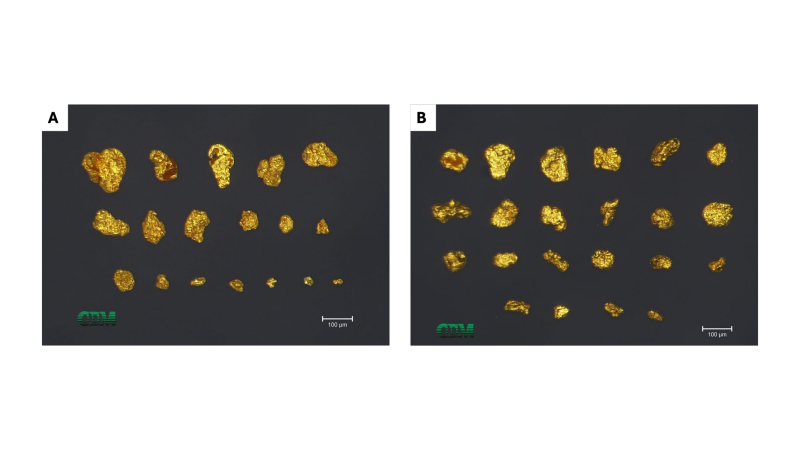
• The visible-gold population is fine by particle count: 166 grains (87.4%) measured 100 micrometres (µm) or less. However, only five grains larger than 150 µm accounted for approximately 44.1% of the calculated visible-gold mass reported for the concentrate, illustrating a pronounced coarse-particle tail and material nugget-effect risk.
• The ODM observations are geologically meaningful but semi-quantitative. Reported calculated ppb values relate to visible gold in a heavy-mineral concentrate and are based partly on an assumed concentrate mass. They are not sample head grades, metallurgical recovery results or mineral resource estimates.
• The RC-0032 results provide additional vertical information at one location within the approximately 6,700-hectare conceptual paleochannel target. Results received from the broader exploration program support the paleochannel interpretation but do not yet establish representative grade or grade continuity.
• Canary is planning an intermediate quantitative test program comprising approximately 40 selected one-metre RC samples expected to weigh approximately 25 kilograms each. The proposed work would include controlled gravity concentration, analysis of the gravity product and tails, and mass-balance, volume and density controls, subject to final laboratory scope and Qualified Person review.
• The Company received an indication of potential sonic-drill availability in September 2026 and is evaluating contracting, site access, permitting, program design and budget requirements. Focused sonic sampling would be designed to assess representative recovered volumetric gold grades, expressed in milligrams per cubic metre (mg/m³), while preserving both fine gold and the important coarser-gold fraction.
• A larger sonic drilling campaign, potentially exceeding 15,000 metres, would only be considered if representative sampling produces sufficiently encouraging and reproducible grade, recovery, continuity, density and volume data to justify resource delineation work.
Click Image To View Full Size
Figure 1. Illustrative visible gold grains recovered by ODM from laboratory-prepared gravity concentrates from Batch 4028. A. Sample 3075: RC-0032 (27m – 28m), B. Sample 3076: RC-0032 (28m – 29m). The 100 µm scale bars illustrate the fine particle dimensions and variable grain morphology.
Source: Overburden Drilling Management Limited. Photographs show visible gold grains recovered from the submitted material; they do not demonstrate sample head grade, metallurgical recovery or economic grade.
A Large Prospective Paleochannel Moving from Discovery to Evaluation
Canary’s 2026 exploration program has established a substantial body of geological evidence supporting a broad paleochannel interpretation at the Jaci Paraná target within the Madeira River Project. The area currently encompassed by the Company’s conceptual interpretation is approximately 6,700 hectares, beneath approximately 15 to 25 metres of overburden, with prospective alluvial sedimentary packages locally interpreted to reach approximately 10 to 30 metres in thickness. These dimensions remain conceptual and are not a mineral resource or volume estimate.
The Company’s exploration emphasis is transitioning from discovery—demonstrating the presence and distribution of gold within sampled paleochannel material—toward technical evaluation. The immediate objective is to determine whether representative sampling can produce reproducible volumetric-grade and recovery information sufficient to justify further evaluation.
“The significance of the ODM results is the repeated recovery of visible gold grains through the submitted interval in RC-0032, rather than any single calculated concentrate value,” said Mark Tommasi, President of Canary Gold. “The results provide additional vertical information at that location and support continued evaluation, but they are not representative head grades or metallurgical recovery results and do not establish grade continuity beyond the sampled hole. Our next phase is designed to generate representative and auditable volumetric data. We plan to test complete submitted RC sample material, quantify gravity recovery and losses and then evaluate focused sonic sampling. A major resource delineation program would only be considered if that work produces sufficiently encouraging and reproducible results.” — Mark Tommasi, President |
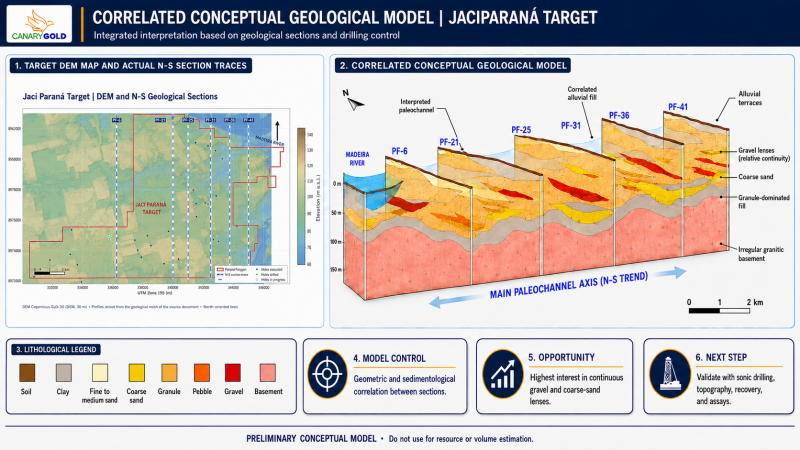
Click Image To View Full SizeCorrelated conceptual geological model
Figure 2. Correlated conceptual geological model for the Jaci Paraná target. The interpretation shows a north-south paleochannel axis, correlated alluvial fill and gravel and coarse-sand lenses interpreted to have relative continuity above irregular granitic basement.
Source: Company interpretation based on geological sections and drilling control. Preliminary conceptual model only; do not use for resource or volume estimation.
Independent ODM Results Demonstrate Repeated Visible-Gold-Grain Recovery at RC-0032
ODM Batch 4028 comprised 30 consecutive one-metre RC samples, numbered 3075 to 3104, collected from RC-0032 and consisting of sand and sand-plus-gravel material. ODM processed the samples and reported process weights, visible-gold-grain counts, morphology and particle dimensions. The observations independently demonstrate repeated visible-gold-grain recovery from the submitted interval at RC-0032; they do not independently establish the lateral extent of the paleochannel or grade continuity beyond that hole.
Visible gold grains were recovered from gravity concentrates prepared from 29 of the 30 samples, with a total of 190 grains identified. Samples 3075 to 3080 contained 101 of the 190 grains, while samples 3086 and 3087 form a second interval of interest. Sample 3087 contained six of the ten pristine grains identified in the batch, potentially indicating local variation in sediment source or transport history. Sample 3084 (36 m–37 m) was the only sample without identified visible gold.
Table 1. ODM Batch 4028 - Results at a Glance
Indicator | Result | Technical interpretation |
Analysis scope | 30 complete 1 m RC samples | Full ODM Batch 4028 dataset reviewed. |
Positive samples | 29/30 (96.7%) | Visible gold grains recovered from 29 submitted samples; not proof of economic grade or continuity. |
Visible grains | 190 | A geological observation, but not a total-gold assay or metallurgical recovery result. |
Morphology | 156 reshaped (82.1%) | Dominant signature of transport, abrasion and alluvial reworking. |
Other morphologies | 24 modified; 10 pristine | Sample 3087 contains six of the ten pristine grains. |
Median maximum length | 50 µm | Fine particles dominate the population by count. |
Length ≤100 µm | 166 grains (87.4%) | Sampling and processing must preserve the fine fraction. |
Length >150 µm | 5 grains (2.6%) | Rare coarse grains create material sampling and nugget-effect risk. |
Calculated coarse mass share | 44.1%* | Five coarse grains contribute nearly half of calculated visible-gold mass reported for the concentrate. |
Maximum reported grain | ~250 × 400 × 50 µm | One grain in sample 3087 accounts for approximately 94% of its calculated visible-gold value. |
*Calculated visible-gold mass uses the reported visible-gold value in heavy-mineral concentrate and an assumed nonmagnetic concentrate weight. It is not sample head grade or a metallurgical recovery result.
Particle Size, Recovery Risk and the Nugget Effect
The ODM particle-size distribution explains why the present results are important geologically but cannot yet be used economically. By count, the population is dominated by fine gold: 87.4% of grains are 100 µm or less and the median maximum grain length is 50 µm. This fine fraction may be vulnerable to loss during RC drilling, sample handling and gravity concentration if recovery conditions are not specifically designed to preserve it.
At the same time, the calculated visible-gold mass reported for the concentrate is strongly influenced by a very small number of larger grains. Only five grains above 150 µm represented approximately 44.1% of that calculated visible-gold mass. In sample 3087, one grain measuring approximately 250 × 400 × 50 µm accounts for approximately 94% of the sample’s calculated visible-gold response; in sample 3078, two coarser grains account for approximately 71%. Grain count is therefore not proportional to the calculated visible-gold mass reported for the concentrate.
This combination - abundant fine particles and a rare coarse-particle tail - creates two distinct technical requirements. Sampling and processing must preserve fine and laminar gold while also using enough sample support to capture the low-frequency coarse particles that can materially influence average recovered grade. This is the central reason Canary is moving toward complete-sample testwork and representative-volume sonic drilling.
CRITICAL TECHNICAL BOUNDARY ODM measured process weights and visible gold grains and then calculated visible-gold values in a heavy-mineral concentrate using an assumed nonmagnetic concentrate mass equivalent to 0.4% of table feed. The reported ppb values refer to calculated visible gold in that concentrate. They are not total gold in the full RC sample, are not head grades, do not establish metallurgical recovery and should not be used to estimate mineral resources or economic value. |
Widespread Gold Occurrence Supports the Paleochannel Model
The current exploration database includes 45 RC holes totalling 2,851 metres, 14 PQ (dry diamond drilling) holes totalling approximately 902 metres and 63 screw auger holes totalling approximately 1,297 metres, for a combined 2026 drilling and auger program of approximately 5,050 metres. Drilling has intersected repeated intervals of rounded to subrounded granules, pebbles, gravels and coarse sands across the target area, consistent with the interpreted alluvial architecture.
Gold particles have been observed in concentrated material from multiple drill locations. The ODM Batch 4028 results independently demonstrate repeated visible-gold-grain recovery through the submitted interval from RC-0032 and provide additional vertical information at that location.
The broad spatial distribution of drilling provides geological context across a target measured in kilometres. However, individual RC holes sample a very small volume relative to the conceptual paleochannel target, and the ODM batch discussed in this release comes from a single hole. The Company is therefore using the existing drilling to prioritize representative sampling areas rather than to infer grade continuity between widely spaced holes.
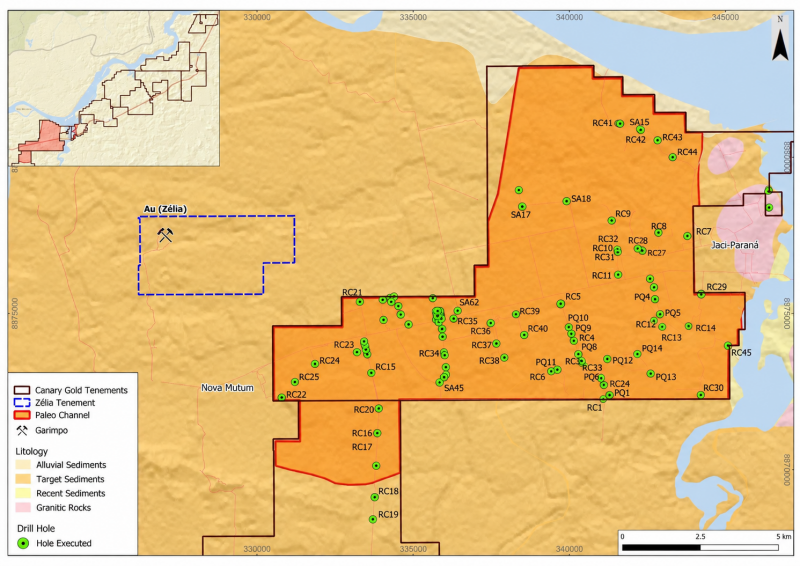
Click Image To View Full SizeJaciparaná paleochannel drill map
Figure 3. Current drill coverage across the interpreted Jaci Paraná paleochannel and Canary tenure. Completed drill holes are shown across a broad target area and provide the basis for selecting focused validation and sonic sampling locations.
A Staged Program to Establish Representative Volumetric Grade
Canary’s next work program is deliberately staged to test representativeness and recovery before the Company commits capital to a major resource delineation campaign. Each phase is intended to answer a specific technical question and to provide a clear decision gate for the next level of expenditure.
1 | Whole-sample RC validation testwork Approximately 40 selected one-metre RC samples, each expected to weigh approximately 25 kilograms, are proposed for quantitative metallurgical screening, subject to confirmation of laboratory scope and Qualified Person review. The proposed program would use controlled gravity concentration followed by analysis of the gravity product and tails. Wet and dry weights, feed mass, concentrate mass, recovery by size fraction, density, volume and analytical mass balance would be recorded. This phase is intended to provide a more quantitative estimate of gold recovered from each complete submitted sample, assess gold remaining in the tails, identify losses associated with the current discovery-stage procedure and inform selection of priority intervals for sonic sampling. |
2 | Focused sonic drilling and bulk sampling The Company has received an indication of potential sonic-rig availability beginning in September 2026 and is evaluating contractor, site, access, permitting, program-design and budget requirements. The initial design under consideration comprises close-spaced sonic grids across selected priority areas, with each grid potentially involving approximately 800 metres of drilling. Sonic drilling is expected to improve interval recovery and sample-volume control while preserving sands, fines and rare coarse particles. Multiple priority areas may be tested, subject to the initial whole-sample results, access, permitting, contracting, financing and budget approval. |
3 | Representative Recovered Gold per Unit Volume Each sonic interval would be processed using a documented and auditable protocol designed to assess recovered gold per controlled sample volume. The principal reporting metric is expected to be milligrams of recovered gold per cubic metre (mg/m³), supported by density, moisture, sample recovery and mass-balance data. Final terminology and conversion to an in-place volume basis will be reviewed by the Qualified Person before implementation. |
4 | Economic decision gate before resource drilling Only if representative sampling produces sufficiently encouraging and reproducible grade, recovery, continuity, density, volume and mining-characteristic data would Canary consider a larger sonic drilling campaign. Subject to those results, the Company anticipates that a resource delineation phase could exceed 15,000 metres and would be designed to collect data required to assess whether an inferred mineral resource estimate can be prepared in accordance with National Instrument 43-101. |
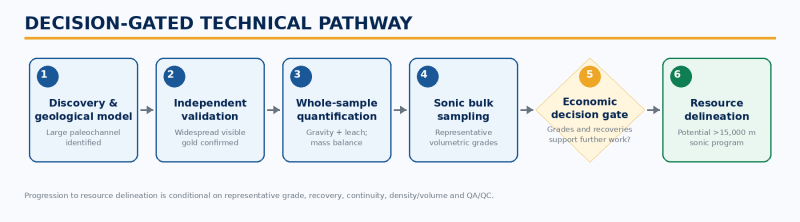
Click Image To View Full SizeDecision-gated technical pathway
Figure 4. Canary’s decision-gated technical pathway. Progression toward resource delineation is conditional on representative grade, recovery, continuity, density and volume control, QA/QC and a supportable economic case.
Near-Term Work and News Flow
Approximately 50 additional samples are currently being processed by ODM. Further SGS batches from RC concentrate work are also pending or in progress. Canary intends to use these discovery-stage results to refine the geological model, identify priority intervals and improve sampling procedures; however, concentrate observations and values will not be reported as equivalent to head grades or metallurgical recovery results.
The proposed whole-sample testwork is expected to require approximately three to four weeks following laboratory receipt, subject to confirmation of the final scope, contracting and laboratory scheduling. Results would be used to inform the location and configuration of initial sonic grids and to refine the recovery protocol before any field mobilization decision.
The Company will provide further updates as material results are received and the sonic sampling program is finalized. Any decision to expand to resource delineation would be based on representative quantitative data rather than visible-gold observations alone.
Quality Assurance, Quality Control and Analytical Methodology
ODM Batch 4028 comprised 30 consecutive one-metre RC samples of sand and gravel material from RC-0032 that were submitted to Overburden Drilling Management Limited (“ODM”) at its laboratory in Ottawa (Nepean), Ontario, Canada. ODM recorded bulk received weights, retained an approximately 300-gram archival split, screened and processed sample material, and examined pan concentrates for visible gold and fine-grained metallic indicator minerals. Visible gold grains were counted, classified by morphology and measured. ODM’s calculated visible-gold values are based in part on an assumed nonmagnetic heavy-mineral-concentrate mass equivalent to 0.4% of table feed and are therefore semi-quantitative. The ODM work was not a metallurgical recovery test.
SGS work referenced in the Company’s technical reporting relates to centrifuge or heavy-mineral concentrates that reduce the original sample mass by approximately 100-fold to 200-fold. Those concentrate values do not represent the gold grade of the original bulk sample. The proposed validation program is intended to improve quantitative characterization by testing substantially larger complete submitted samples, recording sample volume and density, applying mass-balance controls and analyzing both recovered product and tails. Any SGS results used to support public geological conclusions should be disclosed with applicable sample information, methods and QA/QC.
The Company is developing enhanced QA/QC protocols for the sonic program, including documented wet and dry weights, interval recovery, volume, density, feed and product masses, duplicates, blanks, standards where appropriate, chain of custody and recovery by particle-size fraction. Final procedures will be reviewed by the Company’s Qualified Person before implementation.
Qualified Person and Technical Disclosure
The scientific and technical information contained in this news release has been reviewed and approved by Andrew Lee Smith, P.Geo., a Qualified Person as defined by National Instrument 43-101 – Standards of Disclosure for Mineral Projects.
Mr. Smith has previously visited Canary’s Madeira River project in Brazil and is familiar with the regional geology and exploration activities. While not continuously present on site, Mr. Smith has reviewed drilling, sampling, QA/QC and geological information and is satisfied that the information has been collected and reported by site-based personnel in accordance with industry standard practices.
Mr. Smith is not independent of the Company within the meaning of National Instrument 43-101, as he serves as Executive Chairman of Canary Gold Corp.
About Canary Gold Corp.
Canary Gold Corp. is a Canadian public exploration company focused on the acquisition and advancement of gold projects in Brazil. The Company holds an option to earn up to a 70% undivided interest in the Rio Madeira Project through a series of staged exploration expenditures and milestone payments.
In August 2025, Canary further expanded its regional strategy by entering into a definitive agreement to acquire a 100% interest in ten additional mineral tenements totaling approximately 94,700 hectares from Talisman Venture Partners Ltd. , a private British Columbia corporation. The total consideration of CAD $1.7 million has been satisfied through staged cash and share payments.
Talisman retains a 1.0% net smelter return (NSR) royalty on future production from the acquired tenements, one-half of which (reducing the NSR to 0.5%) may be repurchased by the Company at any time for CAD $1.0 million.
Together, these interests provide Canary Gold with a dominant and strategically consolidated land position in the Madeira River region of Rondônia State — one of Brazil’s most prospective yet underexplored gold provinces.
For Further Information, Please Contact:
Canary Gold Corp.
Mark Tommasi, President
Tel: (604) 318-1448
www.canarygold.ca
Cautionary Statement Regarding Forward-Looking Information
This news release contains forward-looking information within the meaning of applicable securities laws, including statements regarding additional ODM and SGS work; the proposed whole-sample test program and its scope, methods, timing and objectives; potential sonic-drill availability, contracting and mobilization; site access and permitting; the design, timing and scale of possible sonic sampling and resource delineation programs; the ability of future work to generate representative volumetric-grade, recovery, continuity, density and volume information; and the possible preparation of a mineral resource estimate. Forward-looking information is based on management’s current expectations and assumptions, including laboratory and contractor availability, satisfactory completion of program design and Qualified Person review, access to equipment and personnel, receipt of any required permits and approvals, availability of financing, satisfactory sample recovery and analytical performance, and results that justify additional work. These assumptions may prove incorrect. Risks and uncertainties include sampling and recovery limitations associated with fine and coarse gold, the nugget effect, laboratory or contractor delays, equipment availability, access and permitting constraints, financing risk, cost escalation, failure to obtain representative or reproducible results, and the possibility that results will not support further drilling, a mineral resource estimate or an economic mining case, together with the risks described in the Company’s continuous disclosure filings. Actual results and future events may differ materially from those anticipated. Readers should not place undue reliance on forward-looking information. The forward-looking information in this release is made as of its date, and the Company will update it only as required by applicable law.
No securities exchange or commission has reviewed or accepted responsibility for the adequacy or accuracy of this release.
Disclaimer
This news release does not constitute an offer to sell or a solicitation of an offer to buy nor shall there be any sale of any securities in any jurisdiction in which such offer, solicitation, or sale would be unlawful. The securities of the Company have not been and will not be registered under the United States Securities Act of 1933, as amended (the “ 1933 Act ” ), or any state securities laws and may not be offered or sold in the “ United States ” or to “ U.S. persons ” (as such terms are defined in Regulation S under the 1933 Act) unless registered under the 1933 Act and applicable state securities laws, or an exemption from such registration requirements is available.
Copyright (c) 2026 TheNewswire - All rights reserved.
© 2026 Canjex Publishing Ltd. All rights reserved.