NORTHAMPTON, MA / ACCESS Newswire / December 2, 2025 / Chemours:
With the refresh of Chemours' Corporate Responsibility Commitment 2030 goals, we are sharpening our focus and helping to build a more circular economy by improving manufacturing processes that close the loop on water and waste as well as promoting product and packaging reuse and recycling. We have announced our new circularity aspiration: to decouple our growth from resource consumption and reduce waste by implementing circularity principles in our operations and with our partners. To ensure a positive circularity trajectory, we plan to announce specific targets and key performance indicators in future sustainability reporting.
Our circularity aspiration is part of our broader commitment to make the most of critical resources, prevent waste, take climate action, and support a thriving society. As our understanding of circularity, product carbon footprint, and lifecycle analysis matures, we expect to see intersections between our circularity and climate goals.
Throughout our operations, many existing processes and practices encompass the principles of circularity and enable the use of resources and materials. We support a circular economy through initiatives that advance safe, global recovery, reclamation, and reuse of our products, including refrigerants. This helps our customers contribute to circularity by extending the lifecycle of materials and feeding them back into the value chain, which saves resources, reduces waste, and creates value for the next generation.
Circular Water Processes
Freshwater systems are under pressure in many areas of the world due to increasing demand, ecosystem degradation, and climate change. This makes incorporating circular principles into water stewardship even more important. We manage water at the local level to best address watershed challenges, including water stress, and then tailor our actions to business and stakeholder needs.
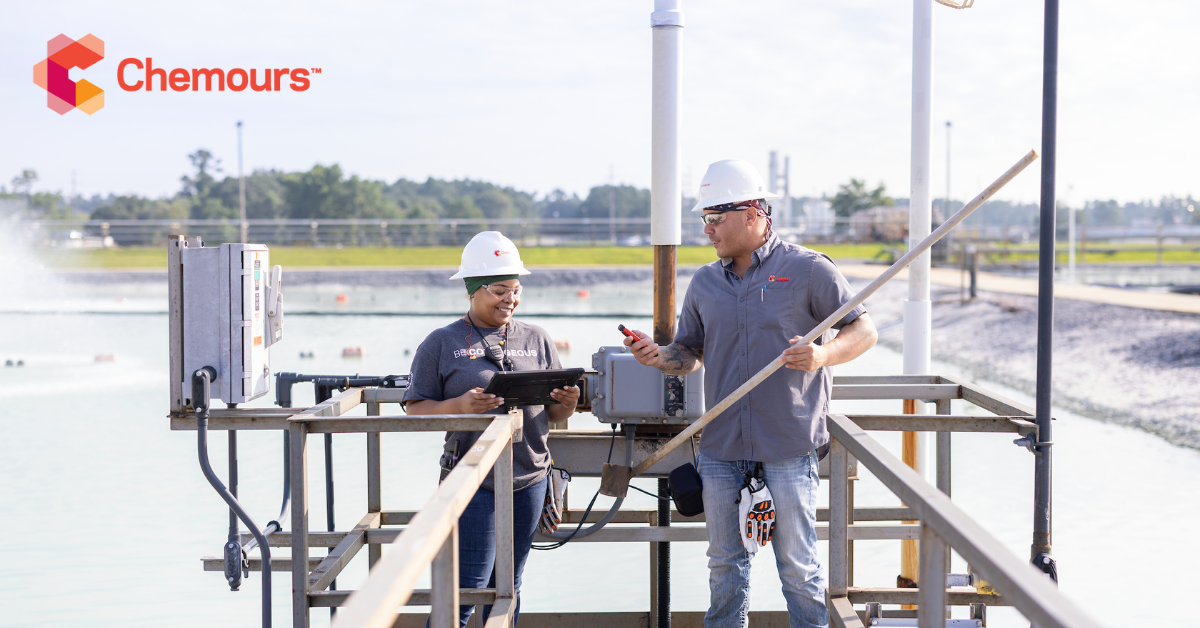
We use the World Resources Institute Aqueduct (Version 4.0) screening model and the World Wildlife Fund Water Risk Filter (Version 5.0) screening tool to evaluate local watershed conditions for baseline water stress. Identifying opportunities to reuse and recycle water in operations is a continuing priority. For example, our mining and mineral separation operations in Florida and Georgia continuously reuse and recycle process water during extraction and separation of mineral sands and rehabilitation of the mined lands. At the Mission Mine in Georgia, our careful management allows extensive reuse of the water until it is returned to the surficial aquifer, with only about one-fifth of the water that was originally withdrawn requiring treatment and offsite discharge.
Material Efficiency and Waste Management
We are moving to better embrace circularity, aiming to maintain the highest utility and value of our assets and products while reducing operational waste. Improving material circularity will become a focal point to drive overall improvement in performance. This represents a fundamental shift in how we view and handle waste. Instead of seeing waste as a problem to be managed, this approach treats it as a valuable resource for creating new materials. This shift in thinking has led us to broaden our goal to achieve a 70% reduction in landfill intensity by 2030 to be more holistic in alignment with our new circular aspiration for materials.
We also continue to encourage everyone at Chemours to rethink and improve waste management strategies, including landfill related waste, to reduce our impact on communities and the environment. As an example, our volunteer Landfill Champions Network is helping promote and implement waste reduction and recycling initiatives by inspiring colleagues to adopt more sustainable behaviors and sharing best practices.
Reinforcing Chemours' commitment to resource efficiency, our Thermal & Specialized Solutions business has created an international F-gas Lifecycle Program across the Americas, Asia, and Europe. The program aims to advance the global recovery, reclaim, and reuse of fluorinated gases (F-gases) safely across its low-GWP Opteon™ products, Freon™ refrigerants, and FM-200™ portfolios. Chemours continues to invest in and expand reclaim channels across regions. In a recent feasibility study, we also demonstrated a successful approach to recycling Nafion™ membranes for chlor-alkali production. The goal of the experiment was to extract impurities from the used membranes and reprocess the membrane to obtain a recycled film, with outstanding results.
Our product packaging has a direct impact on our customers' waste, and we are working to help them reduce their waste footprints by researching and designing product packaging alternatives for recycling and reuse. We will continue to identify and refine opportunities and reporting capabilities. Examples of reusable packaging include railcars, tank and bulk trucks, ISO containers, Flo-Bins, and barges. Examples of recyclable packaging include static-dissipative; flexible, intermediate bulk containers; plastic drums and pails; and metal drums.
The Chemours Company is a global chemistry company with a vision to deliver Trusted Chemistry that makes people's lives better and helps communities thrive. Read more actions taken toward circularity in Chemours' latest Sustainability Report.
View additional multimedia and more ESG storytelling from Chemours on 3blmedia.com.
Contact Info:
Spokesperson: Chemours
Website: https://www.3blmedia.com/profiles/chemours-company
Email: info@3blmedia.com
SOURCE: Chemours
View the original press release on ACCESS Newswire

© 2026 Canjex Publishing Ltd. All rights reserved.