New Index estimates closing the nursing shortage alone could save nearly 100,000 lives cumulatively by 2040; closing the physician gap could add over six months to average life expectancy
Unfilled healthcare positions already cost the average U.S. family $430 a year—which could nearly triple to $1,250 by 2040 without action
Closing the gap will take a portfolio approach—coordinated action from health systems, policymakers and educators

Company Website:
https://www.covista.com/
CHICAGO -- (Business Wire)
Covista, America’s largest healthcare educator, today released the Covista Healthcare Workforce Index, new research that is part of the company’s ongoing series examining the healthcare workforce shortage and looks to identify innovative solutions and fresh perspective around how stakeholders can work together to address the structural challenges around it. This Index is built around a model that sizes the U.S. healthcare workforce gap through 2040 and identifies interventions with the greatest potential to close it. The analysis projects that without action, the healthcare workforce shortage is on track to nearly double by 2040—but the model estimates that a combined approach pairing workforce investment with care delivery innovation could close 92% of the projected gap.
This press release features multimedia. View the full release here: https://www.businesswire.com/news/home/20260928447812/en/
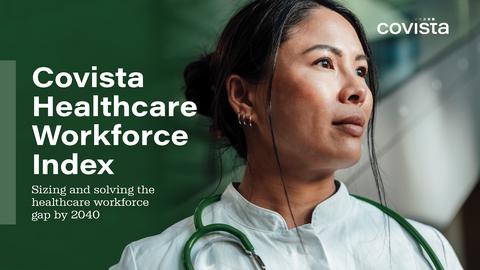
To learn more about the Covista Healthcare Workforce Index visit www.Covista.com/Covista-Healthcare-Workforce-Index.
“This shortage is real, and Americans are feeling it. The math in this Index gives us real optimism, but it will take a different approach. We need to invest in capacity for the people who want to do this work, and pair that with innovations in care delivery," said Steve Beard, Chairman and Chief Executive Officer, Covista. "That capacity is what Covista exists to build, and closing it is the work health systems, policymakers and educators like us have to do together.”
The modeling in the Index estimates the following:
- Closing the gap could mean longer, healthier lives. The model estimates that solving the nursing shortage alone could save nearly 100,000 lives by 2040 and that closing the physician gap could add more than six months to average life expectancy and cut wait times for specialist care by 20%.
- The workforce shortage is a hidden cost to American households, and it's getting worse. According to the model, unfilled healthcare positions cost the average U.S. family1 about $430 a year today, rising to $1,2502 a year by 2040 if left unaddressed—with rural and underserved communities bearing the heaviest burden.
- Closing the gap is possible, but only with a full portfolio approach. No single lever closes a gap this size alone. The model estimates that pairing workforce supply actions with care delivery innovation can close 92% of the projected 2040 gap.
- Investing in talent has the potential for immense impact yet is routinely overlooked. A sustainable healthcare workforce depends on strategic supply actions that invest in talent—attracting, developing and retaining it. The model estimates these actions can close over half of the 2040 gap.
The Covista Healthcare Workforce Index is based upon a model by Oliver Wyman, a leading global management consulting firm with expertise in healthcare and education. The Index draws on more than 60 academic, government, industry and business data sets and interviews with health system leaders. It models headwinds and care delivery innovation at the most likely scenario, based on current adoption trends. Supply actions are modeled at the best case: supply has historically been underinvested, and the Index is meant to project what's possible if that changes rather than projecting today's underinvestment forward.
Talent Pipeline: Underutilized and Underfunded
The Index estimates that investing in talent could have an outsized impact on the shortage. Despite this potential, health systems have historically prioritized short-term fixes over the structural investment supply actions require—leaving this lever the most underutilized. The Index models action across three areas:
- Attracting new talent to the field, particularly among non-traditional students—adult learners and career changers—could close up to 7% of the 2040 gap.
- Developing talent by expanding training capacity and clinical placements, which could close 25% of the gap; nursing schools alone turned away roughly 93,000 qualified applications in 2025.3
- Retaining clinicians already in practice by reducing burnout and strengthening incentives could close another ~25% of the gap.
Care Delivery Innovation: A Real Accelerant, But Not a Replacement for Talent
The Index estimates that AI, breakthrough therapeutics and redesigned care models can meaningfully ease pressure on the demand side of the shortage, but cannot close the gap alone. Their impact is also uncertain and interdependent—AI's promise hinges on adoption and trust, new therapeutics require affordable access and care model redesign depends on having clinicians available to staff new settings in the first place. The Index models three areas of impact:
- AI could help close up to 37% of the 2040 gap by automating documentation and administrative work—but the same tools that improve diagnosis and access can also surface previously unmet need, offsetting much of that gain by an estimated 18%.
- Breakthrough therapeutics such as GLP-1s and CAR-T cell therapy could shrink the gap by a further 21%.
- Care model redesign focusing on prioritizing preventive medicine and routing patients to the right setting and practitioner could close another 13%.
“The opportunity in front of healthcare right now is real—AI, new therapeutics and smarter care models can ease pressure on this shortage in ways we couldn't have delivered a decade ago. But every one of those tools depends on having enough clinicians to put them to work,” said Michael Betz, Chief Growth and Innovation Officer, Covista and President, Walden University. “Technology can offer efficiencies; it can't do the job. Our focus has to be building tools that free up our clinicians to do the thing they love the most: caring for patients.”
Closing the Gap Will Take Coordinated Action Across the Healthcare Ecosystem
No single stakeholder can solve a structural shortage this size alone. But the Index is more than just a warning. The path forward will take health systems, policymakers and educators moving together—not just treating symptoms of the shortage, but reshaping the care delivery model and the talent pipeline that feeds it. Sustained over the coming years, the Index projects that kind of coordinated investment could close the gap. Each stakeholder has a distinct role to play. According to the Index, key actions for each stakeholder group include:
- Health systems should treat the staffing gap as an enterprise risk and a resilience imperative. Specific recommendations include focusing on preventive and primary care delivery, redesigning jobs to retain great talent, expanding the talent pipeline and treating the workforce as a long-term investment.
- Policymakers have an opportunity to fix access, quality and affordability at the root of the healthcare system. Policy prescriptions include widening the door into healthcare, strengthening workforce stability, expanding the faculty pipeline, letting clinicians work to the full extent of their training, modernizing care delivery, preparing clinicians for new technology and investing in safer workplaces.
- Educators play an important role in both the supply and demand sides of the equation and are the primary means for solving the healthcare workforce shortage. Specific recommendations for educators include broadening who can enter the field, creating more faculty opportunities for clinicians, aligning curricula to where the jobs are and building AI fluency into education curricula and workforce training.
To download the full report, please visit www.Covista.com/Covista-Healthcare-Workforce-Index.
About Covista
Covista (NYSE: CVSA) is America's largest healthcare educator, serving 100,000 students and supported by a community of 400,000 alumni across five accredited institutions. Through personalized, tech-enabled education powered by 10,000 faculty and colleagues, Covista expands access to healthcare careers and addresses the U.S. healthcare workforce shortage at scale. Covista is the parent company of American University of the Caribbean School of Medicine, Chamberlain University, Ross University School of Medicine, Ross University School of Veterinary Medicine and Walden University. For more information, visit covista.com and follow us on LinkedIn, Instagram and YouTube.

View source version on businesswire.com: https://www.businesswire.com/news/home/20260928447812/en/
Contacts:
Nick Lucido
covistamedia@covista.com
Source: Covista Inc.
© 2026 Canjex Publishing Ltd. All rights reserved.