- Direct unit-level defense partnership with the Republic of Korea Army's 12th Infantry Division – an active frontline division protecting Korea's DMZ
- Technical implementation and advisory of high-performance battery solutions tailored to operational demand of frontline drone and robotics platforms, targeting system improvements at unit-level
- Field-validated performance data to be procured for product optimization and evidence for formal defense acquisition engagements
TORONTO, April 1, 2026 /CNW/ - NEO Battery Materials Ltd. ("NEO" or the "Company") (TSXV: NBM) (OTC: NBMFF), a low-cost, silicon-enhanced battery developer that enables longer-running, rapid-charging batteries for drones, robotics, and physical AI, is pleased to announce entering into a formal defense cooperation agreement (the "Agreement") with the Republic of Korea ("ROK") Army's 12th Infantry Division – an active frontline division utilizing drone and robotics systems within Korea's border and Demilitarized Zone ("DMZ").
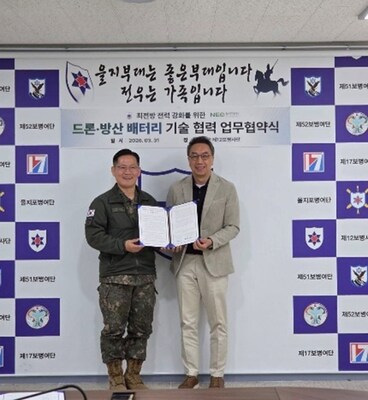
Under the Agreement, NEO and the 12th Infantry Division will partner on (i) the exchange of technical intelligence on high-energy battery technologies for defense drone and robotics platforms, (ii) technical implementation and advisory of battery and energy-related solutions for the specific operational demands from frontline and DMZ environments, and (iii) initiatives to enhance drone and robotics system efficacy at the brigade, battalion, and regiment-level. This unit-level engagement will generate field-validated performance data under live conditions, directly supporting the Company's strategy for formal military procurement consideration within the ROK Army and Ministry of National Defense.
With a strength of over 10,000 personnel, the 12th Infantry Division operates tank, air defense, reconnaissance, and engineering battalions, including the use of drone and robotics systems to protect, patrol, and bolster Korea's strategically sensitive border zones. Extended system endurance, robust cold-weather performance, and fast-charging capabilities are direct operational necessities, and NEO intends to custom-engineer drone and robotics battery products to address these requirements.
Major General Woo-je Cho, Commander of the 12th Infantry Division, remarked that, "South Korea's defense technology modernization is dependent on the integration and performance of autonomous systems in demanding frontline and DMZ environments. Collaborating with NEO Battery will provide our division, brigades, regiments, and battalions access to high-performance, Korean-sourced battery innovations that align with the ROK Army's commitment to strengthening uncrewed defense capabilities."
General (Ret.) C.J. Ko, Director of NEO and former Acting Chief of Staff of the ROK Army,commented, "This defense partnership with an active frontline division is expected to reduce our go-to-market timelines from initial deployment to full military procurement. In unit-level field use, NEO's battery solutions will undergo live stress testing, and the Company will gain access to unique datasets to further optimize products iteratively. With institutional relationships through the Association of the ROK Army, this direct engagement is intended to produce a body of operational evidence that will inform the Company's procurement discussions with the ROK Army and defense organizations across U.S. and allied governments."
About the ROK Army's 12th Infantry Division
The ROK Army's 12th Infantry Division, commonly known as the Eulji Division, was established in 1952 along with the 15th Infantry Division. Stationed along Korea's eastern frontline in Inje, Gangwon Province, the division has maintained a defense posture along the DMZ since the Korean War, serving as the ROK Army's primary deterrent force against potential incursions from the North. Today, the division deploys conventional ground forces, with the gradual implementation of autonomous systems and drone/robotics capabilities, as part of the ROK Army's national efforts to modernize defense and defense technology operations.
About NEO Battery Materials Ltd.
NEO Battery Materials is a Canadian-South Korean battery technology company focused on developing and producing silicon-enhanced lithium-ion batteries in drones, robotics, physical AI, electric vehicles, and energy storage systems. With a patent-protected, low-cost silicon manufacturing process, NEO Battery enables longer-running and ultra-fast charging properties and provides end-to-end battery solutions from materials selection, cell architecture, and process optimization. The Company aims to be a globally-leading producer of high-performance lithium-ion batteries and materials, building a secure, robust battery supply chain for Western manufacturers. For more information, please visit the Company's website at: https://www.neobatterymaterials.com/.
On Behalf of the Board of Directors
Spencer Huh
Director, President, and CEO
This news release includes certain forward-looking statements as well as management's objectives, strategies, beliefs and intentions. All information contained herein that is not clearly historical in nature may constitute forward-looking information. Generally, such forward-looking information can be identified notably by the use of forward-looking terminology such as "plans", "expects" or "does not expect", "is expected", "budget", "scheduled", "estimates", "forecasts", "intends", "anticipates" or "does not anticipate", or "believes", or variations of such words and phrases or state that certain actions, events or results "may", "could", "would", "might" or "will be taken", "occur" or "be achieved". Forward-looking information is subject to known and unknown risks, uncertainties and other factors that may cause the actual results, level of activity, performance or achievements of the Company to be materially different from those expressed or implied by such forward-looking information, including but not limited to: volatile stock prices; the general global markets and economic conditions; the possibility of write-downs and impairments; the risk associated with the research and development of battery-related technologies; the risk associated with the effectiveness and feasibility of battery material, electrode, and cell technologies that have not yet been tested or proven on commercial scale or under real-world operating conditions; the risks associated with battery-related manufacturing process scale-up, including maintaining consistent material, component, and cell quality, production yields, and process reproducibility at a pilot, semi-commercial, or commercial scale; the risks associated with compatibility of existing battery chemistries, formulations, components, or designs; unforeseen risks associated with entering into and maintaining collaborations, joint ventures, partnerships, or commercial contracts with battery cell manufacturers, original equipment manufacturers, and various companies in the global battery and downstream end-user supply chain; the risks associated with the failure to develop and produce commercially viable battery-related products or that technical goals may not be achieved within expected timelines or budgets under a joint development or collaboration; the risks associated with the Company's technologies and products not meeting performance requirements or customer specifications; the risks that prototype and pilot-scale products do not advance into commercially produced products or translate into commercial orders; the risk associated with battery components and cell purchase orders and offtake supply that may not be fulfilled in full, on time, or at all as actual revenue realization depends on delivery schedules, achievement of technical milestones, and customer acceptance and validation; the risk associated with losing official vendor registration or status with existing customers; counterparty risk upon delivery of prototype and commercial products; the risks associated with constructing, completing, securing, and financing pilot, semi-commercial, and commercial battery materials, components, and cell manufacturing facilities including the Canadian and South Korean facilities; the risks associated with potential delays or increased costs with site preparation, equipment procurement and installation, and facility commissioning; the risks associated with integrating silicon anode material production, electrode manufacturing, and cell assembly within a single operational cluster or the Company's business portfolio; the risks associated with supply chain disruptions or cost fluctuations in raw materials, processing chemicals, and additive prices, impacting production costs and commercial viability; the risks associated with uninsurable risks arising during the course of research, development and production; competition faced by the Company in securing experienced personnel, contracts and sales, and financing; access to adequate infrastructure and resources to support battery materials, components, and cell research and development activities; the risks associated with changes in the technology regulatory regime governing the Company; the risks associated with the timely execution of the Company's strategies and business plans; the risks associated with the lithium-ion battery industry and end-users' demand and adoption of the Company's silicon anode technology and battery products; market adoption and integration challenges, including the difficulty of incorporating silicon anodes and silicon battery products within battery manufacturers and OEMs' systems; the risks associated with the various environmental and political regulations the Company is subject to; risks related to regulatory and permitting delays; the reliance on key personnel; liquidity risks; the risk of litigation; risk management; and other risk factors as identified in the Company's recent Financial Statements and MD&A and in recent securities filings for the Company which are available on www.sedarplus.ca. Forward-looking information is based on assumptions management believes to be reasonable at the time such statements are made, including but not limited to, continued R&D and commercialization activities, no material adverse change in precursor, raw material, equipment, and relevant cost prices, development and commercialization plans to proceed in accordance with plans and such plans to achieve their stated expected outcomes, receipt of required regulatory approvals, and such other assumptions and factors as set out herein. Although the Company has attempted to identify important factors that could cause actual results to differ materially from those contained in the forward-looking information, there may be other factors that cause results not to be as anticipated, estimated or intended. There can be no assurance that such forward-looking information will prove to be accurate, as actual results and future events could differ materially from those anticipated in such forward-looking information. Such forward-looking information has been provided for the purpose of assisting investors in understanding the Company's business, operations, research and development, and commercialization plans and may not be appropriate for other purposes. Accordingly, readers should not place undue reliance on forward-looking information. Forward-looking information is made as of the date of this presentation, and the Company does not undertake to update such forward-looking information except in accordance with applicable securities laws.
Neither TSX Venture Exchange nor its Regulation Services Provider (as that term is defined in the policies of the TSX Venture Exchange) accepts responsibility for the adequacy or accuracy of this release.
SOURCE NEO Battery Materials Ltd.

 View original content to download multimedia: http://www.newswire.ca/en/releases/archive/April2026/01/c3585.html
For Investor Relations, PR & More Information: info@neobatterymaterials.com, T: +1 (437) 451-7678