Toronto, Ontario--(Newsfile Corp. - October 29, 2026) - PharmaTher Holdings Ltd. (CSE: PHRM) (OTCQB: PHRRF) ("PharmaTher" or the "Company"), a specialty pharmaceutical and technology company advancing pharmaceutical 3D printing for personalized medicine, today announced that it is building a portfolio of personalized peptide products for niche indications on its M3DICINES™ 3D-printed medicines platform, for near-term commercialization through the new U.S. peptide pathway. The first products are oral, colon-targeted KPV and BPC-157. They are being designed with the patent-pending COntRollable Release in 3D printed Colonic Targeting ("CORR3CT") technology of Craft Health Pte. Ltd. ("Craft Health") to carry the peptide through the stomach and release it in the colon-creating differentiated oral dosage forms for gastrointestinal applications where site-specific delivery may matter.1
The timing is driven by a new U.S. Department of Health and Human Services ("HHS") policy that creates a conditional pathway for qualified Section 503A pharmacies to compound six specified peptides; KPV and BPC-157 are the only two covered for oral use.2
PharmaTher's strategy is to develop personalized peptide products where formulation and delivery create a clear advantage, and to commercialize them with healthcare companies, telehealth platforms and pharmacies that already have patients, distribution and complementary peptide portfolios.
Key Highlights
- Personalized peptide portfolio. PharmaTher is building personalized peptide products for niche indications, starting with colon-targeted KPV and BPC-157, using pharmaceutical 3D printing and proprietary drug-delivery technologies.
- New U.S. peptide pathway. A new HHS policy creates a conditional pathway for six specified peptides, with KPV and BPC-157 the only two covered for oral use.2
- Differentiated colon delivery. CORR3CT is designed to carry a dose past the stomach and release it in the colon. In a peer-reviewed study using budesonide, CORR3CT delivered up to 75% of the dose to the simulated colon, while the commercial comparator released more than 90% before reaching it.1
- Unmet need in large markets. Ulcerative colitis continues to have meaningful unmet needs, including patients who fail to achieve or sustain remission. Third-party estimates value the global IBD treatment market at US$29.57 billion and the peptide therapeutics market at US$140.9 billion in 2025.3
- Partner of choice. PharmaTher aims to be the development and manufacturing partner for healthcare companies, telehealth platforms and pharmacies that want to bring differentiated, personalized peptide products to market, whether or not they build pharmaceutical 3D-printing capabilities in-house.4
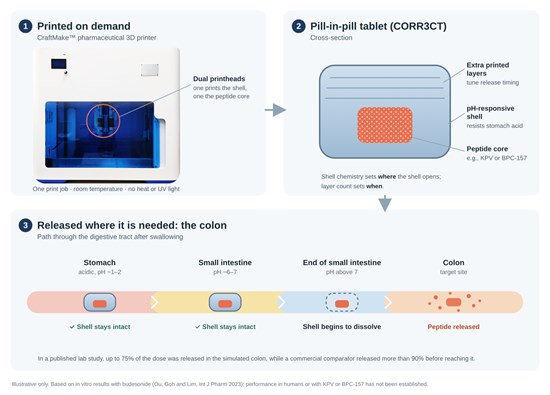
Figure 1. How a 3D-printed CORR3CT tablet is designed to carry a peptide past the stomach and release it in the colon (illustrative).
To view an enhanced version of this graphic, please visit:
https://images.newsfilecorp.com/files/11479/321580_5b9274eeb4a99b76_001full.jpg
Building a Personalized Peptide Portfolio
PharmaTher believes the opportunity is not to sell undifferentiated, commodity peptide products, but to use pharmaceutical 3D printing to create personalized and niche dosage forms that solve specific formulation and delivery challenges. The initial portfolio includes colon-targeted KPV and BPC-157 tablets and a BPC-157 chewable or orally disintegrating tablet designed for the upper gastrointestinal tract.
With CraftMake™ 3D printer systems, peptide products are printed at room temperature without heat or UV, in patient-specific strengths from a validated digital recipe and in economical small batches.4 With PD Labs serving as PharmaTher's U.S. Center of Excellence, the Company intends to develop and operationalize these products in a real-world 503A pharmacy setting while building a repeatable model that may support future healthcare, telehealth and pharmacy partners.5
Why Colon-Targeted KPV and BPC-157
KPV and BPC-157 are being studied for effects in the gastrointestinal tract, making targeted delivery relevant. KPV has demonstrated anti-inflammatory activity in mouse colitis models, including a colon-targeted study that achieved similar therapeutic efficacy at a 12,000-fold lower KPV concentration than free KPV. BPC-157 has limited early human ulcerative-colitis experience using rectal administration. The lead target is left-sided ulcerative colitis: about 30-60% of patients with ulcerative colitis have inflammation in the descending colon, which most oral budesonide products are not designed to reach.1
Neither KPV nor BPC-157 is FDA-approved, but both can now be prescribed and compounded for oral use through the new U.S. pathway, subject to its conditions.6
Differentiated Colon Delivery
CORR3CT is a 3D-printed pill-in-pill tablet with a drug-loaded core inside a pH-responsive shell. The shell is designed to resist stomach acid and delay release until the lower intestine, with additional printed layers used to tune release toward the colon.1
In the peer-reviewed 2023 in vitro study, CORR3CT tablets delivered up to 75% of their budesonide dose to the simulated colon, while the commercial comparator released more than 90% before reaching it. The study provides proof-of-concept for controllable colon targeting using 3D printing. CORR3CT is also the subject of a published U.S. patent application assigned to Craft Health.1
A New U.S. Pathway for Oral Peptides
HHS's Enforcement Discretion Policy Regarding 503A Compounding Using Certain Peptide Bulk Drug Substances is scheduled for publication in the Federal Register on October 30, 2026. It covers BPC-157, Epitalon, KPV, MOTS-c, Semax and TB-500. Of the six covered peptides, only KPV and BPC-157 are included for oral use.2
The policy sets specific conditions, including qualifying peptide supply from an FDA-registered manufacturer with required documentation, patient-specific prescribing, serious adverse-event reporting and documentation of adequate human oral bioavailability for an oral formulation. PharmaTher intends to design its products around these conditions, giving prescribers and pharmacies a documented, quality-controlled alternative to unregulated peptides.2
Partnering with PharmaTher
For healthcare companies with their own peptide concepts or existing peptide portfolios, PharmaTher aims to be a development and technology partner-providing niche, differentiated peptide solutions that can complement existing portfolios without requiring partners to build specialized formulation and pharmaceutical 3D-printing capabilities in-house. The M3DICINES™ platform, built with Craft Health's technology, may also enable multi-peptide products pursued through FDA approval pathways and colon-targeted versions of established gastrointestinal drugs.
Management Commentary
"We are not trying to compete for patients with large telehealth brands that sell undifferentiated, commodity peptide products," said Fabio Chianelli, Chairman and Chief Executive Officer of PharmaTher. "Our focus is the product itself-building niche, personalized peptide solutions where formulation and delivery matter, starting with a colon-targeted strategy for KPV and BPC-157, made possible by our pharmaceutical 3D-printing platform. We believe M3DICINES™ can create value through PharmaTher's own differentiated products and by helping healthcare partners add specialized peptide solutions to portfolios they already offer."
"We built CORR3CT to put a dose where the disease is," said Dr. Wei Jiang Goh, Co-Founder and Chief Executive Officer of Craft Health. "CraftMake™ prints at room temperature without heat or UV, making it well suited to fragile molecules such as peptides. We look forward to supporting PharmaTher's development of targeted oral KPV and BPC-157 products."
About Craft Health Pte. Ltd.
Craft Health is a Singapore-based pharmaceutical technology company founded in 2019 by pharmacists Dr. Wei Jiang Goh and Dr. Seng Han Lim. Its proprietary pharmaceutical 3D printing platform includes the CraftMake™ printer, CraftControl™ software and CraftBlends™ formulations. Its heat- and UV-free semi-solid extrusion process is designed for compounding pharmacies, hospitals and pharmaceutical partners. Learn more at CraftHealth.me.
About PharmaTher Holdings Ltd.
PharmaTher Holdings Ltd. (CSE: PHRM) (OTCQB: PHRRF) is a specialty pharmaceutical and technology company advancing pharmaceutical 3D printing for personalized medicine. Through its M3DICINES™ platform and exclusive North American distribution of the CraftMake™ system, PharmaTher is developing niche, differentiated products and partner programs across peptides, rare-disease treatments and medical countermeasures. Learn more at PharmaTher.com.
Neither the Canadian Securities Exchange nor its Regulation Services Provider accepts responsibility for the adequacy or accuracy of this release.
Cautionary Note Regarding Forward-Looking Information
This news release contains "forward-looking information" within the meaning of applicable Canadian securities laws, including statements regarding: the development and commercialization of colon-targeted KPV, BPC-157 and other peptide products on the M3DICINES™ platform; the application of CORR3CT to peptides and the Company's rights to it; the HHS policy and FDA rulemaking on the 503A bulks list; the role of PD Labs as PharmaTher's U.S. Center of Excellence and potential formulation-development, workflow and fulfillment activities; potential indications and FDA approval pathways; market estimates; the Company's personalized peptide portfolio, partner strategy and timing of commercialization; relationships with healthcare companies, telehealth platforms, pharmacies and other partners; and partnering, CDMO, white-label and licensing opportunities.
Forward-looking information is based on management's current assumptions, including that KPV and BPC-157 can be printed with acceptable stability and release, that in vitro CORR3CT results will translate to peptides and to humans, that the HHS policy will remain in effect, and that the Company will secure qualified peptide supply, financing and partners. Forward-looking information is subject to known and unknown risks, uncertainties and other factors that may cause actual results to differ materially, including: that the HHS policy is interim, may be revised or withdrawn, and may be followed differently by individual states; that FDA may decline to add KPV or BPC-157 to the 503A bulks list; that oral peptide formulations may not achieve adequate bioavailability or local exposure in humans; that the clinical evidence for KPV and BPC-157 is limited and largely preclinical, and that safety or efficacy concerns may emerge; the Company's dependence on Craft Health as its sole supplier of CraftMake™ systems, software and materials; that the Company's rights to CraftMake™ or CORR3CT may be limited, non-exclusive or terminated; that the CORR3CT patent applications may not issue or may not provide meaningful protection; competition from other compounders and delivery technologies; product quality and product liability risks; the Company's ability to obtain financing; and the other risk factors described in the Company's public filings available on SEDAR+ at www.sedarplus.ca.
Compounded drugs are not approved by the FDA, and FDA does not review their safety, effectiveness or quality before they are marketed. KPV and BPC-157 are not FDA-approved for any indication. Market and industry data in this news release are from third-party sources and have not been independently verified by the Company. Statements regarding PharmaTher's products, pipeline and business plans are made solely by PharmaTher; Craft Health has not independently verified, and makes no representation regarding, such statements.
Readers are cautioned not to place undue reliance on forward-looking information. All forward-looking information in this news release is expressly qualified by this cautionary note and speaks only as of the date of this release. Except as required by applicable securities laws, PharmaTher undertakes no obligation to update or revise any forward-looking information. This news release does not constitute an offer to sell or a solicitation of an offer to buy any securities.
Footnotes
1. Ou YH, Goh WJ, Lim SH. "Form & formulation approaches for COntRollable Release in 3D printed Colonic Targeting (CORR3CT) budesonide tablet." International Journal of Pharmaceutics. 2023;635:122680. doi:10.1016/j.ijpharm.2023.122680. https://pubmed.ncbi.nlm.nih.gov/36754183/; U.S. Patent Application Publication US20250312281A1, "System for controllable release in 3D-printed colon targeting (CORR3CT) oral dosage form," assigned to Craft Health Pte Ltd. https://patents.google.com/patent/US20250312281A1/en. The study used an in vitro gastrointestinal simulated system and reported up to 75% of the budesonide dose delivered to the simulated colon, while the commercial comparator released more than 90% before reaching it.
2. U.S. Department of Health and Human Services (HHS), Enforcement Discretion Policy Regarding 503A Compounding Using Certain Peptide Bulk Drug Substances, Appendices A-B (posted Oct. 27, 2026); Federal Register public-inspection notice, FR Doc. 2026-22192, Docket No. HHS-OASH-2026-0496 (scheduled for publication Oct. 30, 2026). HHS policy: https://www.hhs.gov/sites/default/files/hhs-503a-peptide-enforcement-discretion-policy-appendix-b.pdf; Federal Register: https://public-inspection.federalregister.gov/2026-22192.pdf. The policy's conditions include ingredient source and documentation, patient-specific prescriptions, adverse-event reporting and oral-bioavailability documentation.
3. Recent peer-reviewed reviews identify persistent unmet needs in ulcerative colitis despite therapeutic advances, including failure to induce and sustain remission in a substantial proportion of patients. See Expert Rev Gastroenterol Hepatol. 2025 (PMID 39865726), https://pubmed.ncbi.nlm.nih.gov/39865726/; and Expert Rev Gastroenterol Hepatol. 2024 (PMID 39470444), https://pubmed.ncbi.nlm.nih.gov/39470444/. Market estimates: Fortune Business Insights, "Inflammatory Bowel Disease Treatment Market" (2025 market size: US$29.57 billion), https://www.fortunebusinessinsights.com/inflammatory-bowel-disease-treatment-market-106704; Grand View Research, "Peptide Therapeutics Market" (2025 market size: US$140.9 billion), https://www.grandviewresearch.com/industry-analysis/peptide-therapeutics-market.
4. PharmaTher Holdings Ltd., "PharmaTher Enters into Exclusive North American Distribution Agreement with Craft Health for CraftMake™ Pharmaceutical 3D Printing Platform," Oct. 1, 2026. The release describes room-temperature, heat- and UV-free printing, dose customization from a validated digital recipe, small-batch economics and PharmaTher's planned product-development, CDMO, white-label and licensing models. https://www.pharmather.com/news-releases/pharmather-enters-into-exclusive-north-american-distribution-agreement-with-craft-health-for-craftmaketm-pharmaceutical.
5. PharmaTher Holdings Ltd., "PharmaTher Selects PD Labs, a National 503A Compounding Pharmacy, as the U.S. Center of Excellence for its Personalized Medicine and Peptide Platform, PERSONALIZ3D™," Aug. 18, 2026. The release describes PD Labs as an initial operating hub and development site intended to support pharmacy fulfillment, formulation development, standardized workflows, quality controls and integration of pharmaceutical 3D printing into pharmacy operations. https://www.pharmather.com/news-releases/pharmather-selects-pd-labs-a-national-503a-compounding-pharmacy-as-the-us-center-of-excellence-for-its-personalized-medi.
6. KPV evidence: Dalmasso G, et al. Gastroenterology. 2008;134(1):166-178. doi:10.1053/j.gastro.2007.10.026. https://pubmed.ncbi.nlm.nih.gov/18061177/; Laroui H, et al. Gastroenterology. 2010;138(3):843-853.e1-2. doi:10.1053/j.gastro.2009.11.003. https://pubmed.ncbi.nlm.nih.gov/19909746/. BPC-157 evidence: U.S. Food and Drug Administration evaluation of BPC-157-related bulk drug substances prepared for the July 23-24, 2026 Pharmacy Compounding Advisory Committee meeting, including discussion of limited human ulcerative-colitis experience. https://www.fda.gov/media/193343/download.

To view the source version of this press release, please visit https://www.newsfilecorp.com/release/321580

© 2026 Canjex Publishing Ltd. All rights reserved.