Vancouver, British Columbia--(Newsfile Corp. - July 27, 2026) - Golden Arrow Resources Corporation (TSXV: GRG) (FSE: G6A) (OTCQB: GARWF) ("Golden Arrow" or the "Company") is pleased to provide an update on its ongoing surface exploration program at the Atakama Gold Project in Chile ("Atakama"). The program has advanced the four priority near-surface gold targets identified to date-Paula, Lolita Norte, Dos Marias and Cerro Sur-across the nearly 10-kilometre width of the property.
Key results and observations from the four target areas include:
Strong gold grades at surface: The gold in the four zones is mainly structurally hosted in north-to-northwest trending quartz-carbonate-barite-specularite-rich veins and breccia zones with dominant quartz-sericite alteration (see Figure 1).
Paula: 2025 trenching identified a core mineralized zone of 380 metres long by 77 metres wide including five trenches with greater than 1 g/t Au over more than 20 metres (see Figure 3 and Table 1; originally reported January 12, 2026). Additional sub-parallel mineralized zones trenched up to 200 m away, and follow-up detailed mapping supports a broader mineralized zone than initially indicated. The target is open in all directions.
Lolita Norte: +3.5 km-long gold-hosting vein system with rock chip sample highlights including 1.5 m @ 4.75 g/t Au and 0.35 m @ 20.5 g/t Au.
Dos Marias: +3km-long target with identified gold in extensive shear zones up to 20 metres wide along a northwest-trending structure.
Cerro Sur: +8km-long target with highlight rock chip samples of 0.45 m @ 29.72 g/t Au and 1.7 m @ 10.81 g/t Au. Historic drilling at this target provides the only sub-surface geological information to date.
This systematic work has strengthened the Company's understanding of these targets and is guiding the next phase of exploration, including a planned initial drill program at the most advanced target, Paula.
Brian McEwen, Golden Arrow's VP Exploration and Development, stated, "We believed from the outset that the San Pietro project had multi-element, multi-deposit potential. When it came time to monetize our copper discoveries earlier this year, we strategized retaining the large concession group with the strongest gold targets and the environmental permits to advance through detailed drilling stages and into potential development phases. Our interest in these gold targets was cemented when the first trenching at Paula showed clear potential for a near-surface gold system. Since then, the surface work has continued to suggest expansion opportunities that need to be tested at depth, which we plan to do with an initial drill program starting in September. At the same time, we continue to evaluate additional concessions and opportunities that could strengthen the scale and potential of the project and our Chilean portfolio."
Since 2025, Golden Arrow's technical team has mapped a large percentage of the more than 9,000 hectares of concessions, collected 983 surface rock samples and 693 trench samples, and relogged over 4,600 metres of historic drill core. Current work includes detailed mapping (1:1,000 scale) at Paula and additional trenching and sampling at Paula, Lolita Norte and Cerro Sur. Geophysical surveys, including IP-Resistivity and ground magnetometry, will be carried out to assist in exploring the extent of mineralization at Paula and to refine drill targets. Drilling is currently permitted using a maximum of forty drill platforms, and the Company anticipates launching the first drill program at the Paula target in September, subject to financing. In addition, the Company is working to include the Atakama Project under the previously issued Environmental Qualification Resolution ("RCA") (see News Release dated November 10, 2025). The RCA includes several authorizations and allows for an additional 80 drilling platforms. This process is expected to be completed in September.
Project Details
The Atakama Gold Project is an exploration stage project that includes 9,469 hectares of exploration and exploitation concessions. The project is located 100 kilometres north of Copiapó in the mining-friendly Atacama Region of Chile.
Geology, Mineralization and Model
The Atakama project sits in Chile's Cretaceous Iron Belt, which hosts large iron-oxide-copper-gold ("IOCG") deposits such as Manto Verde (approximately 10km to the west) and Candelaria (approximately 100km to the south). Several known IOCG deposits ring the project, including the Company's previously discovered Rincones deposit. Gold occasionally contributes important economic value to IOCG mines in the region, but generally remains ancillary in these deposits. Gold-focused mining in the Atacama Region has largely occurred in the prolific Maricunga belt to the east in the high Andes, where gold is typically found in high-sulfidation epithermal and porphyry-style deposits. Recently, other companies have identified new styles of large gold deposits in the Atacama Region, such as the intrusion-related Ternera deposit in the Coastal Cordillera, approximately 35km west of the Atakama project (operated by Tesoro Gold) and the Pantanillo oxide gold project in the Maricunga (operated by Flagship Minerals).
Manto Verde, Candelaria, Ternera and Pantanillo are located on properties that are not part of the Atakama project, and the disclosure of mineralization on these properties is included for context only. Readers are cautioned that mineral deposits on nearby or geologically similar properties are not necessarily indicative of the mineralization on the Atakama project, and mineralization hosted on such other properties, even where geologically similar, is not necessarily indicative of the presence, style, or economic viability of mineralization on the Atakama project. The disclosure above regarding these properties is derived from public disclosure of their respective operators and has not been independently verified by the Company or its qualified person.
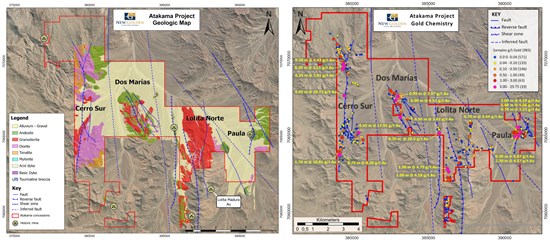
Figure 1. Geology (Left) and Surface Gold Results (Right) at Major Gold Targets, Atakama Project
To view an enhanced version of this graphic, please visit:
https://images.newsfilecorp.com/files/2562/306528_dcc503e9e4b1eb16_002full.jpg
The current working model interprets the mineralization observed to date at Atakama as epithermal/mesothermal and corresponding to the upper part of an intrusive-related system. In this model, iron- and silica-rich fluids separated, with iron-rich fluids creating deeper IOCG mineralization and silica-rich fluids creating shallower gold mineralization (Figure 2). The Company plans to complete age dating, fluid inclusion and other detailed studies later in the year to help corroborate the model. Observations that to date support this interpretation include: near-surface IOCG mineralization to the west, zones of silica lithocap, and quartz pods. Notably, alluvial or colluvial cover conceals large portions of the project.
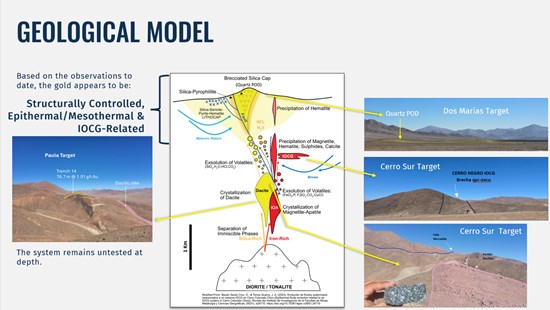
Figure 2. Geological Model and Supporting Examples, Atakama Project
To view an enhanced version of this graphic, please visit:
https://images.newsfilecorp.com/files/2562/306528_dcc503e9e4b1eb16_003full.jpg
Target Details
Paula Target
Paula is the most advanced of the four targets. It covers an area of approximately 1100 by 1200 metres on the easternmost part of the property. At Paula, fine grained andesites, tuffs and volcaniclastic rocks form the main mapped geological units and are intruded by a micro-diorite, with some areas of substantial gravel cover.
The gold system is characterized by an earlier stage alteration assemblage associated with a north-south structural system with veins, breccias, and fractured zones containing tourmaline, quartz, carbonates, and barite in oxidized zones with limonite. The system was originally identified within an area of approximately 1 kilometre by 750m where chip channel sampling returned intervals including 10.0m averaging 1.88 g/t Au (see News Release Dated September 2, 2025).
To date at Paula, the technical team has collected 211 surface rock samples, completed more than 1200 m of trenching that produced 693 samples, conducted ground magnetics geophysical surveying, and mapped the target at a scale of 1:1000.
The 2025 trenching program at Paula included 17 trenches to test the one-kilometre-long mineralized breccia vein system and a smaller parallel structure approximately 200 metres to the west (Figure 3). Higher gold values appear to correlate with tourmaline, in areas of stronger brecciation and replacement.
Notably, trenches 11 through 16 span 380 metres of strike and up to 76.7 metres width at the south end of the main breccia vein system in the south zone (Figure 3), and all returned intervals of greater than 1 g/t Au over more than 10 metres, including five trenches with 1g/t Au over more than 20 metres. Gravel cover conceals the north-south oriented structures along their strike extents, leaving untested potential in those directions. The team opened the trenches across structures using an excavator, and many trenches returned mineralization at the east or west extents of the trenches, indicating that mineralization may continue in those directions as well. In addition, recent detailed mapping suggests that the main mineralized zone may be significantly wider than the initial trenches indicated, reaching over 100 metres. The new trenching program will continue testing the zone for expansion.
Table 1 summarizes trench results as originally reported January 12, 2026.
Table 1. Summary of Results from 2025 Trenching Program at Paula Target
| Breccia Vein System | Trench |
| From
(m) | To
(m) | Interval (m) | Au
(g/t) |
| Paula | 1 |
| 15.1 | 48.3 | 33.2 | 0.18 |
| 2 |
| 31.0 | 102.5 | 71.5 | 0.28 |
| includes | 61.0 | 93.6 | 32.6 | 0.34 |
| 3 |
| 5 | 102.5 | 97.5 | 0.27 |
| includes | 25.6 | 43.2 | 17.6 | 0.43 |
| 4 |
| 22.8 | 80.7 | 57.9 | 0.27 |
| includes | 45.5 | 64.0 | 18.5 | 0.52 |
| 11 |
| 0.0 | 92.2 | 92.2 | 0.30 |
| includes | 75.8 | 88.2 | 12.4 | 1.07 |
| 12 |
| 6.0 | 29.9 | 23.9 | 0.21 |
| 43.1 | 77.9 | 34.7 | 1.10 |
| 13 |
| 14.3 | 47.2 | 32.9 | 0.91 |
| includes | 27.1 | 47.2 | 20.2 | 1.10 |
| 14 |
| 0.0 | 76.7 | 76.7 | 1.01 |
| includes | 15.8 | 42.4 | 26.6 | 1.65 |
| 15 |
| 0.0 | 73.4 | 73.4 | 0.87 |
| includes | 22.6 | 42.8 | 20.2 | 2.09 |
| 16 |
| 4.0 | 42.7 | 38.7 | 1.44 |
| includes | 20.2 | 42.7 | 22.6 | 2.24 |
| 17 |
| 1.5 | 111.7 | 110.2 | 0.34 |
| includes | 13.2 | 36.8 | 23.6 | 0.48 |
| includes | 60.9 | 79.3 | 18.4 | 0.44 |
| includes | 85.3 | 98.6 | 13.4 | 0.45 |
| Paula West | 5 |
| 6.8 | 54.3 | 47.5 | 0.16 |
| 6 |
| 0.0 | 66.4 | 66.4 | 0.19 |
| includes | 46.6 | 57.0 | 10.4 | 0.46 |
| 7 |
| 2.0 | 33.2 | 31.2 | 0.26 |
| 8 |
| 0.0 | 22.3 | 22.3 | 0.19 |
| includes | 13.8 | 22.3 | 8.5 | 0.34 |
| 9 |
| 12.5 | 67.1 | 54.7 | 0.16 |
| 10 | No significant intervals |
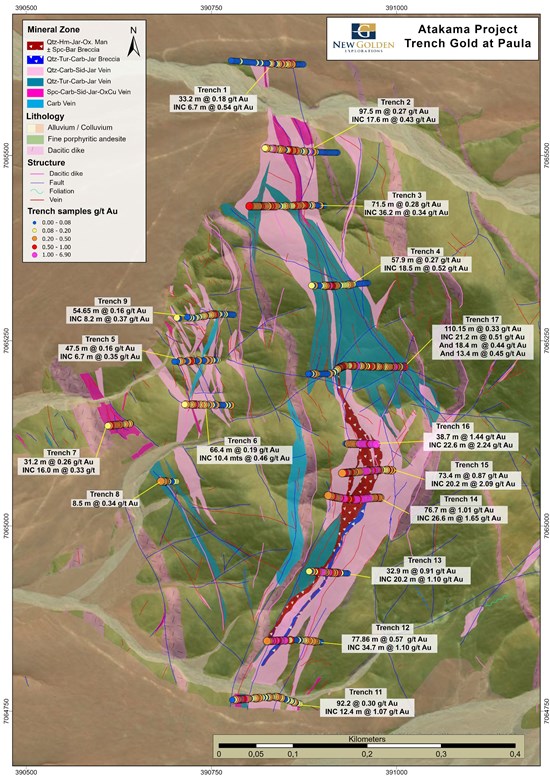
Figure 3. Initial Trench Results from Paula Gold Target, South Zone
To view an enhanced version of this graphic, please visit:
https://images.newsfilecorp.com/files/2562/306528_dcc503e9e4b1eb16_004full.jpg
Lolita Norte
Three kilometres west of Paula, Lolita Norte hosts a similar gold-bearing structural system that Golden Arrow interprets as the northern extension of the Lolita-Madura gold vein system. A private underground gold mining operation exploited the Lolita-Madura system in the 1980's, and its remains sit approximately 2.5 kilometres south of the Golden Arrow concessions. [Proximity to a mineral resource, deposit, or mine does not indicate that mineralization will occur on Golden Arrow's property, and if mineralization does occur, that it will occur in sufficient quantity or grade that would result in an economic extraction scenario.]
Mapping at Lolita Norte has identified east and west sectors to the system. In the east, a coarse granite hosts mineralization associated with a 20-metre-wide north-south oriented structure that dips 70° to the west and is associated with quartz-sericite alteration. A first tourmaline quartz event fills the structure, followed by veins and breccia of quartz-calcite-siderite plus jarosite and later barite and carbonates with specularite. The target features three mineralized north-northeast oriented structural jogs with widths up to 20 metres, including veinlet systems and hydrothermal breccias. In the western part of the target, the main low-angle north-south vein is approximately 6 metres wide and dips to the west. This vein hosts gold mineralization and is associated with a neighboring zone of quart-siderite plus jarosite veining. The system can be followed for at least 3.5 kilometres at surface. To date, the team has collected 210 surface rock samples at Lolita Norte, of which 10 have exceeded 1 g/t Au (Figure 1), with highlights of 1.5 m averaging 4.75 g/t Au and 0.35 m @ 20.5 g/t Au in rock chip samples. The team has mapped the area at an approximate scale of 1:10,000.
Dos Marias
At Dos Marias, volcanic to volcanoclastic rocks of andesitic composition (La Negra formation), with moderate to strong chloritization, dominate the geology. Granodiorite to tonalitic bodies with a northwest orientation intrude the volcanics. Northwest-oriented structures with extensive shear zones 10 to 20 metres wide host gold mineralization. The team has observed hydrothermal veins of whitish drusy quartz and boxwork cavities filled with iron oxides (jarosite-hematite-goethite). The host volcanics exhibit strong hydrothermally associated quartz-sericite alteration. The main northwest structure extends for at least three kilometres. At the target, the team has collected 153 surface samples, of which 13 are above 1 g/t Au (Figure 1), with highlights of 0.95 m grading 3.97 g/t Au and 0.90 m grading 4.52 g/t Au in rock chip samples. The team has mapped the area at a scale of 1:10,000.
Cerro Sur
At the western side of the Atakama project, gold mineralization associated with the Merceditas fault system has been identified in samples taken over eight kilometres, north to south. Golden Arrow has completed geological mapping at a scale of 1:2,500 at the target. Exploration by multiple previous operators provides an historical database of trench sample results, geophysical survey data and drill assays. The team has engaged in a quality assurance/quality control ("QA/QC") program to validate this database, including relogged over 4,100 metres of historic drill core
Lithologically, the area is characterized by multiple intrusive phases of granite, diorite, quartz monzonite, tonalite and dacitic dikes that cut through andesites and volcanoclastics of the La Negra formation, located at the eastern side of the target.
At Cerro Sur, the north-south oriented gold-mineralized breccia vein systems dip strongly to the east. From the center to the north extent of the target, quartz-siderite-jarosite with quartz-sericite alteration fills these breccia veins; to the south, epidote-garnet-magnetite vein and veinlet systems occur with carbonate plus jarosite.
To date, Golden Arrow has collected 393 surface rock samples with 24 of them returning assays above 1 g/t Au (Figure 1) and highlights corresponding to 0.45 m grading 29.72 g/t Au and 1.7 m grading 10.81 g/t Au in rock chip samples.
In addition to the structurally-hosted gold, in the northeastern and southeastern extents of Cerro Sur there are areas of specularite breccia and copper sulfide mineralization of IOCG style. This mineralization is controlled by subvertical northwest structures that have been identified both on surface and in historic drill holes.
Methodology & QA/QC
Rock chip samples were collected with hammer and chisel. Trenches were opened with an excavator to a maximum depth of 2 metres. Channel samples were collected at the bottom of the south wall of the trench, horizontally, with hammer and chisel. Silicified (hard) material was cut with an electrical saw. In all cases the sampling followed a channel. The average length of the samples was 1.7 metres and ranged between 0.4 and 2.6 metres. Trench samples and 675 surface samples were shipped to ALS Laboratory ("ALS") in Copiapó, Chile by a contract truck service for sample preparation, with subsequent analysis at ALS facilities in Lima, Peru. The remaining surface samples were similarly shipped to Andes Analytical Assay ("3AAA") Laboratories in Santiago, Chile for sample prep and analysis. In all cases samples were dried and ground to a particle size of 70% < -2 mm. Riffle splitting was used to obtain 1000 g of material which was pulverized to particle size 85% < 75 µm for subsequent chemical analysis. Gold analysis was completed by Fire Assay followed by atomic absorption, using method Au-AA23 at ALS and FA-AA-1E42 at 3AAA. At ALS, samples >10 g/t were reassayed using fire assay with a gravimetric finish (Au-GRA21). Multi-element testing was completed by ICP-OES reading following a four-acid digestion. Samples with over limits in copper (+ 10,000 ppm) were re-assayed by an ore grade method that includes four acid digestion and ICP-OES reading. The Company follows industry standard procedures for the work carried out at the Atakama Project, with a QA/QC program. Blank and standard samples were inserted in each batch of samples sent to the laboratory for analysis.
Qualified Persons
The exploration programs are designed by the Company's geological staff and results are reviewed, verified (including sampling, analytical and test data) and compiled under the supervision of Brian McEwen, P.Geol., VP Exploration and Development to the Company. Mr. McEwen is a Qualified Person as defined in National Instrument 43-101 and has reviewed and approved the contents of the news release.
About the Atakama Gold Project
The Atakama Gold Project is an exploration stage project focused on identifying new gold deposits with near-term development potential. The project is located 100 kilometres north of Copiapó in the mining-friendly Atacama Region of Chile. Golden Arrow operates Atakama through its 75%-owned Chilean subsidiary, New Golden Explorations Inc. ("NGE").
About Golden Arrow:
Golden Arrow is a mining exploration company with a successful track record of creating value by making precious and base metal discoveries and advancing them into exceptional deposits. The Company is actively exploring its Atakama Gold Project in Chile and a portfolio of prospective properties in Argentina.
Golden Arrow is an affiliated company of Grosso Group, a resource focused management organization that provides operational support to its affiliated companies as they advance quality resource projects.
ON BEHALF OF THE BOARD
"Nikolaos Cacos"
______________________________
Mr. Nikolaos Cacos,
President and CEO
Neither the TSXV nor its Regulation Services Provider (as that term is defined in policies of the TSXV) accepts responsibility for the adequacy or accuracy of this release.
This news release may contain forward-looking statements and forward-looking information within the meaning of applicable Canadian securities legislation (collectively, "forward-looking statements"), including without limitation statements identified by words such as "plans," "anticipates," "believes," "expects," "intends," "estimates," "may," "will," "would" and similar expressions. Forward-looking statements address future events and conditions and therefore involve inherent risks and uncertainties and readers are cautioned not to place undue reliance on forward-looking statements. All statements, other than statements of historical fact, that address activities, events or developments the Company believes, expects or anticipates will or may occur in the future, including, without limitation; statements about the potential mineralization and future exploration plans of the Paula, target and Atakama project; including the timing and results of the planned drill program at Paula; the Company's business strategy, plans and outlooks; the future financial or operating performance of the Company are forward-looking statements.
In making the forward-looking statements in this news release, the Company has applied several assumptions, including, without limitation: that the RCA and the Company's other existing permits and authorizations remain in good standing and support the drilling and other exploration activities described herein; that sufficient equipment, personnel, and financing will be available to the Company to carry out its planned exploration programs, including the initial drill program at Paula; that current interpretations of the geology, structural setting, and continuity of mineralization at the Atakama project will be consistent with the results of further exploration; and that there will be no material adverse change in general business, economic, mining industry, or regulatory conditions affecting the Company or the Atakama project.
Forward-looking statements are subject to a number of risks and uncertainties that may cause the actual results of the Company to differ materially from those discussed in the forward-looking statements and, even if such actual results are realized or substantially realized, there can be no assurance that they will have the expected consequences to, or effects on, the Company. Factors that could cause actual results or events to differ materially from current expectations include, among other things: risks and uncertainties related to the ability to obtain, amend, or maintain licenses, permits, or surface rights; risks associated with obtaining necessary regulatory approvals (including the TSXV's approval); risks inherent in interpreting exploration results, including trench, rock chip, and historic drill core data, particularly where true widths of mineralized zones are not known; fluctuations in gold, copper and other commodity prices; and other risks generally associated with the mining industry; risks associated with technical difficulties in connection with exploration activities; and the possibility that future exploration, development or mining results will not be consistent with the Company's expectations. Actual results may differ materially from those currently anticipated in such statements. Readers are encouraged to refer to the Company's public disclosure documents for a more detailed discussion of factors that may impact expected future results. The Company undertakes no obligation to publicly update or revise any forward-looking statements, unless required pursuant to applicable laws.

To view the source version of this press release, please visit https://www.newsfilecorp.com/release/306528

© 2026 Canjex Publishing Ltd. All rights reserved.