Vancouver, British Columbia--(Newsfile Corp. - May 13, 2026) - Cabral Gold Inc. (TSXV: CBR) (OTCQX: CBGZF) ("Cabral" or the "Company") is pleased to announce results from 2 additional diamond drill holes at the Jerimum Cima target and 4 diamond drill holes at the MG gold deposit within the Cuiú Cuiú Gold District, Brazil.
Highlights
- Recent drilling at the Jerimum Cima target, located 3km ENE of the Central gold deposit and 3.5km NW of the MG gold deposit at Cuiú Cuiú, returned 10.2m @ 8.7 g/t gold from 99.5m depth including 1.3m @ 62.5 g/t gold from 108.4m depth in hole DDH378
- The zone intersected in DDH378 is interpreted to be the same zone intersected by previous drill holes which include DDH372 and recently returned 9.5m @ 87.4 g/t gold including 2.9m @ 285.5 g/t gold as well as other holes which returned 45.6m @ 4.5 g/t gold including 1.5m @ 117.26 g/t gold, and 82.6m @ 0.98 g/t including 9.5m @ 5.74 g/t gold
- These recent drill results suggest the presence of an E-W trending high-grade zone extending for at least 455 metres which appears to form the core of a larger mineralized system at Jerimum Cima
- In addition, drilling at the MG gold deposit returned 10.3m @ 1.45 g/t gold from 152.2m depth in hole DDH361. DDH358 also returned 7.2m @ 1.12 g/t gold from 270.4m depth and 8.7m @ 1.11 g/t gold from 302.0m depth
Alan Carter, Cabral's President and CEO commented, "The Jerimum Cima target is located 3km ENE of the Central gold deposit and 3.5km NW of the MG gold deposit, and is not currently part of the existing resource base at Cuiú Cuiú. Ongoing drilling continues to suggest that we have an important discovery on our hands at Jerimum Cima. DDH378 returned 10.2m @ 8.7 g/t gold from 99.5m depth including 1.3m @ 62.5 g/t gold. This hole was drilled 205m east of DDH372 which recently returned 9.5m @ 87.4 g/t gold including 2.9m @ 285.5 g/t gold. We believe this to be the same high-grade mineralized zone which has now been traced for 455m along strike and remains open to the east. The broader E-W trending mineralized zone however is significantly larger and is up to 200m wide and extends at least E-W for 750m along strike. We look forward to additional results in the near term as our drill program ramps up."
Jerimum Cima Drill Results
The Jerimum Cima target is located 3 kilometres ("km") ENE of the Central gold deposit and 3.5km NW of the MG gold deposit (Figure 1). The target is characterized by a very strong gold-in-soil anomaly of +100 parts per billion ("ppb") gold covering an area of 900 meters ("m") x 1000m and is comparable with the gold-in-soil anomalies above the MG and Central gold deposits, and the PDM and Machichie Main gold discoveries. As with the MG gold deposit and the Machichie Main gold discovery, gold mineralization at Jerimum Cima is centered on a major east-west trending fault zone, which forms a splay off the regional scale Tocantinzinho fault system.
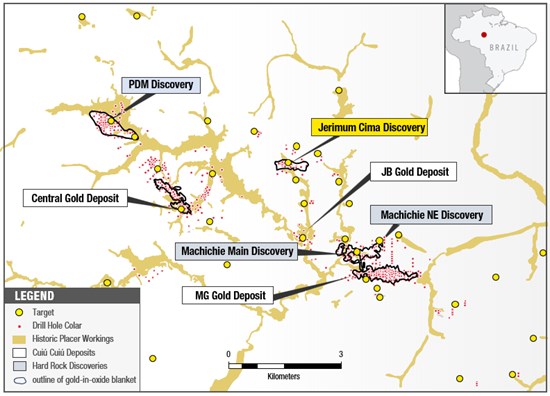
Figure 1: Map showing location of known gold deposits at Central, MG and JB. The location of new discoveries at PDM, Machichie NE and Machichie Main as well as the Jerimum Cima discovery are also shown.
To view an enhanced version of this graphic, please visit:
https://images.newsfilecorp.com/files/3900/297295_14bf035e34c048cc_002full.jpg
Previous drilling at Jerimum Cima returned 9.5m @ 87.4 g/t gold from 173.8m depth including 2.9m @ 285.5 g/t gold (see press release dated March 12, 2026), 45.6m @ 4.5 g/t gold including 1.5m @ 117.26 g/t gold in primary intrusive rock material as well as 49m @ 2.0 g/t gold including 1m @ 57.0 g/t gold (see press release dated May 21, 2025) and 82.6m @ 1.0 g/t including 9.5m @ 5.74 g/t gold (see press release dated January 26, 2026). In addition, a number of surface trenches returned gold intercepts of very good grade in gold-in-oxide material, and include 14m @ 1.6 g/t gold, 20m @ 1.2 g/t gold, 10m @ 1.3 g/t gold, and 24m @ 0.7 g/t gold and 18m @ 1.9 g/t gold (see press release dated November 14, 2024).
DDH378 was drilled on section 551266E with an azimuth of 0 degrees and at an angle of 55 degrees within the central eastern part of the Jerimum Cima target and was designed to test the eastern extension of the high-grade mineralization intersected in previous holes. The hole returned 10.2m @ 8.7 g/t gold from 99.5m depth including 1.3m @ 62.5 g/t gold from 108.4m depth (Figures 2 and 3, Table 1)
The zone intersected in DDH378 is very likely the same zone intersected by previous drill holes to the west. Drillhole DDH359 was drilled 125m west of DDH378 and previously returned 82.6m @ 0.98 g/t including 9.5m @ 5.74 g/t gold. Drillhole DDH372 was drilled 205m to the west and cut 9.5m @ 87.4 gold from 173.8m depth including 2.9m @ 285.5 g/t gold (see press release dated March 12, 2026). Drillhole CC26 was drilled 235m west of DDH378 and previously returned 45.6m @ 4.5 g/t gold including 1.5m @ 117.26 g/t gold. Drillhole RC561 was drilled 455m west of DDH378 and previously returned 49m @ 2.0 g/t gold including 1m @ 57.0 g/t gold (Figure 2). These holes together suggest the presence of a high-grade zone extending at least 455m along strike which may form the core of the mineralized system at Jerimum Cima. The high-grade zone remains open along strike to the east and at depth.
In addition, DDH379 reported herein was drilled on the extreme western limit of the Jerimum Cima target and despite cutting over 200m of highly silicified hydrothermal breccia, the hole failed to cut any significant gold values, apart from 0.7m @ 4.05 g/t gold. This silicified structure extends at least 3km to the NNW and forms the western limit to the mineralized zone at Jerimum Cima. There is evidence of historic placer workings immediately west of this structure suggesting that parts of it may be mineralized.
The high gold grades returned from DDH378 and other holes at Jerimum Cima, notably DDH372 which returned 9.5m @ 87.4 gold from 173.8m depth including 2.9m @ 285.5 g/t gold (see press release dated March 12, 2026), suggest the presence of a central zone of high-grade material which appears to be surrounded by lower grade stockwork mineralization. The high-grade zone appears to extend at least 455m along strike and is open to the east and at depth, and occurs within a broader mineralized envelope that is up to 200m wide and extends along strike at least 750m in an E-W sense. Additional drilling is in progress.
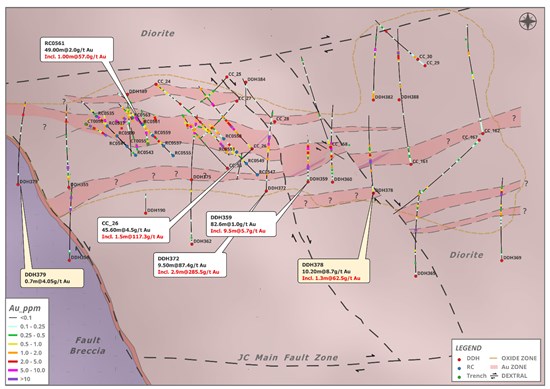
Figure 2: Map showing the location of drill holes at the Jerimum Cima target. The location of diamond drill holes DDH378 and DDH379 reported herein are also shown together with previous significant drill and trench results including DDH372 which cut 9.5m @ 87.4 gold, CC26 which cut 45.6m @ 4.5 g/t gold and DDH359 which returned 82.6m @ 1.0 g/t including 9.5m @ 5.7 g/t gold g/t gold. Note that three parallel mineralized zones in the underlying intrusive rocks have now been identified at Jerimum Cima extending over at least 750m E-W. The limit to the oxide banket as currently known is also shown. Terms: g/t = grams / tonne, m = metres, Au = gold. True widths may be 50% of actual drill intercepts
To view an enhanced version of this graphic, please visit:
https://images.newsfilecorp.com/files/3900/297295_14bf035e34c048cc_003full.jpg
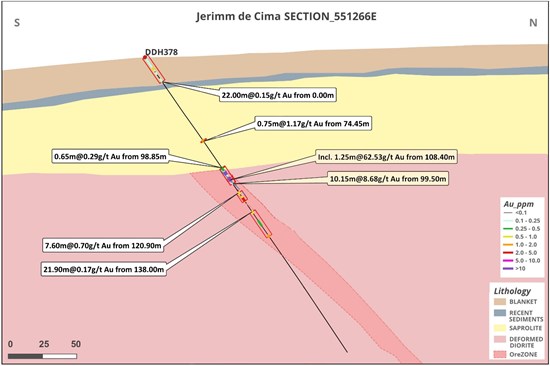
Figure 3: Cross section showing section 551266E at the Jerimum Cima discovery showing results from DDH378 which returned 10.2m @ 8.7g/t gold including 1.3m @ 62.5 g/t gold. DDH378 was drilled at a dip of 55 degrees on a bearing of 0 degrees. True widths may be 50% of actual drill intercepts. Terms: g/t = grams / tonne, m = metres, Au = gold
To view an enhanced version of this graphic, please visit:
https://images.newsfilecorp.com/files/3900/297295_14bf035e34c048cc_004full.jpg
| Drill Hole # | Weathering |
| From | To | Thickness | Grade |
|
|
| (m) | (m) | (m) | g/t gold |
| DDH378 | Blanket |
| 0.0 | 22.0 | 22.0 | 0.15 |
| Saprolite |
| 74.5 | 75.2 | 0.7 | 1.17 |
|
|
| 98.9 | 99.5 | 0.6 | 0.29 |
| Intrusive rock |
| 99.5 | 109.7 | 10.2 | 8.68 |
|
| incl. | 103.4 | 104.0 | 0.5 | 15.12 |
|
| and | 108.4 | 109.7 | 1.3 | 62.53 |
|
|
| 120.9 | 128.5 | 7.6 | 0.70 |
|
| EOH 263.8 | 138.0 | 159.90 | 21.9 | 0.17 |
| DDH379 | Saprolite |
| 39.5 | 40.5 | 1.0 | 0.15 |
| Intrusive rock |
| 194.0 | 196.0 | 2.0 | 0.14 |
|
|
| 222.9 | 223.7 | 0.8 | 0.14 |
|
|
| 261.2 | 261.9 | 0.7 | 4.05 |
|
|
| 296.2 | 296.8 | 0.60 | 1.11 |
|
| EOH 308.0 |
|
|
|
|
Table 1: Drill results from diamond drill holes DDH378 and DDH379, at the Jerimum Cima discovery. DDH378 was drilled at a dip of 55 degrees on a bearing of 0 degrees. DDH379 was drilled at a dip of 60 degrees on a bearing of 0 degrees. Terms: g/t = grams / tonne, m = metres, Au = gold, EOH = end of hole. True widths may be 50% of actual drill intercepts
MG Drill Results
The MG gold deposit is one of the two main gold deposits that currently comprise the Indicated and Inferred resource base at Cuiú Cuiú (see Figure 1). The upper portion of the gold deposit is extensively weathered resulting in a vertical profile of highly weathered basement saprolite extending to 60m depth. This saprolite together with the overlying blanket sediments and soils, which are also mineralized, will form the starter pit for the Phase 1 gold-in-oxide mining operation which is due to commence production in Q4 2026. Recent infill drilling has continued to confirm the presence of good gold grades over significant widths within weathered saprolite material and the overlying blanket sediments at or near surface (see press releases dated May 7, 2026 and April 7, 2026). Current Indicated and Inferred resources within the gold-in-oxide material at MG amount to 8.86 million tonnes ("Mt") @ 0.48 g/t Indicated (135,900 ounces ("oz") and 3.14 Mt @ 0.22 g/t Inferred (22,500oz).
However, the bulk of the gold resources at MG are contained within the underlying primary basement material (hard rock) and amount to open pit resources of 4.79 Mt @ 1.50 g/t gold Indicated (230,300oz) and 0.33 Mt @ 0.57 g/t gold Inferred (5,900oz) and underground Inferred resources of 0.99 Mt @ 2.08 g/t gold (65,800oz) (see the NI 43-101 report dated effective July 31, 2022).
Four additional diamond drill holes (DDH358, DDH361, DDH364 and DDH380) were completed at MG in order to address gaps in the 2022 resource model. All four holes cut the mineralized zone with DDH358 returning 7.2m @ 1.12 g/t gold from 270.4m depth and 8.7m @ 1.11 g/t gold from 302.0m depth. DDH361 also returned 10.3m @ 1.45 g/t gold from 152.2m depth including 1.0m @ 7.20 g/t gold from 152.2m depth and 0.7m @ 8.20 g/t gold from 157.0m depth. DDH380 returned 19.0m @ 0.52 g/t gold from 233.7m depth and 15.8m @ 0.50 g/t gold from 276.2m depth (See Figure 4, Table 2).
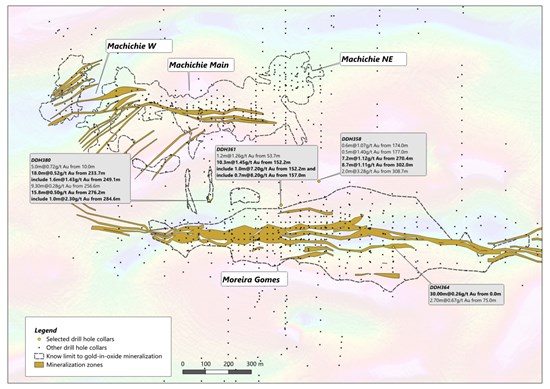
Figure 4: Map of the Moreira Gomes (MG) gold deposit and the Machichie Main and Machichie NE discoveries. Note the location of holes DDH358, DDH361, DDH364 and DDH380. All of the holes were drilled at a dip of 50 degrees on a bearing of 180 degrees except for hole DDH380 which was drilled at a dip of 60 degrees and a bearing of 180 degrees.True widths may be 50% of actual drill intercepts. Terms: g/t = grams / tonne, m = metres, Au = gold
To view an enhanced version of this graphic, please visit:
https://images.newsfilecorp.com/files/3900/297295_14bf035e34c048cc_005full.jpg
| Drill Hole # | Weathering |
| From | To | Thickness | Grade |
|
|
| (m) | (m) | (m) | g/t gold |
| DDH358 | Intrusive rock |
| 174.0 | 174.6 | 0.6 | 1.07 |
|
|
| 177.0 | 177.5 | 0.5 | 1.40 |
|
|
| 270.4 | 277.6 | 7.2 | 1.12 |
|
|
| 302.0 | 310.7 | 8.7 | 1.11 |
|
|
| 308.7 | 310.7 | 2.0 | 3.28 |
|
| EOH 371.3 |
|
|
|
|
| DDH361 | Blanket |
| 53.7 | 54.9 | 1.2 | 1.26 |
| Intrusive rock |
| 152.2 | 162.5 | 10.3 | 1.45 |
|
| incl. | 152.2 | 153.2 | 1.0 | 7.20 |
|
| and | 157.0 | 157.7 | 0.7 | 8.20 |
|
| EOH 308.0 |
|
|
|
|
| DDH364 | Blanket |
| 0.00 | 30.00 | 30.00 | 0.26 |
| Intrusive rock |
| 75.0 | 77.7 | 2.7 | 0.67 |
|
| EOH 159.2 |
|
|
|
|
| DDH380 | Saprolite |
| 10.0 | 15.0 | 5.0 | 0.72 |
| Intrusive rock |
| 233.7 | 252.0 | 18.0 | 0.52 |
|
| incl. | 249.1 | 250.7 | 1.6 | 1.43 |
|
|
| 256.6 | 265.9 | 9.30 | 0.28 |
|
|
| 276.2 | 292.0 | 15.8 | 0.50 |
|
| incl. | 284.6 | 285.6 | 1.0 | 2.30 |
|
| EOH 308.0 |
|
|
|
|
Table 2: Drill results from diamond drill holes DDH358, DDH361, DDH364 and DDH380 at the MG gold deposit. All of the holes were drilled at a dip of 50 degrees on a bearing of 180 degrees except for hole DDH380 which was drilled at a dip of 60 degrees and a bearing of 180 degrees. Terms: g/t = grams / tonne, m = metres, Au = gold, EOH = end of hole. True widths may be 50% of actual drill intercepts
Drilling is ongoing at the Jerimum Cima target with 2 diamond drill rigs and 1 RC rig with the objective of generating initial resources for the gold-in-oxide blanket and the underlying primary mineralized zones. Diamond drilling is also ongoing at Mutum and Central and further drilling is planned at Machichie Main and Machichie NE with the objective of updating the global resource base later this year. The infill RC drilling program at the MG gold-in-oxide deposit is continuing and aimed at upgrading the current Probable reserve base.
About Cabral Gold Inc.
The Company is a junior resource Company engaged in the exploration, development and near-term production from gold properties located in Brazil. The Company has a 100% interest in the Cuiú Cuiú gold district located in the Tapajós Region, within the state of Pará in northern Brazil. Three main gold deposits have so far been defined at the Cuiú Cuiú project which contain National Instrument ("NI") 43-101 compliant Indicated resources of 12.29Mt @ 1.14 g/t gold (450,200oz) in fresh basement material and 13.56Mt @ 0.50 g/t gold (216,182oz) in oxide material. The project also contains Inferred resources of 13.63Mt @ 1.04 g/t gold (455,100oz) in fresh basement material and 6.4Mt @ 0.34 g/t gold (70,569oz) in oxide material. The resource estimate for the primary material is based on the NI 43-101 technical report dated October 12, 2022. The resource estimate for the oxide material at PDM and MG is based on a NI 43-101 technical report dated October 21, 2024. The resource estimate for the oxide material at Central and Machichie is based on a NI43-101 technical report ("Updated PFS") dated July 29, 2025. The Company is currently engaged in the construction of a Phase 1 gold-in-oxide heap leach operation based on the NI43-101 technical report PFS and expects to enter commercial gold production in Q4 2026.
The Tapajós Gold Province is the site of the largest gold rush in Brazil's history which according to the ANM (Agência Nacional de Mineração or National Mining Agency of Brazil) produced an estimated 30 to 50 million ounces of placer gold between 1978 and 1995. Cuiú Cuiú was the largest area of placer workings in the Tapajós and produced an estimated 2Moz of placer gold historically.
Quality Assurance / Quality Control
Cabral maintains a Quality Assurance / Quality Control ("QAQC") program for all its exploration projects using industry best practices. Key elements of the QAQC program include verifiable chain of custody for samples, regular insertion of certified reference materials, blanks, and duplicates, as well as check assays on results. RC samples are split, collected in plastic sample bags, and sealed on drill hole location. Drill core is halved by saw cut or slicer (in soft saprolite). RC and core samples are shipped in sealed bags by independent contractor to SGS GEOSOL Laboratorios in Vespasiano, Brazil, an independent analytical services provider with global certifications for Quality Management Systems (ISO 9001:2015 and ISO 14001:2015 (ABS Certificates 32982 and 39911) and ISO/IEC 17025:2017 accreditation (CRL-0386)). Gold analyses are routinely performed via 50g fire assay with secondary assay techniques applied on higher grade samples. Final assay results are validated by Cabral Geological Staff prior to insertion into the database. Additional information regarding the Company's data verification processes is set out in the CBR, 43-101, PFS Technical Report, July 2025, which can be found on the Company's website.
Qualified Person and Technical Information
Technical information included in this release was supervised and approved by Brian Arkell, B.S. Geology and M.S. Economic Geology, SME (Registered Member), AusIMM (Fellow) and SEG (Fellow), Cabral Gold's Vice President, Exploration and Technical Services, and a Qualified Person under NI 43-101.
Neither the TSX Venture Exchange nor its Regulation Services Provider (as such term is defined in the policies of the TSX Venture Exchange) accepts responsibility for the adequacy or accuracy of this release.
Forward-looking Statements
This news release contains certain forward-looking information and forward-looking statements within the meaning of applicable securities legislation (collectively "forward-looking statements"). The use of the words "will", "expected" and similar expressions are intended to identify forward-looking statements. These statements involve known and unknown risks, uncertainties and other factors that may cause actual results or events to differ materially from those anticipated in such forward-looking statements. Such forward-looking statements should not be unduly relied upon. The Company believes the expectations reflected in those forward-looking statements are reasonable, but no assurance can be given that these expectations will prove to be correct.

To view the source version of this press release, please visit https://www.newsfilecorp.com/release/297295

© 2026 Canjex Publishing Ltd. All rights reserved.