Results show Pipeline device offers safe and effective treatment
of large and giant aneurysms

MANSFIELD, Mass. -- (Business Wire)
Covidien
(NYSE:COV), a leading global provider of healthcare products, today
announced that the final results of the PUFs
(Pipeline for Uncoilable or Failed Aneurysms) clinical study of its Pipeline™
embolization device have been published in the June issue of Radiology.1Radiology is the official peer-reviewed medical journal of the
Radiological Society of North America.
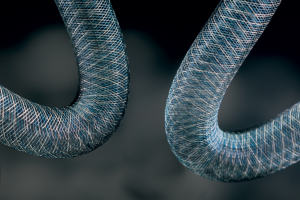
Covidien's Pipeline is an embolization device designed to divert blood flow away from the aneurysm in order to provide a complete and durable aneurysm embolization while maintaining patency of the parent vessel. (Photo: Business Wire)
The Pipeline
device met the trial’s primary endpoints for both effectiveness and
safety. Based on these data, the Pipeline device was approved by the
U.S. Food and Drug Administration (FDA) on April 6, 2011.
“Patients with an unruptured large or giant wide-necked aneurysm in the
internal carotid artery are at significant risk of death or a highly
disabling stroke and other significant neurologic complications if the
aneurysm bursts or pushes on surrounding nervous tissues,” said
principal investigator Tibor Becske, MD, assistant professor,
Departments of Radiology, Division of Neuro Interventional Radiology and
Neurology at NYU Langone Medical Center in New York. “This study of
highly complex aneurysms confirms that, for certain patients, there is a
safe and effective minimally invasive procedure to address the
underlying pathology of the aneurysm – allowing the vessel to heal over
time.”
A brain aneurysm is a weak, bulging area on the wall of an artery in the
brain. Over time, the blood flow and pressure within the artery
gradually weaken the arterial wall, which can result in a rupture and
the release of blood into the space around the brain.
“The Pipeline device offers hope for those patients who have had poor
alternatives for treating this often debilitating and sometimes fatal
medical condition,” said Christine Buckley, Executive Director of the
Brain Aneurysm Foundation. “We’re pleased that Covidien dedicated itself
to generating clinical evidence supporting new innovative devices that
have helped many patients in our community overcome an incredibly
frightening and serious diagnosis so they can go on to live normal
lives.”
Traditional endovascular methods of treating these aneurysms have
included a reconstructive approach of filling the aneurysm sac with an
embolic material (usually detachable coils), or parent artery occlusion,
where doctors attempt to close off the affected artery. However, neither
of these approaches addresses the underlying pathology of the aneurysm.2345
Overall, 108 patients were enrolled into the study. Of the 106 evaluable
aneurysms that were treated with one or more Pipeline devices, 73.6%
completely closed (p-value <.0001) without the use of an alternative
treatment. Importantly, the occlusion rate in these patients also
improved over time, reaching 86.8% complete occlusion at one-year
follow-up. These occlusion rates are significant, especially for this
challenging patient population.
Investigators compared the Pipeline device to historical controls
because no other blood flow diverting devices are available in the U.S.
Effectiveness of stents has not been proven to FDA standards; and
outcomes for surgical or other endovascular treatments have been
suboptimal.
Investigators measured safety of the device by the number of patients
who suffered an ipsilateral stroke or neurologic death in the 180 days
following the procedure. In the study, six of 107 (5.6%) patients
(p-value <.0001) suffered one of these events, significantly less than
the predefined safety threshold of 20%. The 20% threshold was based on a
literature review of adverse events rates associated with other current
procedures and therapies.
“Covidien remains committed to delivering clinical data to help redefine
how neurointerventionalists treat large and giant wide-necked
aneurysms,” said Mark A. Turco, M.D., Chief Medical Officer, Vascular
Therapies, Covidien. “The publication of the PUFs pivotal data
represents an important milestone for the company and we look forward to
continuing to work with the medical community to deliver additional
evidence to support new treatment options for patients.”
Note: Dr. Becske is a paid consultant for Covidien.
About Covidien
Covidien is a leading global healthcare products company that creates
innovative medical solutions for better patient outcomes and delivers
value through clinical leadership and excellence. Covidien manufactures,
distributes and services a diverse range of industry-leading product
lines in three segments: Medical Devices, Pharmaceuticals and Medical
Supplies. With 2012 revenue of $11.9 billion, Covidien has 43,000
employees worldwide in 70 countries, and its products are sold in over
140 countries. Please visit www.covidien.com
to learn more about our business.
1 Becske T, Kallmes DF, Saatci I, et al. Pipeline for
Uncoilable or Failed Aneurysms: Results from a Multicenter Clinical
Trial. Radiology. Published online before print February 15, 2013, doi:
10.1148/radiol.13120099
2 Campi A, Ramzi N, Molyneux AJ, et al. Retreatment of
Ruptured Cerebral Aneurysms in Patients Randomized by Coiling or
Clipping in the International Subarachnoid Aneurysm Trial (ISAT). Stroke
2007; 38(5): 1538-44.
3 Molyneux A, Kerr R, Stratton I, et al. International
Subarachnoid Aneurysm Trial (ISAT) of neurosurgical clipping versus
endovascular coiling in 2143 patients with ruptured intracranial
aneurysms: a randomized trial. J Stroke Cerebrovasc Dis 2002; 11(6):
304-14.
4 Molyneux AJ. Indications for treatment of cerebral
aneurysms from an endovascular perspective: the creation of an evidence
base for interventional techniques. Neurosurgery clinics of North
America 2005; 16(2): 313-6, ix.
5 Molyneux AJ, Kerr RS, Birks J, et al. Risk of recurrent
subarachnoid haemorrhage, death, or dependence and standardised
mortality ratios after clipping or coiling of an intracranial aneurysm
in the International Subarachnoid Aneurysm Trial (ISAT): long-term
follow-up. Lancet Neurol 2009; 8(5): 427-33.

Photos/Multimedia Gallery Available: http://www.businesswire.com/multimedia/home/20130617005460/en/
Contacts:
Vascular Therapies
David T. Young, 508-452-1644
Manager,
External Communications
david.young@covidien.com
or
Coleman
Lannum, CFA, 508-452-4343
Vice President
Investor Relations
cole.lannum@covidien.com
or
Bruce
Farmer, 508-452-4372
Vice President
Public Relations
bruce.farmer@covidien.com
or
Todd
Carpenter, 508-452-4363
Senior Director
Investor Relations
todd.carpenter@covidien.com
Source: Vascular Therapies
© 2026 Canjex Publishing Ltd. All rights reserved.